Illospace: A Full-Stack Collaborative Space Where Humans and AI Agents Share One Brain

Illospace is an open-source full-stack workspace where humans and AI Agents share memory and collaborate as equals.
Illospace is an open-source workspace application that deeply integrates team collaboration with AI Agents. Its core innovation is a "shared memory" mechanism where human members and AI Agents jointly maintain a knowledge base, solving the context fragmentation problem of AI tools. The product features a canvas-based interface with built-in system tools including databases and cron jobs, enabling a complete loop from ideation to execution and representing a paradigm shift from traditional collaboration tools to human-machine shared workspaces.
Product Overview
Illospace is a full-stack workspace application that deeply integrates team collaboration with AI Agents. Its core philosophy is to let human team members and AI agents share the same working environment, the same memory, and the same "Team Brain," enabling truly meaningful human-machine collaboration.
An AI Agent refers to an AI system capable of perceiving its environment, autonomously planning, and executing multi-step tasks — fundamentally different from traditional single-turn Q&A AI. From a technical architecture perspective, Agents typically operate on a "Perceive-Plan-Act" loop: first perceiving the current environment state and task objectives, then leveraging the reasoning capabilities of large language models for task decomposition and path planning, and finally interacting with the external world through Function Calling to obtain feedback before entering the next cycle. This architecture enables Agents to handle complex tasks requiring multi-step reasoning and cross-system operations, rather than merely answering isolated questions. Core Agent capabilities include: task decomposition (breaking complex goals into executable steps), tool calling (invoking external APIs, databases, code execution environments, etc.), and reflective iteration (adjusting strategies based on execution results). Since 2023, Agent frameworks represented by AutoGPT, LangChain Agent, and the OpenAI Assistants API have rapidly proliferated, driving the rise of the "Agentic AI" concept. Multi-Agent systems take this further by introducing role specialization and collaboration protocols — different Agents assume roles such as planner, executor, and reviewer, coordinating task completion through message passing. The maturity of these systems forms the core technical foundation for Illospace's "human-machine coexistence" design.
Unlike traditional project management tools such as Notion and Linear, Illospace doesn't simply embed an AI assistant into existing workflows. Instead, it builds from the ground up a "Living Space" where humans and Agents coexist as equals.
Core Feature: Shared Memory and Team Brain
Illospace's most differentiating design lies in its "shared memory" mechanism. Human members and AI Agents jointly maintain a knowledge base, bringing three key changes:
- AI Agents can understand the team's context, historical decisions, and work habits
- Team members can review Agent work progress and reasoning processes at any time
- Information no longer exists in silos between individuals or tools, but forms a unified organizational memory
On a technical level, this mechanism relies on RAG (Retrieval-Augmented Generation) and vector database technology. RAG was originally proposed by the Meta AI research team in 2020. Its core approach converts unstructured information — documents, conversation history, decision records — into high-dimensional vectors through embedding models, stored in vector databases (such as Pinecone, Weaviate, or pgvector). The key capability of vector databases is "semantic similarity search" — unlike traditional keyword matching, they can find content that is semantically similar but differently worded. For example, a search for "project delay risk" can surface historical discussions about "delivery timeline may be pushed back." When an Agent needs to answer a question or execute a task, it first retrieves relevant context from the knowledge base, then combines it with a large language model to generate responses. RAG fundamentally addresses the bottleneck of limited LLM context windows — even Claude 3 with its 200K token support cannot accommodate all the knowledge a team accumulates over months; the RAG architecture allows the knowledge base to scale infinitely, retrieving the most relevant fragments on demand for context injection.
This design solves a core pain point in current AI tool usage — context fragmentation. Most AI assistants start each conversation from scratch, whereas Illospace's Agents are always-on, continuously accumulating understanding of the team and projects, truly evolving from "forgetful assistants" into "collaborators who know the team's history."
Canvas-Based Interactive Interface Design
Illospace's interface adopts the Canvas design paradigm, composed of Ideas and Threads. The canvas interaction paradigm is not entirely new, but it has gained renewed vitality in the AI era. Early examples include whiteboard tools like Miro and FigJam, as well as the bidirectional linking note paradigm pioneered by Roam Research. In 2024, OpenAI launched its Canvas feature and Notion introduced an AI canvas editor, signaling the full migration of this paradigm toward AI collaboration scenarios.
Compared to traditional linear chat or fixed kanban boards, canvas-based interfaces offer the following advantages:
- Visual workflows: Team members can intuitively see tasks and progress being handled by others
- Flexible information organization: Allows freer arrangement and association of information, suitable for creative work
- Dynamic interface generation: Agents can automatically generate interactive interfaces based on needs, adapting to different work scenarios
The core advantage of canvas-based interfaces lies in "spatial metaphor" — cognitive science research shows that the human brain's spatial memory system (hippocampus) is naturally adept at processing positional relationships and topological structures. Visualizing information nodes, task dependencies, and collaboration states in a two-dimensional space aligns better with the cognitive model of team collaboration than linear lists, and makes it easier to discover implicit connections between pieces of information. On the technical implementation level, modern canvas interfaces are typically rendered using WebGL or the Canvas API, combined with virtualization techniques to maintain smooth performance even with large numbers of nodes. For AI Agents, the canvas also provides critical "Observability" — team members can intuitively track an Agent's reasoning path and work state, which is essential for building human-machine trust and significantly reduces the cognitive burden of team-Agent interaction.
Built-in System Tools: Creating a Programmable Work Environment
Illospace provides a suite of practical system-level tools, making it not just a collaboration platform but a programmable full-stack work environment:
- Database creation: Teams can create and manage databases directly within the workspace without switching to external tools
- Cron Jobs: Supports setting up automated periodic tasks, letting Agents execute repetitive work on schedule
- Workspace applications: Custom applications can be built within the space to meet specific business needs
Cron Jobs originate from the cron daemon in Unix systems, with the name derived from the Greek word "χρόνος" (time). They are one of the most classic automation mechanisms in IT infrastructure, born in the 1970s Unix systems and still in use today. In modern cloud-native architectures, scheduled tasks have evolved into more complex workflow orchestration systems, such as Apache Airflow (which defines task dependencies using Directed Acyclic Graphs/DAGs) and Temporal (which provides durable workflow execution guarantees). These systems address the core pain points of traditional cron: task failure retries, distributed execution, execution history auditing, and more. Embedding Cron Jobs within a collaborative workspace means teams can assign AI Agents an "on-duty" role — for example, automatically summarizing project progress every night, generating data reports weekly, or automatically responding when specific conditions are triggered. The key difference from automation platforms like Zapier is that Illospace's scheduled tasks are directly integrated with team memory and Agent capabilities. Execution results automatically flow back into the shared knowledge base, forming a closed-loop automation-collaboration ecosystem rather than an isolated trigger-execute pipeline.
The combination of these tools enables teams to complete the full loop from ideation to execution within a unified environment, dramatically reducing the efficiency loss caused by tool switching.
Comparative Analysis with Existing Collaboration Tools
Collaboration tools currently on the market can be broadly categorized as follows:
| Category | Representative Products | Limitations |
|---|---|---|
| Project Management | Notion, Linear | AI serves only as an auxiliary feature, unable to actively participate in collaboration |
| AI Conversation | ChatGPT, Claude | Lacks team collaboration capabilities, context cannot be persisted |
| Automation Platforms | Zapier, n8n | Focus on process automation, lacking creative space and real-time collaboration |
Illospace aims to break these boundaries by merging team collaboration, AI Agents, and workflow automation into a unified space, pioneering a new category of "human-machine collaborative workspace."
Open Source and Free: Lowering the Barrier to Entry
Illospace is released as open source on GitHub and is free to use. This strategy aligns with the mainstream PLG (Product-Led Growth) model in the current SaaS landscape — letting the product itself drive customer acquisition and retention, rather than relying on sales teams. The PLG model was systematically articulated by OpenView Venture Partners around 2016, and the success of products like Slack, Figma, and Notion pushed it into the mainstream. Its core logic is: in an era of highly transparent information on the internet, users prefer to experience a product before purchasing. Therefore, lowering the trial barrier and letting product value propagate organically is more efficient than traditional sales funnels.
For AI tool products, open source carries additional strategic value: open-source code can undergo community security audits, and for workspace products involving sensitive team data, transparency is key to building trust. Open-source community contributions can accelerate feature iteration, especially for integration connectors with third-party tools that often require extensive long-tail development. Furthermore, combining an open-source workspace with open-source LLMs like Llama and Mistral provides enterprises concerned about data privacy with a fully self-hosted option — all data and model inference runs within the enterprise's private infrastructure, fundamentally eliminating data leakage risks. This is particularly critical for compliance-sensitive industries such as finance, healthcare, and government.
The specific benefits of this strategy include:
- Rapidly building a user base and community contributions
- Lowering the decision cost for teams trying new tools
- Building trust through open source and obtaining authentic usage feedback
For a product in an entirely new category, open source is an effective path for validating product direction and iterating quickly.
Challenges and Future Prospects
The human-machine collaborative workspace is an area of tremendous potential.
Related articles
 Product Reviews
The Programmer's Desk Setup Guide: Building a Workspace That Feels Like Home
Discover how programmers build productive, comfortable workspaces. From multi-monitor setups to ergonomic design, explore the desk philosophy that drives focus and flow.
 Product Reviews
Qoder vs Cursor Real-World Comparison: Which $20/Month AI IDE Is Better?
Hands-on comparison of Qoder vs Cursor AI IDEs: Agent autonomy, human interaction count, and architecture decisions. Qoder needed only 2 interactions vs Cursor's 8.
 Product Reviews
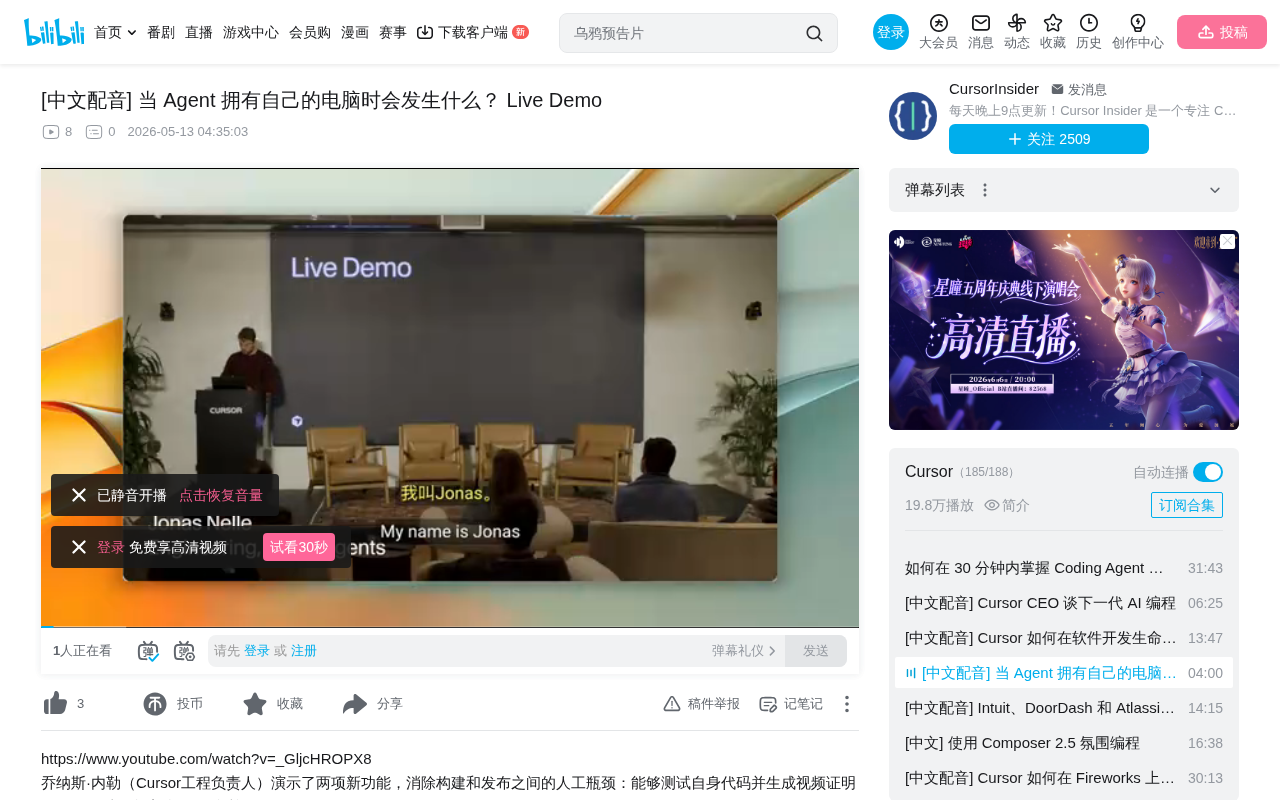
Cursor Cloud Agent Demo: Eliminating Bottlenecks Across the Entire Software Development Lifecycle
Deep analysis of Cursor's Cloud Agent demo showing how cloud VMs, automated test artifacts, and a full-chain control plane systematically eliminate human bottlenecks across the software development lifecycle.