Ilya Sutskever's SSI May Release Its First AI Model This Month

Ilya Sutskever's Safe Super Intelligence (SSI) may release its first AI model this month, per investor sources.
According to investor Gavin Baker's recent interview statements, Safe Super Intelligence (SSI)—founded by former OpenAI Chief Scientist Ilya Sutskever—may release its first model this month. This would be the stealth $5B startup's first public technical demonstration since its founding, offering a glimpse into its safety-first approach to building superintelligence.
Major Rumor: SSI About to Release Its First Model
According to information circulating on the Reddit community and statements made by prominent investor Gavin Baker in a recent interview, Safe Super Intelligence (SSI)—the company founded by former OpenAI Chief Scientist Ilya Sutskever—may release its first model this month. The news quickly sparked heated discussion in the AI community, and for good reason: since its founding, SSI has maintained near-complete silence.
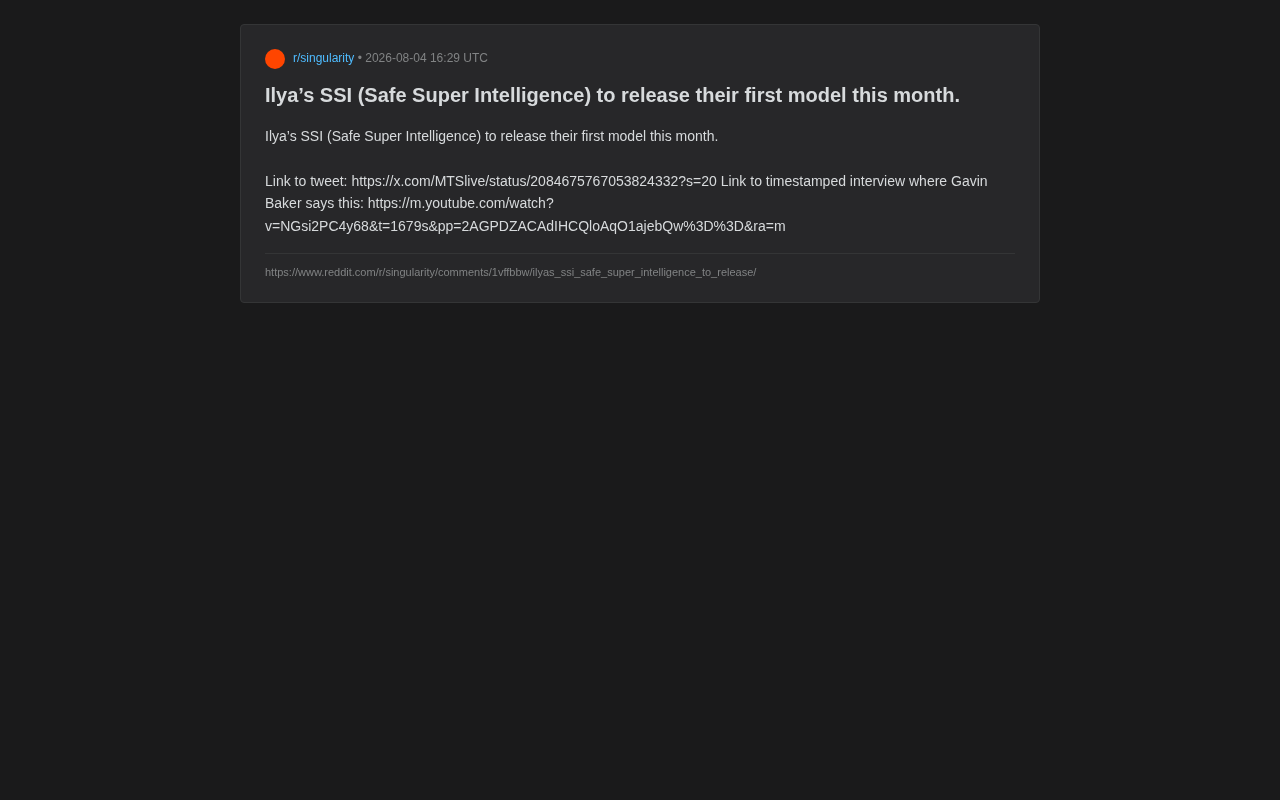
The core source of this information is a statement by investor Gavin Baker during a YouTube interview (with a specific timestamp referenced), along with related Twitter reposts. Gavin Baker is the founder and CIO of Atreides Management, having previously managed the technology sector at Fidelity Investments for over a decade. He is one of Wall Street's most closely watched tech investors. His judgments on the AI industry carry high credibility among institutional investors, and his public statements are typically based on deep exchanges with portfolio companies or industry insiders. Therefore, while this still qualifies as market rumor—SSI has not officially confirmed anything—given the source's background and SSI's weight in the industry, this news deserves serious attention.
Who Is SSI: Ilya's New Chapter After Leaving OpenAI
To understand the significance of this news, we need to review SSI's origins. In 2024, Ilya Sutskever founded Safe Super Intelligence after leaving OpenAI. As one of the foundational figures in deep learning, Ilya was the soul of OpenAI's technical efforts, participating in and leading core work ranging from the GPT series to alignment research.
More specifically, Ilya Sutskever is one of the central drivers of the modern deep learning revolution. He studied under Geoffrey Hinton (2024 Nobel Prize in Physics laureate) and co-authored AlexNet, the groundbreaking paper from the 2012 ImageNet competition that is widely considered the starting point of the deep learning renaissance. During his tenure at OpenAI, he served as Chief Scientist and directed the development of the GPT model series, making pioneering contributions particularly in the practical validation of Scaling Laws and sequence-to-sequence learning. In late 2023, he participated in the OpenAI board's brief removal of Sam Altman, after which he gradually stepped back from company operations, ultimately leaving officially in 2024 to found SSI.
A Company That "Does Only One Thing"
SSI's most distinctive feature is its extreme focus. The company has publicly stated that its sole objective is to build "safe superintelligence," and it does not plan to release any intermediate products to generate revenue. This "go-direct" approach stands in stark contrast to the productization and iterative strategies employed by companies like OpenAI and Anthropic.
For this reason, SSI has previously given the outside world the impression of a "stealth" research organization—no product releases, no API, no consumer-facing applications. If a first model is indeed released this month, it would be SSI's most significant public action since its founding, and would suggest either some form of strategic adjustment or a milestone achievement worth demonstrating.
Why SSI Releasing a Model Matters
Funding and Valuation Context
SSI has previously completed multiple massive funding rounds, reaching a valuation of approximately $5 billion, with participation from top-tier VCs including Andreessen Horowitz (a16z) and Sequoia Capital—all built on the foundation of "no product yet." This is extremely rare in venture capital—investors are betting entirely on Ilya's technical judgment and team capability. The investment logic is similar to early bets on DeepMind: before AlphaGo emerged, DeepMind was similarly in a pure research state for years, yet Google ultimately acquired it for over $500 million, with subsequent value far exceeding that figure. Against this backdrop, SSI's first model release—regardless of the outcome—will serve as a critical checkpoint for validating SSI's technical approach and the first opportunity for investors to verify their thesis.
A Safety-First Technical Approach
SSI's name itself is a declaration—"Safe" is placed before "Super Intelligence." The "safe" here points to AI Alignment, the core technical challenge of ensuring that AI systems' behaviors and objectives remain consistent with human intentions. As large language model capabilities have surged, the alignment problem has moved from academic theory to the frontier of engineering practice. Current mainstream alignment methods include RLHF (Reinforcement Learning from Human Feedback), Constitutional AI, and others, but whether these methods can remain effective at superintelligence levels is a matter of serious disagreement in the field.
By placing safety first in its company name, SSI suggests it may be exploring novel alignment methods that go beyond the current RLHF paradigm—the unfinished work Ilya was pursuing when he led the Superalignment team in his later days at OpenAI. If SSI does release a model, the industry will pay particular attention to how it balances capability and safety: Is this model a pure research demonstration, or a system with practical capabilities? Does it reflect a design philosophy on alignment and controllability that differs from mainstream large models? The answers to these questions could influence the entire industry's perspective on the "safe AI" pathway, and potentially redefine whether safety and capability are mutually exclusive or complementary.
Staying Rational: The Line Between Rumor and Fact
Before getting too excited about this news, we must remain cautious. All current information comes from third-party accounts—investor interviews and social media dissemination—and lacks an official statement from SSI. "Releasing this month" rumors are not uncommon in the AI industry, and delays or postponements happen regularly.
Furthermore, even if the release is real, the specific form of a "first model" carries significant uncertainty. It could be a technical demonstration aimed at the research community, or merely an external disclosure of an internal milestone—not necessarily a product available for public use. Given SSI's previous strategic position of not releasing intermediate products, the nature and motivation of this release itself warrants deeper analysis—is it a signal of strategic adjustment, or has a milestone been reached that merits public disclosure? Therefore, until SSI provides clear official information, this news is better treated as a signal worth tracking rather than an established fact.
Conclusion
Regardless of the final outcome, SSI's every move touches a nerve across the entire AI industry. As Ilya Sutskever's core endeavor after leaving OpenAI, this company carries the weight of immense expectations regarding the grand proposition of "safe superintelligence." If the release this month proves true, it will be our first window into SSI's technical achievements—and the industry's first opportunity to judge what kind of technical realization Ilya's unique understanding of AI's future direction can produce. Let's wait for official confirmation.
Related articles

Felix Rieseberg Personal Homepage
Felix Rieseberg's personal homepage sparks attention on Hacker News. This article covers the Slack engineer's technical background, the rise and fall of nativefier, and the value of a developer homepage as a tech calling card.

@ai-sdk/vue 3.0.306 Patch Release Syncs with [email protected] Update
@ai-sdk/vue 3.0.306 released, synced with [email protected]. A routine patch release for the Vercel AI SDK ecosystem with no public API changes; the Vue adapter layer stays version-aligned with the core package.

Gemini 4 Argon API Launches: The Era of Million-Token Output Begins
Google launches Gemini 4 Argon with sparse MoE architecture, up to 1M output tokens, and a 68.90% Vals Index score, available across API, AI Studio, and the Gemini app.