Implementing AdaBoost from Scratch: Day 27 of a Hand-Coded Machine Learning Journey

A learner hand-codes AdaBoost on Day 27, documenting the self-discipline and methodology behind scratch ML implementation.
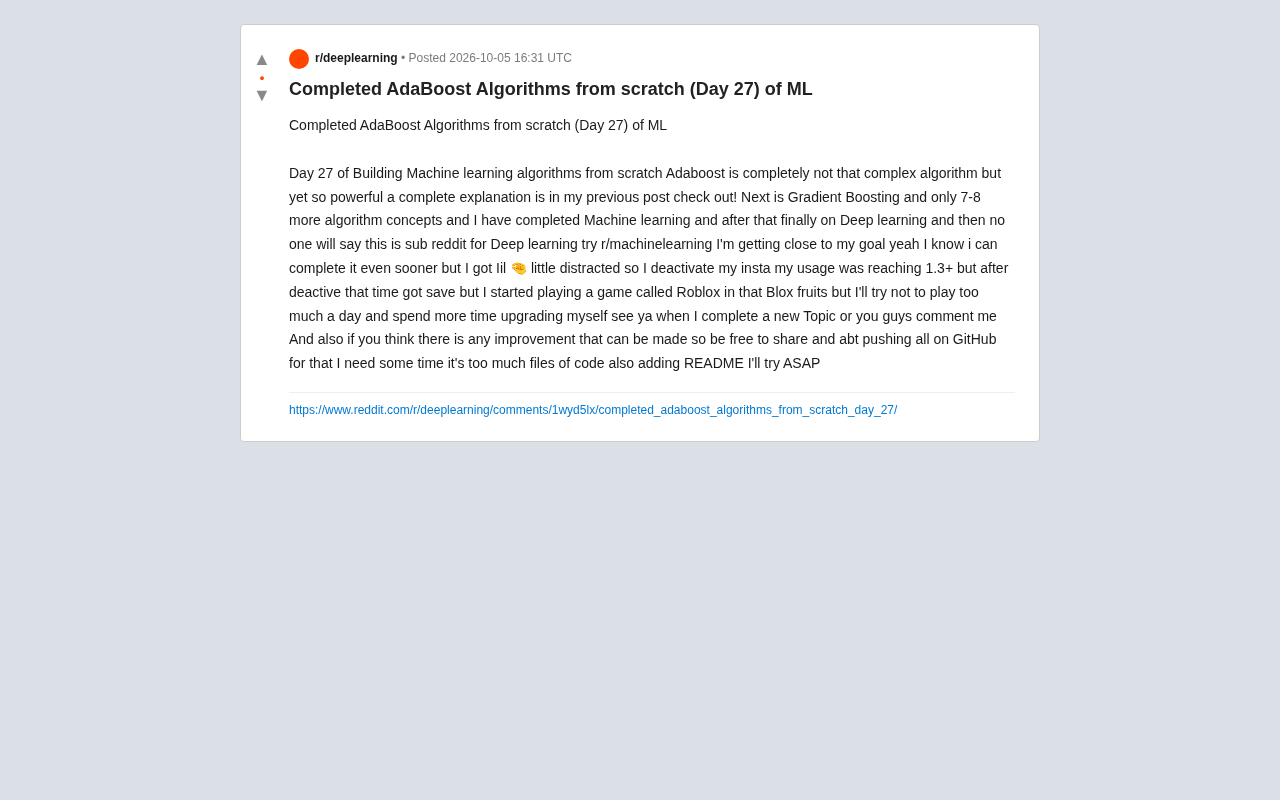
A Reddit user's daily "build ML from scratch" series reached Day 27 with a hand-coded AdaBoost implementation. The post explains AdaBoost's core mechanism — chaining weak learners with adaptive sample reweighting — and argues that personally deriving the exponential loss function is key to genuine understanding. The learner's roadmap continues to Gradient Boosting, then 7–8 more algorithms before transitioning to deep learning. Notably, the author candidly admits swapping Instagram addiction for gaming, offering an honest look at the self-discipline challenges of long-term learning. All code will eventually be open-sourced on GitHub.
A Learner Committed to Hand-Coding Every ML Algorithm
In an era flooded with machine learning tutorials where a few lines of scikit-learn can get a model running in minutes, most learners default to calling pre-built libraries. But a dedicated group has chosen a harder path — implementing every classic algorithm from scratch. One Reddit user's ongoing series, "Building Machine Learning Algorithms from Scratch," has reached Day 27, with the completion of a hand-coded AdaBoost implementation.
The value of this approach is real: when you personally derive the loss function and implement the weight update logic, your understanding of how an algorithm truly works far exceeds what you get from simply importing a library. AdaBoost, as a classic ensemble learning method, is an excellent test of that depth of understanding.
AdaBoost: Deceptively Simple, Remarkably Powerful
The author offered a particularly apt description in their post: "AdaBoost isn't really that complex of an algorithm, yet it's so powerful." This captures the algorithm's essence perfectly.
Core Concept Overview
AdaBoost (Adaptive Boosting) isn't hard to understand conceptually. It chains together multiple "weak learners" — typically decision trees of depth 1, known as decision stumps — to build a strong classifier. The key mechanism works as follows:
- After each training round, the algorithm increases the weights of misclassified samples and decreases the weights of correctly classified ones;
- The next weak learner pays more "attention" to the samples that the previous round got wrong;
- All weak learners are then combined with weighted votes based on their individual performance to produce the final prediction.
This adaptive mechanism — where each subsequent model corrects the errors of its predecessors — is precisely what allows a collection of mediocre weak classifiers to combine into a powerfully accurate whole. Once you understand this, the implementation challenges concentrate on two places: the sample weight update formula and the learner weight calculation.
At the mathematical level, AdaBoost's rigor shows in two key formulas. The first is the weak learner weight (also called its "say") calculation: $\alpha_t = \frac{1}{2} \ln\frac{1-\varepsilon_t}{\varepsilon_t}$, where $\varepsilon_t$ is the weighted error rate for that round. The lower the error rate, the greater that learner's weight in the final vote. If the error rate approaches 0.5 (the level of random guessing), the weight approaches zero, meaning that learner contributes virtually nothing. The second is the sample weight update: correctly classified samples have their weights multiplied by $e^{-\alpha_t}$, while misclassified samples have their weights multiplied by $e^{+\alpha_t}$, followed by normalization. Both formulas derive from the stepwise minimization of the exponential loss function $L = \sum_i e^{-y_i F(x_i)}$ — this is the fundamental difference between AdaBoost and a naive weighted voting scheme. Its weight update strategy has rigorous mathematical grounding, not just heuristic intuition.
Why It's Worth Implementing from Scratch
AdaBoost is manageable in terms of code volume, but the mathematical derivations — especially the relationship between the exponential loss function and the weight updates — are where understanding is truly tested. Implementing it by hand helps learners fully grasp why the weights are updated this particular way, not just how to update them.
Learning Roadmap: Closing in on the Goal
The author also shared their upcoming study plan, outlining a clear progression:
- Next stop: Gradient Boosting
- Finishing ML: About 7–8 more algorithm concepts to complete the entire ML phase
- Ultimate goal: Transition to Deep Learning
Moving from AdaBoost to Gradient Boosting is a natural next step. Both belong to the Boosting family, but Gradient Boosting reframes the optimization using gradient descent to minimize the loss function — laying the groundwork for understanding industry-standard tools like XGBoost and LightGBM. This ordering is well thought out.
The most fundamental difference between Gradient Boosting and AdaBoost lies in the generality of the optimization framework. AdaBoost is essentially a special case under exponential loss, while Gradient Boosting reinterprets the process of "training the next weak learner" as fitting the negative gradient (i.e., "pseudo-residuals") of the current model under any differentiable loss function. This idea, introduced by Friedman in 2001, allows the same framework to handle classification, regression, ranking, and more — simply by swapping the loss function. This generality is precisely why Gradient Boosting became the theoretical foundation for XGBoost (2016), LightGBM (2017), CatBoost, and other industrial-grade frameworks. The learning path from AdaBoost to Gradient Boosting helps learners leap from understanding "one specific algorithm" to grasping "an entire class of optimization thinking" — one of the most important cognitive upgrades in the ensemble learning phase.
Self-Discipline and Distraction: The Reality of Long-Term Learning
Worth noting is the author's candid sharing of their real mental state throughout the learning journey — which is more valuable as a reference than pure technical showcasing. They mentioned deleting Instagram to save time, having previously clocked over 1.3 hours of daily usage. However, some of that reclaimed time has since flowed into playing "Blox Fruits" on Roblox. The author noted they're working to keep gaming time under control and redirect more energy toward self-improvement.
This honest acknowledgment of procrastination and distraction is the most common challenge in any long-term learning project. The fact that they've kept going for 27 days speaks for itself — consistency over time matters far more than raw speed.
An Open and Collaborative Approach
The author also expressed several open invitations:
- Welcoming improvement suggestions: Actively inviting the community to propose optimizations to their implementation;
- GitHub open-source plans: Due to the large number of code files and the need to add README documentation, full upload will take some time — but they've committed to getting it done.
This approach of learning in public, sharing as you go, and accepting community feedback is the defining spirit of open-source learning culture. For anyone else on the self-taught ML path, following a public progress log like this is itself a source of motivation.
Lessons for Self-Learners
What looks like a simple progress update actually reflects several learning principles worth borrowing:
- Implement from scratch rather than calling libraries: Trade efficiency for deep understanding of underlying mechanisms;
- Plan a clear progression path: Move methodically from ensemble learning to deep learning;
- Face your own weaknesses honestly: Actively manage sources of distraction; accept imperfect but consistent progress;
- Stay open and share your work: Use public accountability and open source to gather feedback and sustain motivation.
Whether you're just starting out or already have a foundation, this "one algorithm a day" practice rhythm offers a replicable model. Truly mastering machine learning has never been about how many tutorials you've watched — it's about how many lines of code you've written that you actually understand.
Related articles

Chain of Thought Isn't Just for AI: How Humans Can Use CoT to Improve Thinking Quality
Chain of Thought isn't just a prompt trick for large models. Starting from a Hacker News discussion, this article analyzes why CoT works for human thinking too, breaks down actionable ways to transfer it, and highlights the key differences between human CoT and machine CoT.
Cloudflare Teams Up with OpenAI: Closi…
Cloudflare Teams Up with OpenAI: Closing the Loop from Vulnerability Discovery to Defense with AI
Cloudflare uses OpenAI Daybreak to investigate security vulnerabilities and generate reviewable remediation plans, while developers use Codex to boost coding efficiency and quality.

Orca Multi-Agent Orchestration in Practice: A Guide to Parallel Collaboration with Claude and Codex
Orca is Stable AI's free open-source agent workbench supporting 34 agents like Claude Code and Codex in parallel. Learn its Git worktree isolation, multi-model orchestration, and mobile management.