Implementing RAG and Agents Without Frameworks: An Essential Skill for AI Engineers
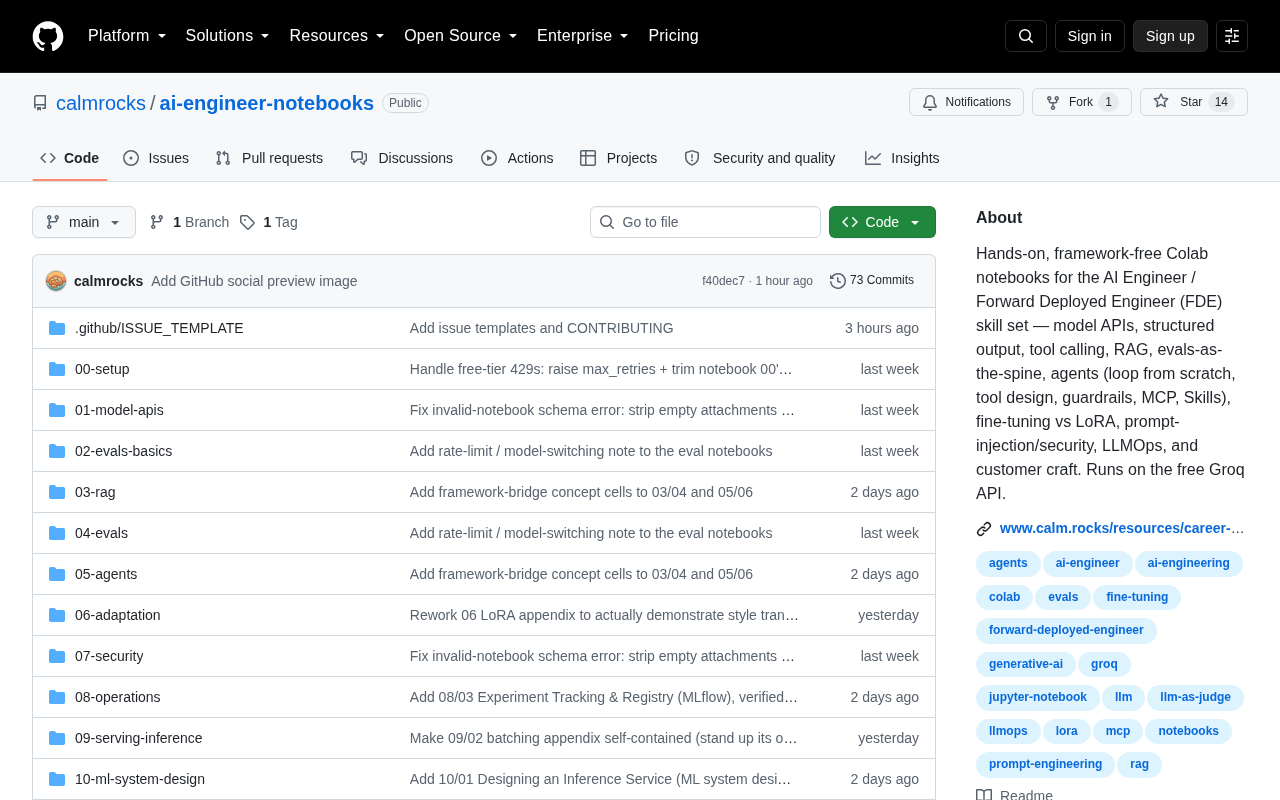
Learn RAG, Agents, and Evals from scratch without frameworks using free Jupyter Notebooks on Google Colab.
AI Engineer Notebooks is a free, open-source collection of framework-free Jupyter Notebooks that teach RAG, Agents, and Evals from the ground up using plain Python and low-level APIs. Runnable on Google Colab with zero setup, the project helps developers break free from framework black boxes and build a deep understanding of AI engineering fundamentals.
A Noteworthy Open-Source Learning Resource
In AI engineering practice, developers often face a paradox: on one hand, frameworks like LangChain and LlamaIndex significantly lower the barrier to building RAG (Retrieval-Augmented Generation) and Agent applications; on the other hand, the heavy abstraction these frameworks introduce often leaves developers knowing what works but not why it works—making debugging a nightmare when things go wrong.
A recent project that surfaced on Hacker News, "AI Engineer Notebooks," was created to address exactly this pain point. It's a free, framework-free collection of Jupyter Notebook tutorials that run directly in Google Colab, covering three core topics: RAG, Agents, and Evals.
While the project hasn't generated much discussion on Hacker News yet, its "zero-framework" positioning offers a back-to-basics learning path in an AI engineering education landscape overflowing with framework-centric approaches.
Why Framework-Free Learning Matters
Deep Understanding of Underlying Mechanisms
"Framework-free" means these tutorials don't rely on any high-level abstraction libraries. Instead, they use low-level APIs and plain Python code to implement RAG pipelines, Agent logic, and evaluation systems. The core value of this approach is clear:
Learners can see exactly what happens at every step—how documents are chunked, how vector embeddings are generated, how similarity search works, and how retrieved results are stitched into prompts. Once you've built these components by hand, you'll truly understand what frameworks abstract away and what details they hide when you eventually adopt them.
More Transparent Debugging, More Flexible Migration
Another hidden risk of frameworks is vendor lock-in. When your business logic is deeply coupled to a framework's API, a version upgrade, deprecated interface, or migration to a different tech stack can become extremely costly. Implementations based on native code are more transparent, more controllable, and far easier to customize for specific needs.
A Deep Dive into the Three Core Modules
RAG: A Complete Retrieval-Augmented Generation Implementation
RAG is the most widely adopted technical paradigm in enterprise AI applications today. It addresses LLM knowledge staleness and hallucination issues by incorporating external knowledge bases. A complete RAG system involves multiple stages: document loading, text chunking, vectorization, retrieval, reranking, and generation.
A framework-free implementation helps developers understand how parameter choices at each stage affect the final output—such as the trade-off between chunk size and retrieval precision, performance differences across embedding models, and how prompt engineering impacts generation quality.
Agents: Building Intelligent Agents from Scratch
Agents are the key technology that gives LLMs the ability to act. Through tool calling, task planning, and multi-step reasoning, agents enable models to autonomously complete complex tasks.
Building an Agent from scratch gives developers deep insight into how reasoning paradigms like ReAct work, as well as how to design tool interfaces, manage conversation state, and handle error fallbacks. This foundational knowledge is critical regardless of which Agent framework you ultimately use.
Evals: Building a Systematic Evaluation Framework
Evaluation is often the most overlooked yet most critical aspect of AI engineering. Without systematic evaluation, there's no way to quantify improvements, let alone achieve continuous optimization.
By treating Evals as a standalone topic, this tutorial series demonstrates a commitment to engineering rigor—a good AI application isn't one that "seems to work," but one backed by clear, reproducible evaluation metrics to support every iteration.
Low-Barrier Access via Google Colab
The project uses Google Colab as its runtime environment, further lowering the barrier to entry. Developers don't need to set up complex local Python environments, install GPU drivers, or manage dependency conflicts—just a browser and a Google account to get started.
This "ready-to-use" format, combined with free access, is especially well-suited for:
- AI engineering beginners: Those who want to build a solid foundation from the ground up rather than relying on framework "magic"
- Experienced developers: Those frustrated by framework "black boxes" who want to understand the underlying principles of RAG and Agents
- Rapid-prototyping engineers: Those who need to quickly validate ideas without being constrained by framework conventions
Getting Back to Engineering Fundamentals
In an era where AI application development is increasingly "framework-ified," AI Engineer Notebooks offers a rare contrarian perspective: rather than rushing to stack features with frameworks, take the time to understand the shape of each building block first.
Of course, this doesn't mean frameworks have no value—in production environments, mature frameworks can significantly boost development efficiency. But for those aspiring to become exceptional AI engineers, building a solid mental model from native code tends to yield far greater returns in the long run. This free, open-source tutorial series is an ideal starting point for honing those foundational skills.
Related articles

Chain of Thought Isn't Just for AI: How Humans Can Use CoT to Improve Thinking Quality
Chain of Thought isn't just a prompt trick for large models. Starting from a Hacker News discussion, this article analyzes why CoT works for human thinking too, breaks down actionable ways to transfer it, and highlights the key differences between human CoT and machine CoT.
Cloudflare Teams Up with OpenAI: Closi…
Cloudflare Teams Up with OpenAI: Closing the Loop from Vulnerability Discovery to Defense with AI
Cloudflare uses OpenAI Daybreak to investigate security vulnerabilities and generate reviewable remediation plans, while developers use Codex to boost coding efficiency and quality.

Orca Multi-Agent Orchestration in Practice: A Guide to Parallel Collaboration with Claude and Codex
Orca is Stable AI's free open-source agent workbench supporting 34 agents like Claude Code and Codex in parallel. Learn its Git worktree isolation, multi-model orchestration, and mobile management.