In-Depth Review of the 2026 Python Complete Tutorial (648 Episodes): Can You Really Master It in 7 Days Through Self-Study?

A critical review of a 648-episode Python tutorial with practical self-study advice for beginners.
This article analyzes a 648-episode systematic Python tutorial on Bilibili, noting its well-designed three-phase structure (fundamentals, intermediate, hands-on projects) while pointing out that "7-day mastery" is pure marketing and the massive volume may lead to extremely low completion rates. Learners are advised to study with clear goals, start hands-on practice early, and focus on Python's integration with AI large models for career competitiveness.
Yet Another Complete Python Tutorial — What's Different This Time?
Python tutorials on Bilibili are arguably the most competitive content niche on the platform — ranging from videos with hundreds of thousands of views to those with barely a few hundred, tutorials of every style keep popping up. Recently, a brand-new 2026 Python systematic tutorial claiming to have "648 episodes" has attracted considerable attention. The creator claims to have spent a month studying various Python tutorials on Bilibili, then three months producing the course, with the goal of creating a complete curriculum that's "easy enough for absolute beginners to understand while providing plenty of practice exercises."
This course is ambitious: from zero foundation to employment-ready, covering trending topics like AI applications, web scraping, and data analysis. But is 648 episodes really necessary? Is the "7 days from beginner to master" promise realistic? Let's break it down from two perspectives: course structure and content design.
Course Structure Breakdown: A Three-Phase Python Learning Path
According to the creator's introduction, the entire course is divided into three major modules: Fundamentals, Intermediate, and Hands-on Projects — a classic and proven programming education framework.
Fundamentals: From Environment Setup to Core Python Syntax
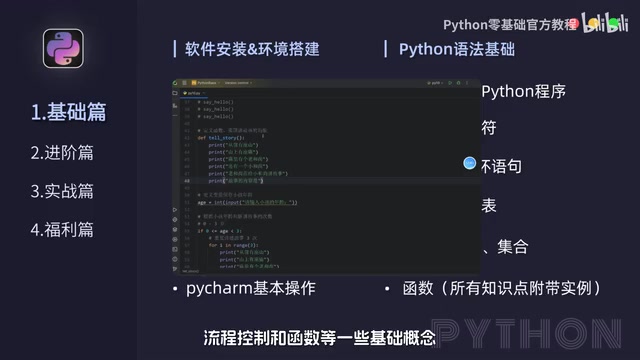
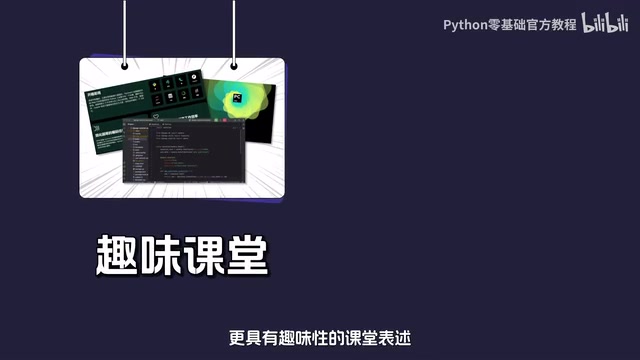
The fundamentals section starts with setting up Python and PyCharm, covering core concepts like variables, data types, control flow, and functions. These are topics any Python introductory tutorial must cover; what matters is whether the teaching approach is genuinely beginner-friendly. The creator emphasizes using "more engaging classroom delivery" — a crucial factor on Bilibili, where dry syntax lectures are the number one reason beginners give up.
Intermediate: Object-Oriented Programming and Advanced Features
The intermediate section covers object-oriented programming (OOP) concepts, functional programming, and Python's advanced features and techniques. This is the "watershed" for many self-learners — whether you can grasp concepts like classes, inheritance, decorators, and generators directly determines whether you can progress from "writing scripts" to "building projects."
Object-Oriented Programming (OOP) is one of the cornerstones of modern software engineering, and Python's support for OOP is particularly comprehensive. The core concepts of OOP include encapsulation, inheritance, and polymorphism, binding data and behavior together through the abstraction mechanism of "classes." For self-learners, switching from procedural to object-oriented thinking often requires weeks or even months of deliberate practice. Python's advanced features include decorators, generators, context managers, and more. Decorators are essentially higher-order functions, widely used for cross-cutting concerns like logging, permission checks, and caching; generators implement lazy evaluation through the yield keyword, significantly reducing memory usage when processing large-scale data. These features are an important dividing line between "Python users" and "Python developers," and are frequently tested in interviews.
Hands-on Projects: The Critical Leap from Learning to Application
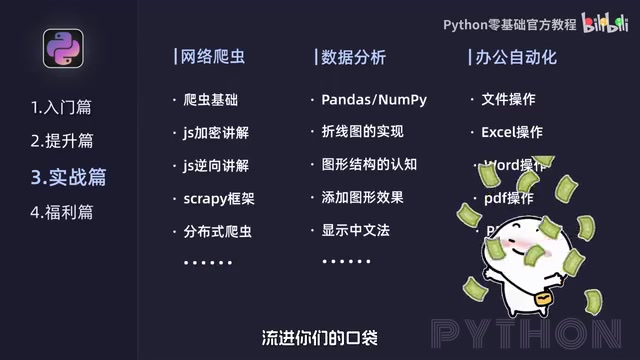
The project section is the highlight of this course, including projects on scraping images and videos, office automation, data storage, analysis, and mining. These are indeed the most common real-world applications of Python and the direct motivation for many people learning the language.
Objective Analysis: Several Issues Behind a 648-Episode Python Tutorial
Is "7 Days from Beginner to Master" Realistic?
With 648 episodes, even at just 5 minutes each, the total runtime exceeds 54 hours. Finishing in 7 days means studying at least 8 hours per day — not counting time for exercises and digestion. For absolute beginners, this pace makes true "mastery" virtually impossible. A more reasonable expectation: 7 days can get you started, but mastery requires at least several months of continuous practice.
The "7-day mastery" in the title is primarily marketing language, and learners shouldn't be misled by such promises. Building programming skills requires substantial hands-on practice — there are no shortcuts.
Is the Volume an Advantage or a Burden?
648 episodes puts this among the "heavyweight" Python tutorials on Bilibili. On one hand, sufficient episodes mean topics can be broken down more granularly, with ample explanation space for each concept; on the other hand, overly long courses can create a "can't finish" anxiety that actually reduces completion rates.
Low completion rates are a structural challenge that the online education industry has faced for years. A joint MOOC research report by MIT and Harvard shows that average completion rates for massive open online courses have long hovered between 5% and 15%, with series exceeding 100 episodes typically showing even lower completion rates. Multiple factors drive this phenomenon: learners lack external accountability, course pacing doesn't match individual rhythms, and the psychological illusion that "bookmarking equals learning." Cognitive Load Theory offers a clear explanation: human working memory capacity is limited, and overly long courses cause learners to continuously receive new information before internalizing prior knowledge, creating "false progress." Video learning on platforms like Bilibili adds the competitive interference of entertainment content, further increasing the difficulty of persisting through long courses. Therefore, the 648-episode design requires learners to have extremely strong self-management skills to truly deliver value.
The Value of Supplementary Learning Resources
The creator mentions providing learning mind maps, materials, software installation packages, lecture notes, and e-books as supplementary resources. These auxiliary materials are indeed valuable for self-learners — mind maps in particular help build a holistic view of the knowledge system, avoiding the "can't see the forest for the trees" problem.
Practical Advice for Python Self-Learners Starting from Scratch
Regardless of which tutorial you choose, the following tips are worth considering:
1. Don't try to learn everything at once. Rather than watching all 648 episodes but remembering nothing, it's better to solidly complete the fundamentals and then start building projects. Programming is "practiced" into existence, not "watched" into existence.
2. Learn with a goal in mind. If your goal is data analysis, don't spend too much time on web scraping; if it's office automation, you can skip machine learning content. Targeted learning is far more efficient than trying to cover everything.
3. Combine with official documentation. No video tutorial can replace the authority of Python's official documentation. Developing the habit of consulting documentation is a necessary step on the path from beginner to professional developer.
4. Learning Python in 2025-2026 means AI is unavoidable. Since 2023, the commercialization of large language models (LLMs) represented by GPT-4, Claude, and Gemini has profoundly reshaped the skill requirements for Python developers. Major AI companies like OpenAI and Anthropic all provide official Python SDKs, making LLM API integration a low-barrier yet high-value skill. On the practical application level, developers can use frameworks like LangChain and LlamaIndex to rapidly build RAG (Retrieval-Augmented Generation) systems, intelligent agents, and automated workflows. According to multiple 2024-2025 tech hiring reports, "Python + LLM API integration" has become a bonus or even a requirement for positions like data engineer, backend developer, and AI product manager. After mastering the basics, it's recommended to focus on combining Python with large model APIs — this is currently one of the most competitive directions for employment.
Conclusion: Is This Python Tutorial Worth Studying?
This 648-episode Python tutorial has a conventional structural design, with its three-phase learning path following the general patterns of programming education. The creator's attitude of spending months polishing the course deserves recognition, and the completeness of supplementary resources is a plus. However, the "7-day mastery" title promise is overly exaggerated, and the massive volume of 648 episodes may become a completion rate liability.
For true absolute beginners, this course can serve as one reference for systematically learning Python, but remember: the most important thing in learning to code isn't finding "the best tutorial" — it's opening your editor and starting to write code.
Key Takeaways
- The course uses a three-phase structure (Fundamentals, Intermediate, Hands-on Projects), covering everything from environment setup to practical projects like web scraping and data analysis
- The massive 648-episode volume is a double-edged sword: topics are broken down in detail but completion rates may be extremely low — learners need to plan their pace wisely
- "7 days from beginner to master" is marketing language; actually mastering Python requires at least several months of continuous practice
- Learning Python in 2025-2026 should focus on integration with AI large models — tech stacks like LangChain and RAG are currently the most competitive directions for employment
- The core of learning programming lies in hands-on practice, not passively watching videos — start project practice as early as possible after completing the fundamentals
Related articles
 Product Reviews
The Programmer's Desk Setup Guide: Building a Workspace That Feels Like Home
Discover how programmers build productive, comfortable workspaces. From multi-monitor setups to ergonomic design, explore the desk philosophy that drives focus and flow.
 Product Reviews
Qoder vs Cursor Real-World Comparison: Which $20/Month AI IDE Is Better?
Hands-on comparison of Qoder vs Cursor AI IDEs: Agent autonomy, human interaction count, and architecture decisions. Qoder needed only 2 interactions vs Cursor's 8.
 Product Reviews
Cursor Cloud Agent Demo: Eliminating Bottlenecks Across the Entire Software Development Lifecycle
Deep analysis of Cursor's Cloud Agent demo showing how cloud VMs, automated test artifacts, and a full-chain control plane systematically eliminate human bottlenecks across the software development lifecycle.