In the AI Health Era, Do Simple Fitness Bands Still Have a Place?
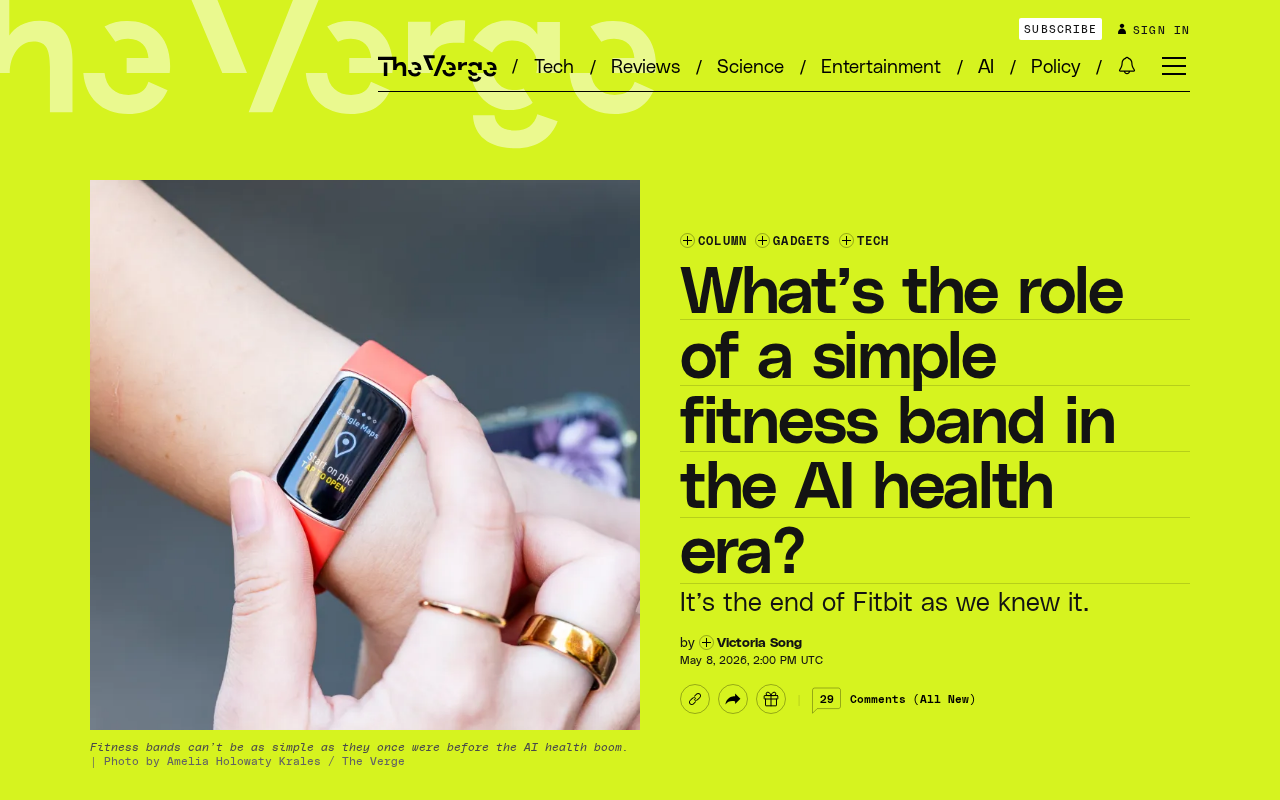
In the AI health era, simple fitness bands still hold unique value through lightweight, low-intrusive design.
This article explores the unique positioning and value of simple fitness bands in an era of increasingly complex AI health monitoring devices. It highlights the "feature overload paradox" — where excessive professional-grade data creates anxiety rather than health improvements for average users. Behavioral science shows that reducing cognitive load and activation friction is key to building healthy habits. The ideal future wearable should embrace "progressive intelligence," hiding AI complexity behind a streamlined user experience.
When AI Health Monitoring Takes Over
As smartwatches grow increasingly complex and AI health assistants emerge one after another, what role can a simple fitness band still play? Victoria Song, a senior reviews editor at The Verge, explored this question in depth in her weekly column Optimizer.
The question itself is worth pondering — when we're surrounded by smart devices and AI health apps that all claim to be "life-changing," have the most basic wearables become obsolete?
The Core Positioning of Fitness Bands: Effortless Self-Improvement
Victoria Song's definition of a fitness band is remarkably precise: It exists to make you better, but in a casual, low-effort way.
This positioning encompasses several key traits:
- Lightweight: Virtually unnoticeable on your wrist
- Ease of use: No complex setup or learning curve required
- Low intrusiveness: It won't constantly bombard you with notifications the way a smartwatch does
This is precisely the point that gets overlooked in the current AI health device craze. When every product is competing to offer more features and deeper AI analysis, what users truly need might just be a quiet companion.
The Feature Overload Paradox in the AI Health Era
More Data, Better Health? Not Necessarily
Modern smartwatches and AI health platforms are heading toward an extreme: they try to monitor everything about you — from blood oxygen saturation to stress levels, from sleep stages to heart rate variability. Every data point comes with AI analysis and personalized recommendations.
But here's the question: Does more data actually lead to better health outcomes?
Take heart rate variability (HRV) as an example — a metric that measures the tiny fluctuations in time intervals between consecutive heartbeats, and a "pro-level feature" that high-end wearables are racing to highlight. HRV is indeed an important scientific indicator of autonomic nervous system function; higher HRV is generally associated with good cardiovascular health and stress recovery capacity. However, interpreting HRV is extremely complex. It's influenced by age, sex, fitness level, time of measurement, and many other factors, with enormous individual variation. For the average user, a single day's HRV reading is virtually meaningless — it takes weeks or even months of baseline data to form a meaningful trend analysis. When devices push these professional-grade metrics directly to users without medical backgrounds, they tend to create confusion and anxiety rather than genuine health insights.
For most ordinary users, overly complex health data can actually cause anxiety. Do you really need to check your HRV trend chart every day? Do you really need an AI telling you that your "body battery" is down to 40%?
The Unique Value of Simple Fitness Bands
Behavioral science research provides theoretical support for the idea that "simpler devices are more effective." BJ Fogg, founder of Stanford University's Behavior Design Lab, argues in his "tiny habits" theory that the key to behavior change lies in reducing activation friction, not increasing the volume of information. When a device presents users with too much data requiring interpretation, it triggers "decision fatigue" — users tend to avoid action rather than take action when faced with complex information. By contrast, a simple step goal (like "2,000 steps to go today") provides a clear, immediate call to action that's far more likely to trigger actual behavior change. This also explains why many people who buy feature-packed smartwatches end up using them only to check the time and count steps — the brain automatically filters out information that exceeds its processing capacity.
The value of fitness bands lies precisely in their being "not smart enough":
- Lower cognitive load: Focus only on basic metrics like steps and heart rate, without drowning you in data anxiety
- Build foundational exercise habits: First develop the habit of moving every day, then worry about optimizing training details
- Affordable pricing: Lower the barrier to health monitoring to the absolute minimum — available for under $50
- Battery life advantage: One to two weeks of battery life means you can truly "put it on and forget about it"
Who Are Fitness Bands For? The Decision Logic for Different Users
According to market research from IDC and other firms, the global wearable device market shows a clear barbell-shaped structure: at one end are premium smartwatches like the Apple Watch Ultra and Garmin Fenix series, featuring professional sports tracking and health monitoring at prices typically exceeding $400; at the other end are budget products like Xiaomi Band and Huawei Band, capturing the mass market with basic functionality and ultra-long battery life. Fitness bands in the $15–50 price range still account for a significant share of global wearable device shipments, with particularly strong demand in emerging markets and among users who are just beginning their health awareness journey. This market structure itself demonstrates that "simple devices" aren't outdated products — they fulfill a real, existing tier of user needs.
There's an important user segmentation here:
- Health enthusiasts / athletes: Need precise data and deep AI analysis — a smartwatch is the better choice
- Average people / beginners: Only need basic activity reminders and simple tracking — a fitness band is more than enough
- Data-anxious users: Should actually "downgrade" from complex devices to a simple band to ease psychological pressure
The AI health era doesn't mean everyone needs the most advanced technology. Technology should serve people, not the other way around.
Looking Ahead: Balancing Simplicity and Intelligence
Fitness bands won't disappear, but their role is indeed evolving. The concept of "progressive intelligence" has deep academic roots in the field of Human-Computer Interaction (HCI), corresponding to the design principle of "Progressive Disclosure" — where systems gradually reveal deeper functionality and information based on user needs and context, rather than exposing all complexity at once. In the AI health space, this concept is gaining traction in practice: for example, Apple Watch's "notification silencing" mode, Oura Ring's daily health score (which compresses complex data into a single number), and the "focus modes" some devices are beginning to introduce — displaying only basic data by default and expanding into detailed analysis only when the user actively requests it.
The ideal wearable device of the future might look like this:
- The device itself maintains a simple, lightweight wearing experience
- AI works quietly in the background, intervening proactively only when truly necessary
- Users can freely choose the depth of information and frequency of alerts they want
The core of this design philosophy is hiding AI's computational complexity behind a clean interface, ensuring users always feel they're receiving "just the right amount" of information — rather than a full display of technological capability. Not everyone needs a miniature computer strapped to their wrist. Sometimes, a simple band is all it takes to help you take the first step toward a healthier life.
Conclusion: The Product Philosophy of Less Is More
In an age where AI is everywhere, "simplicity" is itself a product philosophy. Fitness bands remind us that the essence of health management isn't collecting more data — it's building better habits. Sometimes, less is more.
Key Takeaways
- The core value of fitness bands lies in their lightweight, low-intrusive approach to self-improvement
- The AI health era presents a feature overload paradox — more data doesn't necessarily lead to better health outcomes
- Professional metrics like HRV require long-term baseline data to be meaningful; pushing them directly to average users often backfires
- Behavioral science shows that reducing cognitive load and activation friction is key to building healthy habits
- Different user segments have clearly distinct needs for health monitoring devices, and market data confirms sustained demand for simple devices
- The future of wearables should embrace progressive intelligence, hiding AI complexity behind a streamlined experience
Related articles
 Industry Insights
IRS Fully Embraces Claude AI, Accelerating Federal Government's AI Adoption
The IRS is recruiting staff with 24/7 Claude AI access, marking Anthropic's breakthrough into the federal government. Explore the strategic implications and tax use cases.
 Industry Insights
Nadella Introduces the Loopcraft Framework: Building AI Ecosystems Through Feedback Loops
Microsoft CEO Satya Nadella's Loopcraft framework explains how to build frontier AI ecosystems through nested feedback loops across technology, business, and ecosystem dimensions.
 Industry Insights
OpenAI's Internal Codex Usage Surges 56x — AI Coding Is Eating Everything
OpenAI reveals internal Codex usage data: Research up 56x, Customer Support 32x, Engineering 27x, Legal 13x since Nov 2025. AI coding tools are penetrating every department faster than expected.