In the Era of Multi-AI Programming, Validation Is the Bottleneck: Discuss Before Building, Check Before Publishing

As multi-AI programming speeds up generation, the delivery bottleneck shifts to validation, requiring separation of validation from discussion and retaining human approval.
The article points out that multi-AI programming tools have greatly increased code generation speed, but the real bottleneck has shifted from "writing code" to "proving the code is correct." The Brainstorm team makes validation and human review an independent step in the workflow, deliberately separated from the discussion process of drafting changes, to prevent models from forming a closed loop of self-justification. Publishing to the project's main branch always requires human approval, and automation stops before publishing. In addition, the platform uses a BYOK model, distinguishing platform licenses from model usage rights for a transparent cost structure; it is also Linux-first, so non-Linux users should note compatibility. This three-stage "discussion—validation—approval" workflow is better suited to teams already accustomed to multi-model collaboration and with release safety requirements, while for individual small-scale changes it may feel too heavy.
Multi-AI programming tools have raised code generation speed by an order of magnitude, but what truly holds back delivery pace is no longer the act of "writing." In their latest practice, the Brainstorm team offers a blunt assessment: when generation gets faster, the bottleneck shifts to "proving that this code is correct." They make validation and human review an independent step in the workflow, separate from the discussion process of drafting changes, and publishing to the project's main branch always requires human approval.
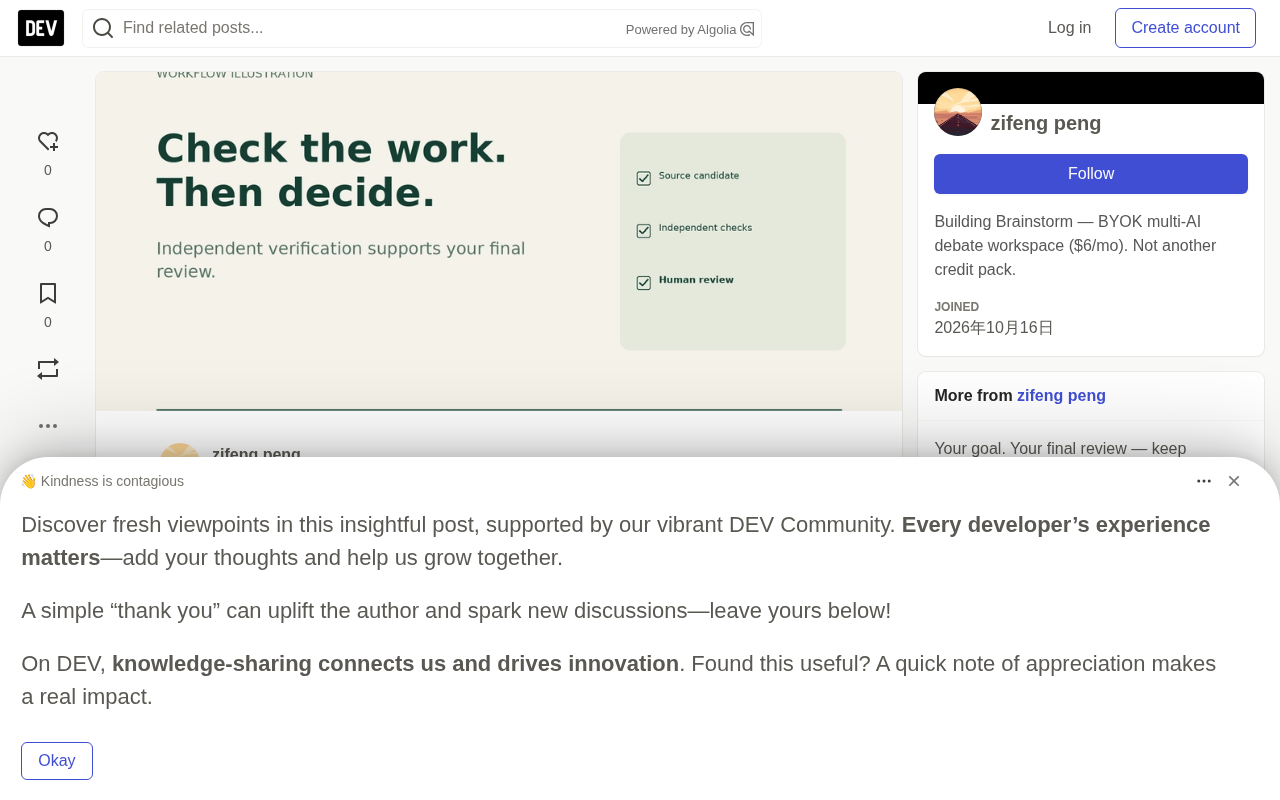
After Generation Speeds Up, the Question Becomes "How Do You Prove It"
Multi-AI programming is not a new concept, but orchestrating multiple models to participate in the same coding task rapidly amplifies output volume. The more code there is, the more there is to confirm: Do these changes actually solve the problem? Have they introduced new side effects? Are there hidden conflicts between the solutions different models propose?
Brainstorm's original phrasing is deliberately restrained—"independent validation is a step in the workflow, not a guarantee of perfect code." This is in effect a correction of a common mindset today: many people assume that "adding a layer of validation" equals "the code is fine," but validation itself has blind spots. It can raise confidence, but it cannot replace human judgment.
According to the source, they make validation and human review explicit steps rather than implicit actions buried in the discussion flow. The discussion phase is responsible for drafting changes, and the validation phase is responsible for proving them; the two are deliberately separated in the process. The benefit of this split is that the responsibility boundaries of each stage are clear, and when something goes wrong, it is possible to pinpoint exactly which step failed to catch it.
Separating Discussion and Validation Is an Engineering Discipline
Separating "discussion" and "checking" sounds like a minor process detail, but the practical impact is significant. If discussion and validation are mixed together, models can easily form a closed loop of self-justification—it drafts the solution, then uses the same logic to "validate" the solution, and the conclusion naturally tends toward approval.
Brainstorm's approach is to make validation an independent step, clearly separated from the discussion that drafts changes. The cost is a longer process; the benefit is that reviewers are not facing a product that has "endorsed itself," but rather an object that requires independent re-examination. For team collaboration, this is especially critical: when multiple people and multiple models participate together, who confirmed what and when must be traceable.
The design of the publishing stage is equally noteworthy. The original information explicitly states that publishing to the project's main branch still requires your approval. In other words, automation can advance to the "ready to publish" step, but the final gate is guarded by a human. This is not distrust of AI capability, but a realistic assessment of the risk of changes in production environments.
In software engineering, the "model self-justification loop" corresponds to a known failure mode: when the generator and the reviewer are the same entity and use the same context and reasoning path, review tends to confirm rather than question. Traditional code review breaks this loop by introducing an independent reviewer. The same applies in multi-AI programming scenarios—if the model that drafted the solution is allowed to validate it using the same logic, validation degenerates into a formality. Splitting validation into an independent step is essentially migrating the principle of "generator-reviewer" separation of duties into human-AI collaboration workflows, so that reviewers face external artifacts requiring independent re-examination rather than outputs with a self-endorsing character.
The BYOK Model and the Linux-First Trade-off
Brainstorm adopts a BYOK (Bring Your Own Key) model: you bring your own eligible model account. A platform license is not the same as model usage rights, and these two things are explicitly separated.
The direct consequence of this design is a transparent cost structure—model calls go through your own account, and the platform provides the workflow and collaboration layer rather than bundling model capabilities into a subscription. For developers who already have model accounts, this reduces duplicate payments; for the platform, it hands responsibility for model selection and quota management back to the user.
Another clear orientation is Linux-first. This usually means the team puts its main development and testing resources on the Linux environment, and adaptation for other platforms will lag behind. For target users, this is a signal of efficiency; for non-Linux users, it is a compatibility risk that needs to be confirmed in advance.
BYOK (Bring Your Own Key) is an authorization model that has become popular in AI tools in recent years: users call services using their own model API keys rather than having the platform provide them uniformly. This model is common in middleware products that need to connect to multiple model providers. Its advantages are that users can directly reuse existing model subscriptions or quotas, avoiding duplicate payment for the same model capability; and the platform does not need to bear the resale cost of model calls or the pressure of quota management, and can focus only on workflow and collaboration features. The potential cost is that users need to handle key security, quota monitoring, and configuration of multiple model accounts themselves, which creates a certain barrier for developers unfamiliar with API management.
Who This Workflow Is For
From the description, Brainstorm is aimed at development teams already accustomed to multi-model collaboration and with requirements for release safety. If an individual developer is only using a single model for small-scale changes, explicit validation steps may feel heavy; but when changes involve the main branch and multi-person collaboration, this three-stage structure of "discussion—validation—approval" has real value.
Its core proposition can be condensed into one sentence: do not skip the confirmation step just because generation has become faster. Multi-AI programming improves output speed, but delivery quality still depends on whether you are willing to reserve independent time and space for validation.
Developers who need it can learn about the specific workflow design at https://brainstorm.mungwaan.cn.
Related articles

JobRunner MCP Server: AI Agents Can Now Fix Failed Java Jobs
JobRunner launches an open-source MCP server enabling AI agents to view cluster status, diagnose failures, and recover Java jobs—incident response from any cloud coding environment or existing agent.

MLAI Digital Launches 9 Security Agents: MCP Server Safeguards the Full Lifecycle of Agentic AI
MLAI Digital launches Security MCP Server with nine built-in specialized security agents covering vulnerability discovery, attack simulation, prompt injection detection, API and infrastructure assessment, and accelerated remediation—embedding security validation across the full Agentic AI lifecycle from development to production.

Running Isaac Lab on H100 GPUs: Exploring Better Approaches
Exploring optimization methods for running Isaac Lab on NVIDIA H100 GPUs, including MIG configuration, mixed precision, TensorRT acceleration, and community experience to improve robotics simulation and reinforcement learning efficiency.