In the Vibe Coding Era, Share Your AI-Built Personal Apps via RSS
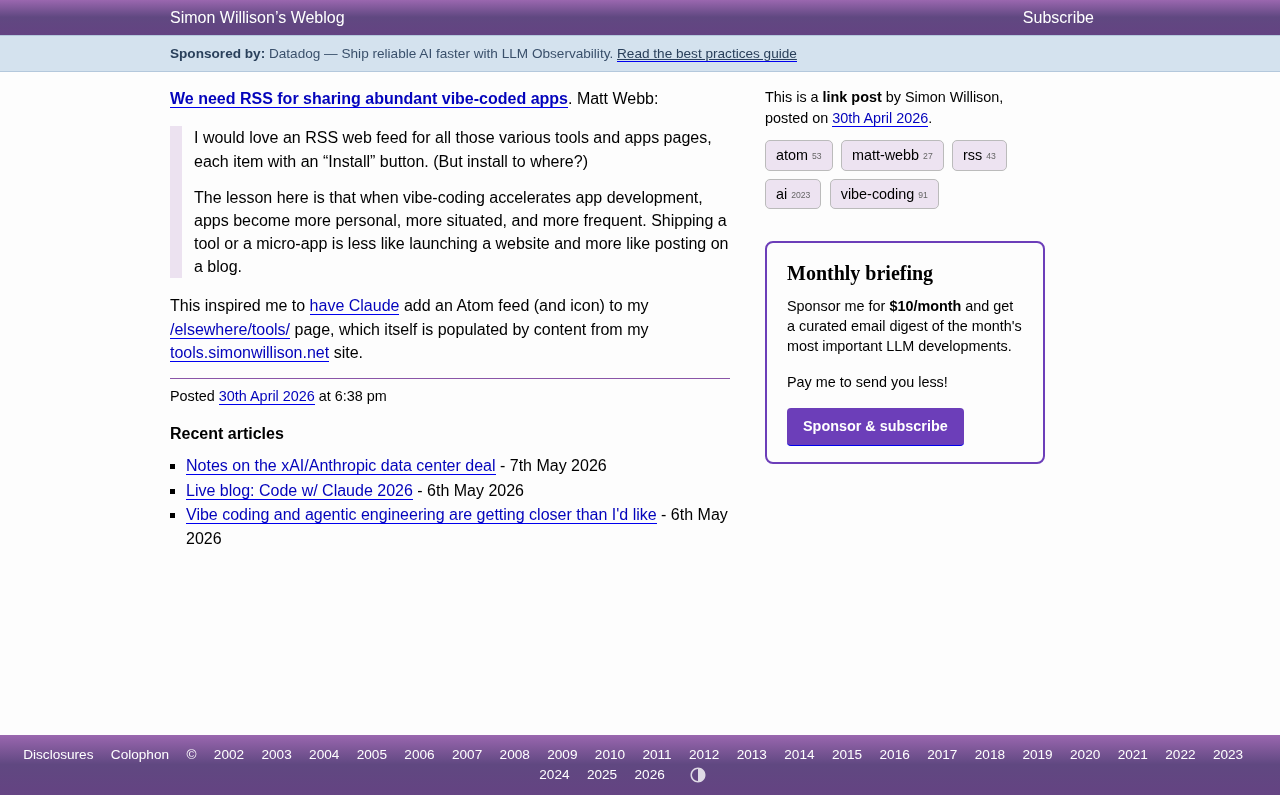
RSS may be the ideal protocol for distributing micro-apps in the AI era
With the rise of vibe coding, AI-assisted development has driven the cost of building small tools close to zero, making app output as frequent as blogging. Matt Webb proposed using RSS to aggregate and distribute these micro-apps, and Simon Willison immediately put it into practice. This approach grafts the mature content distribution paradigm onto app distribution, though "install to where" remains the core unsolved question. AI is reshaping software production and consumption patterns, and open protocols like RSS are finding renewed vitality in this new context.
When Building Apps Becomes as Simple as Writing a Blog Post
An interesting trend is emerging: with the rise of vibe coding, more and more developers are using AI to rapidly build large numbers of small tools and micro-applications. These apps are no longer meticulously polished commercial products — they're more like personal, context-specific, high-frequency outputs — as casual and natural as writing a blog post.
The question follows naturally: How should these ever-proliferating personal apps be discovered and shared?
Matt Webb proposed a seemingly retro yet remarkably insightful idea on his blog — using RSS to aggregate and distribute these vibe-coded applications.
Vibe Coding Is Redefining What an "App" Means
Traditionally, releasing an app was a big deal: it required development, testing, deployment, and promotion — a process that could take weeks or even months. But vibe coding has completely changed this rhythm.
Vibe coding refers to developers leveraging AI programming assistants (such as Claude, Cursor, etc.) to quickly generate usable code and tools by describing requirements in natural language. This concept was first coined by OpenAI co-founder Andrej Karpathy in February 2025 — he described an entirely new way of programming: developers no longer write code line by line, but instead describe the desired functionality to AI in natural language, letting the AI generate the complete code implementation. The developer's role shifts from "writer" to "guide" — you just need to describe the vibe, and AI handles the implementation details. This approach became possible thanks to the quantum leap in code generation capabilities of large language models (LLMs), particularly breakthroughs by models like Claude and GPT-4 in understanding complex programming intent. AI-native IDEs like Cursor further integrated this capability into the development workflow, allowing developers to converse with AI, generate, and modify code directly within the editor. This approach dramatically lowers the barrier to development, driving the cost of "building a small tool" close to zero.
As Matt Webb put it:
When vibe coding accelerates app development, apps become more personal, more contextual, more frequent. Publishing a tool or micro-app no longer feels like launching a website — it feels more like publishing a blog post.
This means we're entering an era of app abundance. Every developer's personal site might have a /tools/ page filled with various tools built on a whim. Simon Willison's tools.simonwillison.net is a prime example. Willison is the co-creator of the Django web framework and one of today's most active AI tool practitioners. His tools page aggregates a large collection of single-page web tools rapidly built with AI assistance — from JSON formatters to image processing tools, spanning a wide variety. Most of these tools are pure frontend HTML/JavaScript applications that require no backend server and run directly in the browser. Willison's approach represents an emerging developer culture: treating AI as a "pair programming partner," building purpose-specific tools that solve particular problems in extremely short timeframes (typically minutes to tens of minutes), rather than pursuing generality or commercialization.
Why Use RSS to Distribute Personal Apps?
RSS (Really Simple Syndication) was born in the blogging era as a simple, open, decentralized content subscription protocol. It was originally developed by Netscape for its portal site in 1999. The core principle is remarkably intuitive: a website maintains a standardized XML file that chronologically lists the latest content entries, each containing metadata like title, summary, link, and publication time. Users subscribe to this XML file's URL through RSS readers (such as Feedly, NetNewsWire, etc.), which periodically poll for updates and push new content to users. RSS's core value lies in its decentralized nature — content distribution doesn't depend on any centralized platform. Anyone can publish a feed, and any reader can subscribe — a stark contrast to today's algorithm-driven social media feeds.
When the pace of app output starts matching the frequency of blog posts, using RSS to aggregate them becomes perfectly logical.
Matt Webb's vision is straightforward:
I want those tools and app pages to have an RSS Web Feed, each entry with an "install" button. (But install to where?)
The elegance of this idea lies in grafting the mature paradigm of content distribution onto the new scenario of app distribution. Imagine: you subscribe to the tool RSS feeds of a few developers you trust, and whenever they build a new small tool with AI, you see it in your RSS reader and can install or try it with one click.
Inspired by this, Simon Willison immediately took action — he had Claude add an Atom Feed and subscription icon to his /elsewhere/tools/ page. It's worth noting that Atom is an improved version of RSS, standardized by the IETF in 2005 (RFC 4287), addressing some ambiguity and compatibility issues in the RSS specification with greater technical rigor. From idea to implementation — this itself is a perfect embodiment of the vibe coding spirit.
The Unsolved Question: Where Do These Micro-Apps Get Installed?
The question Matt Webb left in parentheses — "But install to where?" — is precisely the most critical missing piece in this vision.
Currently, these vibe-coded apps come in various forms: some are pure frontend single-page HTML applications, some depend on specific runtime environments, and some require API key configuration. We don't yet have a unified, lightweight "personal app runtime" to host them.
Several possible directions exist:
- The browser as platform: Many vibe-coded tools are essentially single-page web apps, and the browser is naturally their runtime environment. PWA (Progressive Web App) technology allows web apps to have near-native capabilities like offline operation, desktop icons, and push notifications, but this technical path has consistently faced challenges from varying levels of platform vendor support.
- Personal servers and sandbox environments: Platforms like Glitch or Val Town provide one-click deployment capabilities. Glitch was launched in 2017 by Fog Creek Software (also the parent company of Stack Overflow and Trello), with the core philosophy of making web app creation and sharing as simple as editing a document — users can write code directly in the browser, apps deploy instantly with a public URL, and others can one-click "remix" (copy and modify) any project. Val Town is a newer-generation platform that lets users write small server-side JavaScript/TypeScript functions (called "vals") that automatically receive HTTP endpoints, scheduled execution capabilities, and persistent storage — essentially a minimalist serverless computing environment. The common thread among these platforms is reducing deployment complexity to a minimum, letting developers focus on logic itself, which aligns perfectly with the spirit of vibe coding.
- Local AI app containers: As local AI capabilities strengthen, desktop environments specifically designed to run these micro-apps may emerge.
The Paradigm Shift in Software Distribution in the AI Era
This discussion is ostensibly about RSS and tool sharing, but it points to a deeper transformation: the production and consumption patterns of software are being reshaped by AI.
Looking back at the history of software distribution, we've experienced several major paradigm shifts. Early software was distributed via physical media (floppy disks, CDs), requiring users to purchase and manually install. In the 2000s, the Linux community pioneered package managers (like apt, yum), enabling centralized online distribution and dependency management. Apple's App Store launch in 2008 brought this model to the consumer market, creating the mobile app economy boom, but also establishing a highly centralized gatekeeping mechanism — apps needed to pass review, comply with platform rules, and pay commissions.
When the marginal cost of creating an app approaches zero, software is no longer a scarce resource but becomes abundant like content. What we need is no longer a heavyweight distribution mechanism like an app store, but lightweight, open, composable protocols like RSS. The RSS distribution model Matt Webb proposes is essentially an attempt to return to a distribution method closer to the early Web spirit: open, decentralized, permissionless.
This may be an unexpected gift that the AI era brings to the open internet: protocols and ideas once considered "outdated" are finding new life in a new context. When AI enables everyone to become an app creator, we need a distribution network not controlled by any single platform more than ever — and that's precisely the problem RSS solved over twenty years ago.
Key Takeaways
- Vibe coding makes app development as frequent and personal as blogging, spawning a proliferation of micro-tools and applications
- Matt Webb proposed using RSS to aggregate and distribute these vibe-coded apps, applying the content distribution paradigm to app distribution
- Inspired by this, Simon Willison immediately used Claude to add an Atom Feed to his tools page, putting the concept into practice
- "Install to where" remains the core unsolved question, requiring a lightweight personal app runtime to host these micro-apps
- AI is reshaping software production and consumption patterns, and open protocols like RSS are gaining renewed vitality in this new context
Related articles
 Expert Opinions
Rethinking Scaling Laws: Parameters Are Not the Only Answer
Deep analysis of Scaling Law evolution from Kaplan to Chinchilla to the MoE era, exploring why blindly stacking parameters is a mistake, and how GLM-5.3 proves scaling has multiple knobs.
When AI Treats Humans as Subagents: Ro…
When AI Treats Humans as Subagents: Role Reversal and Hidden Risks in Human-AI Collaboration
Exploring the paradigm shift where humans become "subagents" in AI Agent architectures. Analyzes human node design in LangChain and AutoGen, and the risks of ceding control and cognitive atrophy.
 Expert Opinions
The Lazy Person's Productivity Theory: Why Being 'Lazy' Actually Drives Peak Performance
Explore the engineering philosophy behind 'lazy people are most productive': how constructive laziness drives automation, AI tools amplify efficiency, and systems thinking eliminates wasted effort.