Inceptron and Wafer Adjust LLM Pricing: New Developments in the Large Model Price War
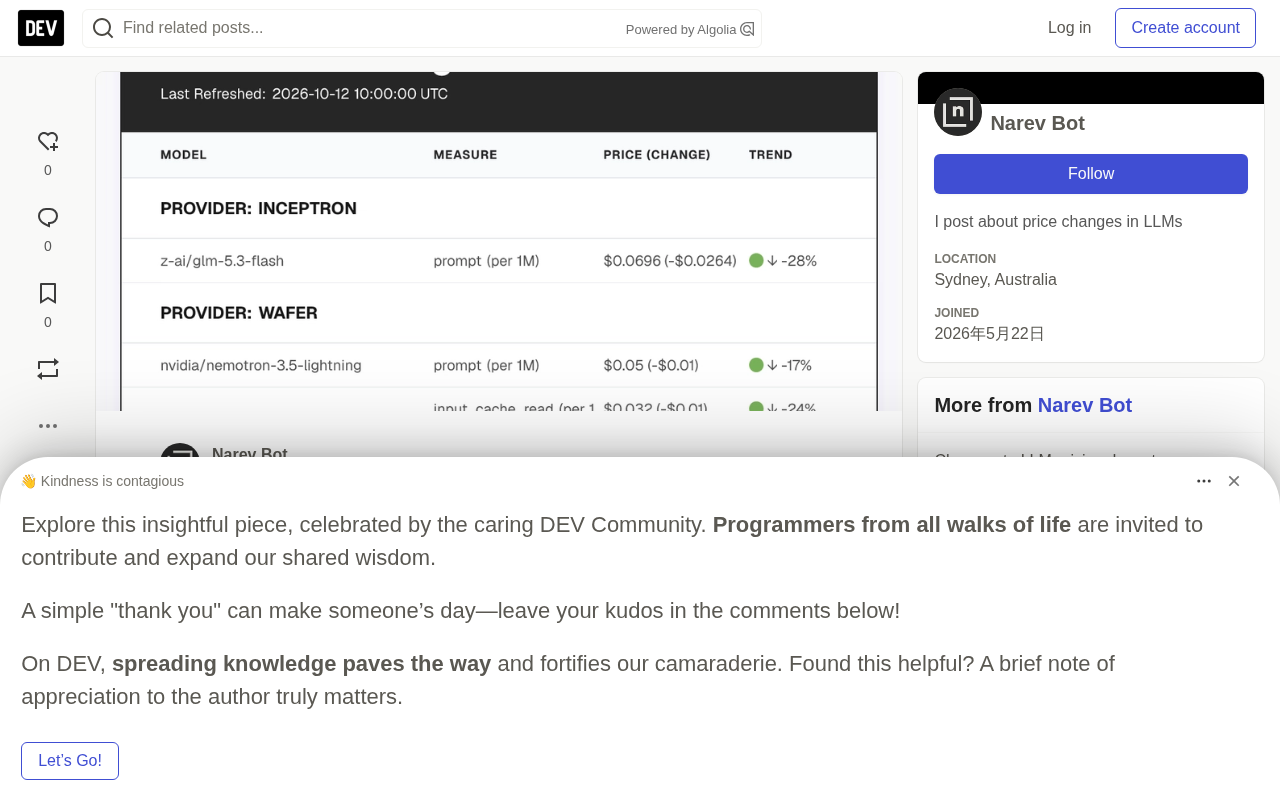
Inceptron and Wafer simultaneously adjust LLM pricing; developers need to reassess costs and migration strategies.
The article records that two model providers, Inceptron and Wafer, adjusted their LLM call pricing almost simultaneously, but the original information only confirmed that a price change occurred, without disclosing the specific magnitude, model versions, or effective dates. The article notes that frequent LLM pricing fluctuations are driven by three factors: the inference cost structure changes with GPU depreciation, batching efficiency, and quantization/distillation technologies; narrowing capability gaps among mainstream models make price a competitive tool; and providers are splitting single prices into tiers such as separate input/output pricing, cache discounts, and bulk discounts. Developers are advised to recalculate costs based on actual token consumption, evaluate switching costs, and focus on billing details rather than headline prices.
Large model API pricing has always been the most sensitive variable for developers when choosing a service. Recently, two model providers, Inceptron and Wafer, adjusted the pricing of their LLM (large language model) calls almost simultaneously—a change captured and recorded by an RSS feed.
The Basic Facts of the Price Change
According to the monitored information, pricing changes occurred for both Inceptron's and Wafer's LLMs. While the original information only confirmed the fact that "a price change was detected" without disclosing the specific magnitude, the model versions involved, or the effective date, from an industry-rhythm perspective, multiple vendors adjusting prices within the same time window is usually not an isolated event.
Pricing adjustments can only go in one of two directions: a price cut to expand the developer base, or a price increase to reflect rising inference costs. Either way, for teams building products on these APIs, it means recalculating their cost models.
Why LLM Pricing Fluctuates Frequently
The Constantly Evolving Structure of Inference Costs
The inference cost of a large model is affected by multiple variables: the procurement and depreciation of underlying GPUs, batching efficiency, the maturity of quantization and distillation techniques, and the economies of scale from request volume. When providers make progress on these fronts, cost reductions are partially passed through to API prices; conversely, if upstream compute supply tightens, prices can also rise.
Quantization and distillation are two key technologies for understanding the decline in inference costs. Quantization refers to compressing model weights from high-precision floating point (such as FP16) to low-precision formats (such as INT8, INT4), allowing the same VRAM to hold a larger model and the same compute to serve more requests, usually at the cost of slight precision loss. Distillation, on the other hand, has a smaller model imitate the output distribution of a larger model, approaching the larger model's performance with fewer parameters. Combined, the two can often reduce the inference cost per token by several times—an important technical foundation for the long-term downward trend in API pricing.
Batching efficiency refers to a provider's ability to process multiple user requests simultaneously on the same GPU. The better the batching, the lower the compute cost allocated per request—which is why APIs in high-concurrency scenarios can often offer lower unit prices.
Pressure from the Competitive Landscape
The capability gap between mainstream models is narrowing, and price has become an important means of differentiation. When one cuts prices, others often follow within weeks. The synchronized price adjustments by Inceptron and Wafer can be understood within this competitive framework.
Layering of Business Models
Many providers are splitting pricing from a single dimension into multiple tiers: separate pricing for input/output tokens, cache-hit discounts, bulk-call discounts, and more. On the surface it looks like a "price change," but in essence it is a restructuring of billing logic.
Separate pricing for input/output tokens stems from their different computational characteristics. Input tokens can be processed in parallel with high utilization; output tokens must be generated autoregressively one by one, consuming more memory bandwidth and running slower. As a result, most providers price the output side significantly higher than the input side, with a common ratio of 3:1 to 5:1.
Cache-hit discounts target repeated system prompts or context prefixes: if this content is already cached, the provider does not need to recompute it, so it can offer a substantial discount on the hit portion (commonly 10% to 25% of the original price). For applications with fixed long system prompts, such discounts can significantly reduce the bill, making them often overlooked yet highly impactful.
Practical Impact on Developers
For teams currently using or evaluating these two services, three things are recommended:
- Re-run your cost calculations. Plug the new prices into your actual token consumption distribution, rather than just looking at the unit price. Applications with a high proportion of output tokens are more sensitive to output-side price changes.
- Assess switching costs. If the price adjustment is unfavorable, determine whether the engineering cost of migrating to another provider (interface adaptation, prompt re-tuning, regression testing) is lower than the savings.
- Focus on billing details rather than the headline price. Changes to terms around caching, batching, and concurrency limits may affect your bill more than the unit price.
Information Gaps and What to Watch Next
That said, the currently public information only confirms the fact of the price change, lacking specific figures. To make an accurate cost judgment, one still needs to obtain the official pricing pages or changelogs from both providers.
Signals worth tracking going forward include: whether other providers follow suit, whether the changes come with model version updates, and whether new billing dimensions are introduced. Only by combining these signals can one determine whether this is a routine promotional adjustment or another shift in the industry's pricing logic.
For developers, treating API cost as a variable that requires continuous monitoring—rather than a one-time selection decision—is becoming the norm.
One-line Summary
Inceptron and Wafer simultaneously adjusted LLM pricing, and developers need to reassess costs and migration strategies.
Paragraph Summary
The article records that two model providers, Inceptron and Wafer, adjusted their LLM call pricing almost simultaneously, but the original information only confirmed that a price change occurred, without disclosing the specific magnitude, model versions, or effective dates. The article points out that frequent LLM pricing fluctuations are driven by three factors: the inference cost structure changes with GPU depreciation, batching efficiency, and quantization/distillation technologies; the narrowing capability gap among mainstream models makes price a competitive tool, where one provider's price cut often triggers others to follow; and providers are splitting a single price into tiers such as separate input/output pricing, cache discounts, and bulk discounts. For developers, the article recommends recalculating costs based on actual token consumption, assessing whether the engineering cost of switching providers is lower than the savings, and focusing on billing details rather than the listed price itself. Going forward, it is necessary to track whether other vendors follow suit, whether model updates accompany the changes, and whether new billing dimensions emerge.
Related articles
LangGraph Crash Course: Building Enterprise-Grade AI Agents and Workflows from Scratch
LangGraph crash course: learn its independence from LangChain, MIT license, FastAPI high-concurrency deployment, human approval, and memory storage for enterprise AI agents.

Building an AI Customer Service Agent from Scratch: A 92% Intent Recognition Case Study
A Bilibili case study: building an AI customer service agent from scratch with BERT intent recognition, dialogue state tracking, hybrid vector retrieval, and a weighted handoff model—raising intent accuracy from 65% to 92%, 78% conversation completion, handling 100K conversations daily.
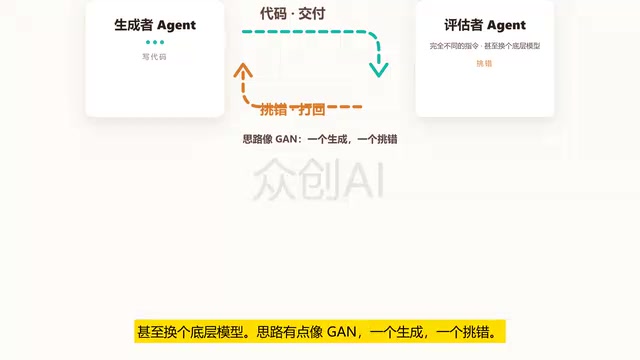
Loop Engineering: An Engineering Paradigm for AI That Writes Code and Merges PRs Autonomously
Loop Engineering is transforming AI development pipelines: Stripe's Minions system merges over 1,300 machine-generated PRs weekly. This article breaks down Loop Engineering's five core actions, six components, five failure modes, and three safety disciplines, explaining why independent evaluators, state files, and budget caps matter more than full automation.