India's Quick-Commerce Twist: New iPhones Now Arrive Faster Than Pizza

iPhone 18 Pro hits India's quick-commerce apps — delivered faster than pizza, but sold out within hours.
India's quick-commerce platforms have added Apple's iPhone 18 Pro to their instant-delivery lineup, letting consumers receive the flagship handset in minutes — faster than a pizza. Yet stock ran patchy within hours, exposing both fierce market demand and the deep tensions of managing high-value goods on quick-commerce supply chains. Platforms like Blinkit, Zepto, and Swiggy Instamart are rapidly expanding from groceries into consumer electronics via dense urban dark store networks to boost margins, while Apple gains a new distribution channel in a key market. Whether this model is sustainable — given capital-intensive inventory, loss prevention, and after-sales complexity — remains an open question.
Buying a Phone as Fast as Ordering Food
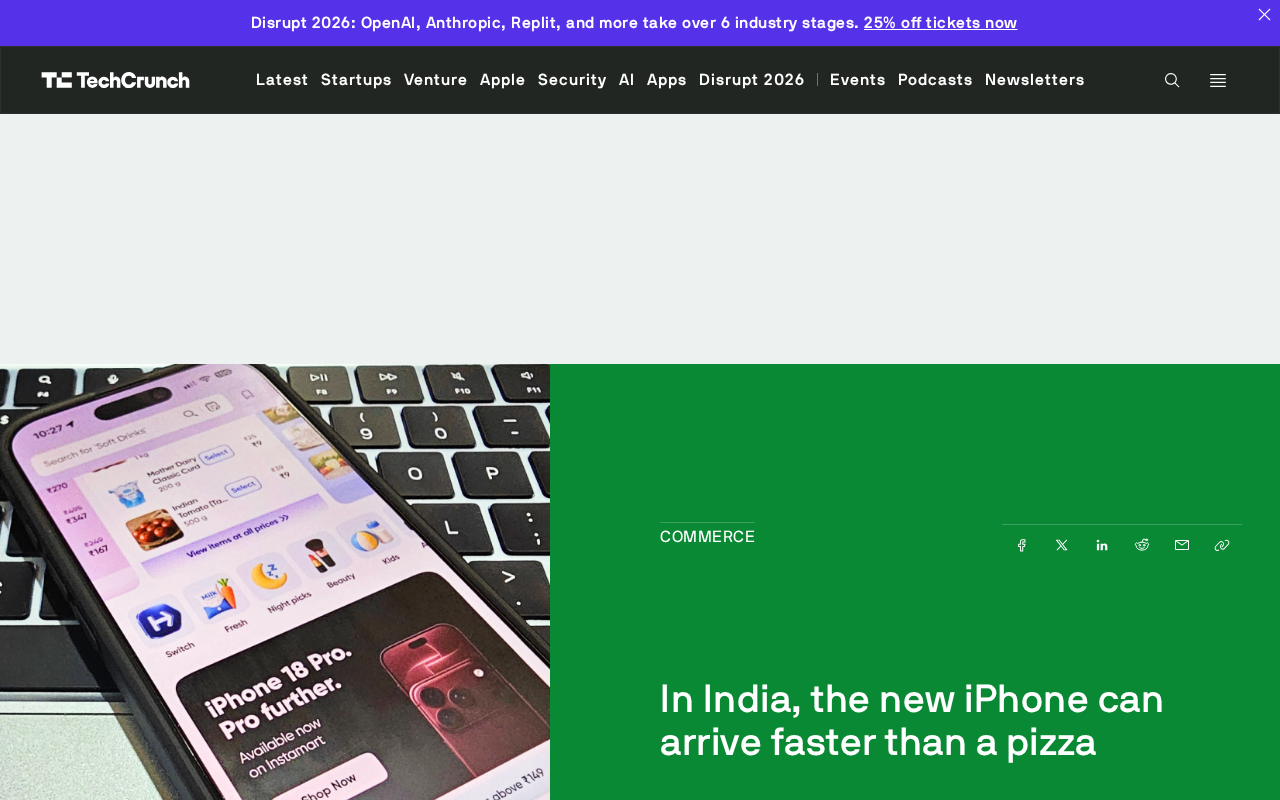
In India, the experience of buying the latest iPhone is being completely redefined. According to international media reports, after Apple's iPhone 18 Pro lineup went live on Indian quick-commerce platforms, consumers could receive a brand-new handset in their hands within minutes — sometimes faster than a pizza delivery.
This phenomenon reflects the rapid maturation of India's quick-commerce infrastructure. High-end electronics were traditionally available only through official stores, authorized resellers, or e-commerce sales events, with delivery timelines measured in days. Now, quick-commerce platforms are compressing that window down to a matter of minutes.
Stock Shortages Signal Strong Demand
Notably, just hours after the iPhone 18 Pro series went live on Indian quick-commerce apps, availability became patchy. This rapid sell-through signals two things simultaneously: robust demand for Apple's premium flagships in the Indian market, and an inventory management challenge that quick-commerce platforms face when handling high-value, high-demand goods.
The core logic of quick-commerce relies on a network of local dark stores and micro-fulfillment nodes distributed across cities, pre-positioning popular items as close to consumers as possible. But for something like an iPhone — with a high unit price and significant stocking costs — platforms struggle to maintain adequate inventory at every node. When demand surges all at once, stockouts become the norm.
The Rise of Quick-Commerce in India
India's quick-commerce sector has grown at a remarkable pace in recent years. Platforms like Blinkit, Zepto, and Swiggy Instamart have reshaped urban shopping habits with ultra-fast delivery in 10 to 30 minutes. Initially focused on groceries, household essentials, and food delivery, these platforms are now rapidly expanding into higher-ticket categories like consumer electronics and beauty products.
Adding flagship smartphones to the instant-delivery catalog is a critical move for these platforms to boost average order value and improve margins. For Apple, leveraging quick-commerce channels to reach consumers also represents a further deepening and diversification of its distribution network in India — a strategically important market.
What is a dark store? A dark store is the core infrastructure of the quick-commerce model — a small warehouse node dedicated entirely to picking and fulfilling online orders, with no storefront open to the public. Unlike traditional supermarkets, dark stores are densely distributed within urban neighborhoods, typically covering a 1–3 km radius, and work alongside delivery riders to achieve 10–30 minute delivery windows. Blinkit (formerly Grofers), Zepto, and Swiggy Instamart all rely on this model to scale, and dark store density in India's major cities is already quite substantial. Stocking high-value items like iPhones inside dark stores means platforms must tie up significant capital in inventory at each node upfront — which is precisely why availability tends to go "patchy." Once the limited stock at a given node sells out, nearby consumers see an out-of-stock status, and cross-node replenishment often cannot be completed within the promised delivery window.
Deeper Implications for the Consumer Market
The ability to receive a new iPhone within tens of minutes marks a structural shift in India's consumer electronics retail. It not only heightens consumers' sense of instant gratification but could also change the logic of new product launches — moving away from queuing on e-commerce platforms or camping overnight outside stores, toward a second-by-second scramble on quick-commerce apps.
That said, the sustainability of this model remains to be seen. Instant delivery of high-value goods involves a complex web of challenges: capital tied up in inventory, theft and loss prevention, and post-sale service fulfillment. The patchy availability is a vivid illustration of the difficult balance platforms must strike between demand and supply. For both Apple and quick-commerce platforms, managing the supply chain for premium products while maintaining a seamless experience will be the central challenge going forward.
The "loss prevention" challenge for high-value quick-commerce items is particularly acute in this industry. The per-unit loss from ordinary consumer goods is relatively manageable, but a flagship phone worth tens of thousands of rupees that goes missing, gets swapped out, or is damaged during delivery or warehousing represents a far greater cost to the platform than everyday items. In response, some platforms have already introduced dedicated tamper-evident seal verification processes, rider identity binding, and end-to-end video recording specifically for high-value electronics. Post-sale fulfillment adds another layer of complexity: whether phones purchased through quick-commerce channels carry the same warranty rights as those bought through official channels remains inconsistent — and that gap is a potential barrier to scaling this model widely.
Related articles

Claude Reportedly Able to Hide Secret Messages in Benign Images
A Reddit post claims Claude Fable 5.1 can hide secret messages in benign images. This article reviews the background, image steganography principles, and potential security risks, and suggests a testing path from rumor to verification.

Federal Government Awards $85 Million; CFS to Develop Fusion-Specific Semiconductors
The federal government awards $85 million to Commonwealth Fusion Systems to develop conductors and power semiconductors for fusion plants. This article analyzes the significance of this funding for the fusion supply chain and commercialization path.

When Should AI Assistants Proactively Suggest? Timing Is Everything
When should AI assistants proactively suggest? Reddit discussion reveals: the same suggestion feels different at different times. This article analyzes the dual nature of proactive suggestions, the boundary of user expectations, and design principles, exploring how to balance automation and user control.