Indie Developer Earns $65K in 8 Months: The Complete Guide to Monetizing MVP Development Services

Indie developer earns $65K in 8 months through MVP development services
Indie developer Manage, with experience building 40+ products, quit his full-time job and founded MVP development service UniqueSide, promising 7-day delivery of minimum viable products. Through Twitter personal branding and a Build in Public strategy for customer acquisition, he productized his skills into a standardized service, generating $65,000 in revenue within 8 months — validating productized services as a viable indie monetization path.
An indie developer named Manage, with experience building over 40 products, quit his full-time job in Singapore and founded UniqueSide — a company specializing in MVP (Minimum Viable Product) development services. In just 8 months, he generated $65,000 in revenue. His story reveals how personal branding, Twitter marketing, and technical skills can come together to build a sustainable indie developer monetization model.
From Employee to Indie Developer: A Long-Planned Transition
Manage started building products during college in 2015 and has since launched over 40 products spanning web apps and mobile apps. While many of these didn't succeed, the accumulated experience gave him the ability to ship products rapidly.
During his time as an employee, he worked at four different companies. The work culture at his last company left him deeply dissatisfied, prompting him to ask: "Is it worth working for a company I don't like, just to do my own things in my spare time?" Ultimately, he made a major decision — quit and go all-in on his own projects.

He admits this was the biggest risk of his life, but he set a safety net for himself: if it doesn't work out, he'd just find another job. As it turned out, 8 months later, it proved to be the best decision he ever made.
UniqueSide Business Model Breakdown: How Can You Deliver an MVP in 7 Days?
UniqueSide's core positioning is crystal clear — providing MVP development services for founders and entrepreneurs who have ideas but lack the technical skills or time to build them. This positioning stems from Manage's years of real-world observation: throughout his journey of building and launching products, he encountered countless people with ideas but no way to bring them to life.
MVP (Minimum Viable Product) is a core concept systematically articulated by Eric Ries, the father of the Lean Startup methodology, in his 2011 book The Lean Startup. Its essence is to build a product prototype with core functionality at minimal development cost, quickly push it to market to gather real user feedback, thereby validating business hypotheses and reducing startup risk. The MVP philosophy disrupts the traditional software development approach of "perfect first, then launch," emphasizing "launch first, then iterate." Dropbox initially validated demand with just a demo video, and Airbnb's founders started by simply listing their living room online — both are classic examples of MVP thinking. For non-technical founders, outsourcing MVP development to professional developers is the shortest path to quickly validating a business idea without possessing technical capabilities.
Manage's core competitive advantage is speed. With experience building 40+ products, he promises to deliver an MVP within 7 days. This claim sparked considerable controversy on Twitter, with some arguing it's impossible to build a product in 7 days, but Manage says he has even launched his own products in 2-4 days.
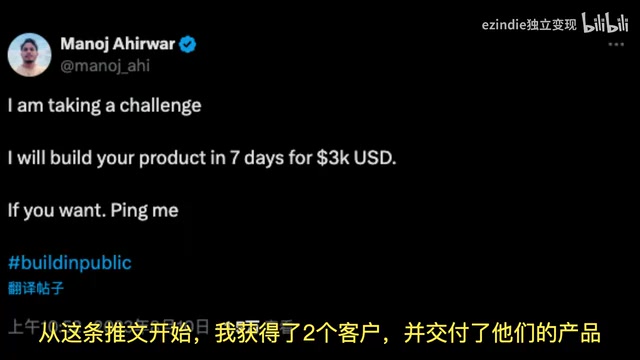
UniqueSide is essentially a Productized Service — a business model that sits between freelancing and SaaS products, popularized by cases like Brett Williams' DesignJoy. The core idea is to standardize and package what would otherwise be customized, hourly-billed services, selling them at a fixed price, fixed delivery timeline, and fixed scope. Compared to traditional outsourcing, this model offers advantages including: predictable revenue structure, replicable delivery processes, and lower sales friction. From a pricing strategy perspective, productized services typically command a 30%-100% premium over hourly freelance rates because clients are buying not just time, but certainty and professional credibility. This model is particularly suited for developers with deep vertical skills who don't want to bear the cold-start risk of a SaaS product — it's a lower-risk, more stable cash-flow path to indie monetization.
Looking at the revenue data, UniqueSide generated over $65,000 in revenue between September 2023 and March 2024, showing a steady growth trend. This validates an important business principle: productizing your strongest skills is itself a highly efficient monetization method.
Twitter Personal Branding for Customer Acquisition: From 38 Followers to Paying Clients
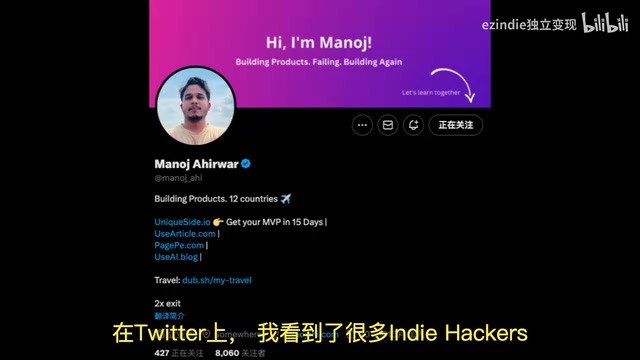
Manage's customer acquisition story is a textbook case of Twitter personal brand building. He had a Twitter account created 10 years ago that he never used — in a decade, it had only gained 38 followers.
In December 2022, he decided to take Twitter seriously. Previously, he had been posting on LinkedIn but saw poor engagement. On Twitter, he discovered a thriving community of Indie Hackers, which motivated him to stay on the platform.
Indie Hackers is a community platform for entrepreneurs founded by Courtland Allen in 2016 and later acquired by Stripe, focused on bringing together individual creators achieving financial independence through internet products. Unlike traditional VC-driven startup culture, Indie Hacker culture emphasizes bootstrapping, staying small and profitable, prioritizing cash flow, and rejecting external funding and hyper-growth narratives. The Indie Hacker community on Twitter is a key distribution channel for this culture, forming a unique interactive ecosystem: developers share product progress, revenue milestones, and failure post-mortems with each other, creating a strong sense of community identity. It was discovering this ecosystem of like-minded builders that led Manage to go deep on Twitter rather than LinkedIn.
From 0 to 100 Followers: The Hardest but Most Critical Phase
Manage shared his Twitter growth strategy:
- Starting phase: Actively reply to others' posts and build connections. At the beginning, your tweets might get zero visibility — that's normal
- Breaking 100 followers: This is the hardest milestone; once you hit it, give yourself a round of applause
- Sustained growth: Focus on creating original content, maintain engagement with others, and most importantly — stay authentic
Build in Public: The Customer Acquisition Power of Sharing Progress Openly
His key strategy was openly and transparently sharing business progress. At the end of every month, he shares revenue statistics on Twitter and LinkedIn. He believes that "numbers and statistics are a powerful way to show people you're doing things right."
Build in Public is a content marketing and trust-building strategy that has emerged in recent years within the indie developer and startup community. The core idea is to publicly share what is typically considered "internal information" — product development processes, business data, failure experiences — with the public. This strategy was first popularized on Twitter by indie developers like Pieter Levels (Levels.io), who openly shared MRR (Monthly Recurring Revenue) data for each project, accumulating a large number of loyal followers who converted into paying users. The underlying logic of Build in Public is "transparency equals trust."
Related articles
Meta Muse Hits 900K Downloads in Six D…
Meta Muse Hits 900K Downloads in Six Days: The AI Agent Era Has Officially Arrived
Meta's AI agent Muse hit 902K downloads in 6 days, topping US App Store and Google Play charts above ChatGPT and Claude. A deep dive into Muse's capabilities and the AI Agent race.
 Industry Insights
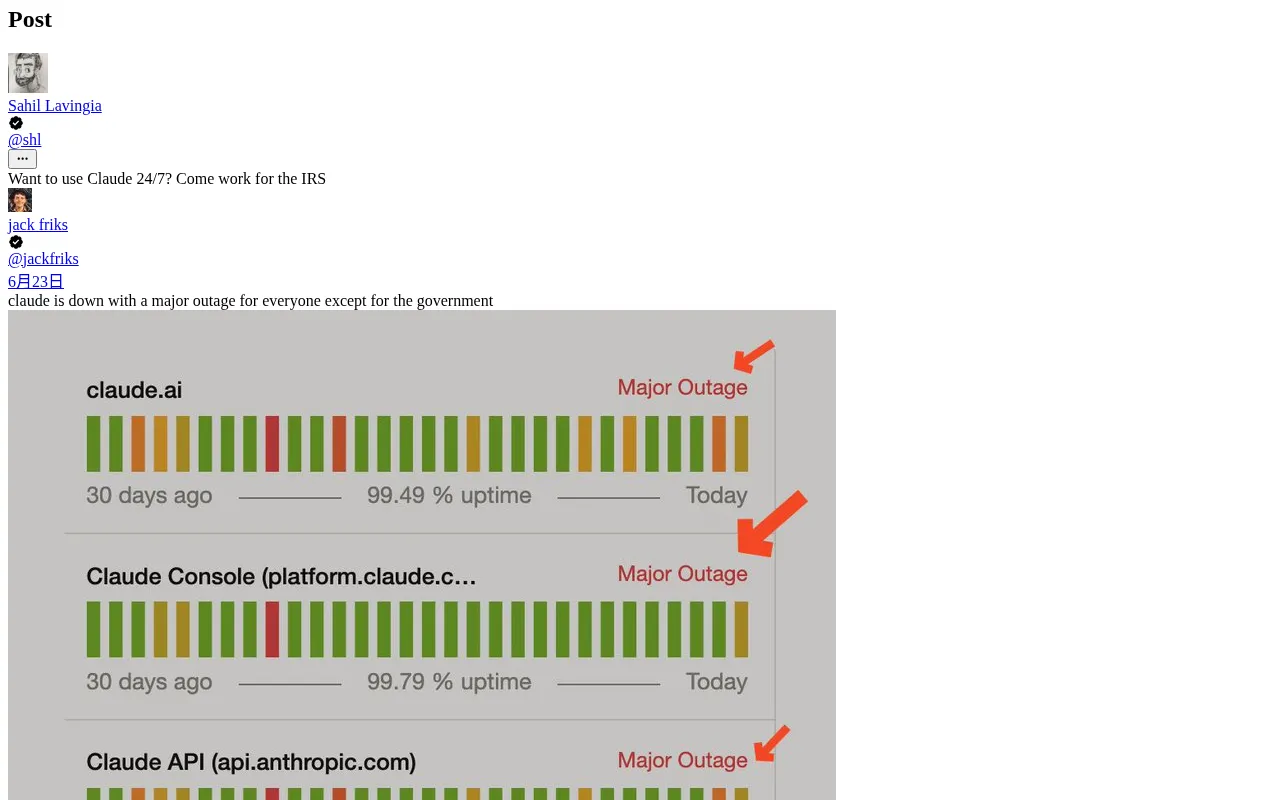
IRS Fully Embraces Claude AI, Accelerating Federal Government's AI Adoption
The IRS is recruiting staff with 24/7 Claude AI access, marking Anthropic's breakthrough into the federal government. Explore the strategic implications and tax use cases.
 Industry Insights
The IRS Mobile App Debate: A Trust Crisis in Government Digital Transformation
The IRS's proposed mobile app has sparked heated debate. This article analyzes the core arguments, exploring data security, privacy, and the trust crisis in government digital transformation.