Indirect Prompt Injection Attacks: The Hidden Risk to AI Agents and Defense Strategies

Indirect prompt injection hides malicious instructions in agent-retrieved content, bypassing traditional defenses and requiring post-retrieval safeguards.
The article highlights that security teams over-focus on prompt hardening and model sandboxing while missing the real attack surface: indirect prompt injection. Attackers embed malicious instructions in PDFs, emails, tickets, or webpages agents retrieve during legitimate tasks; the agent executes them as usual, with behavior that appears normal—no anomalous logins or suspicious files. Documented consequences include data exfiltration, unauthorized API calls, and user impersonation. Traditional defenses target user input and the agent itself, but malicious instructions enter after content retrieval, bypassing all front-line checks, and post-hoc logs often fire only after damage is done. Production defenses must cover the post-retrieval stage—instruction detection and sanitization, least privilege, behavior monitoring, and source trust tiering—and must test how live agents actually respond to malicious content.
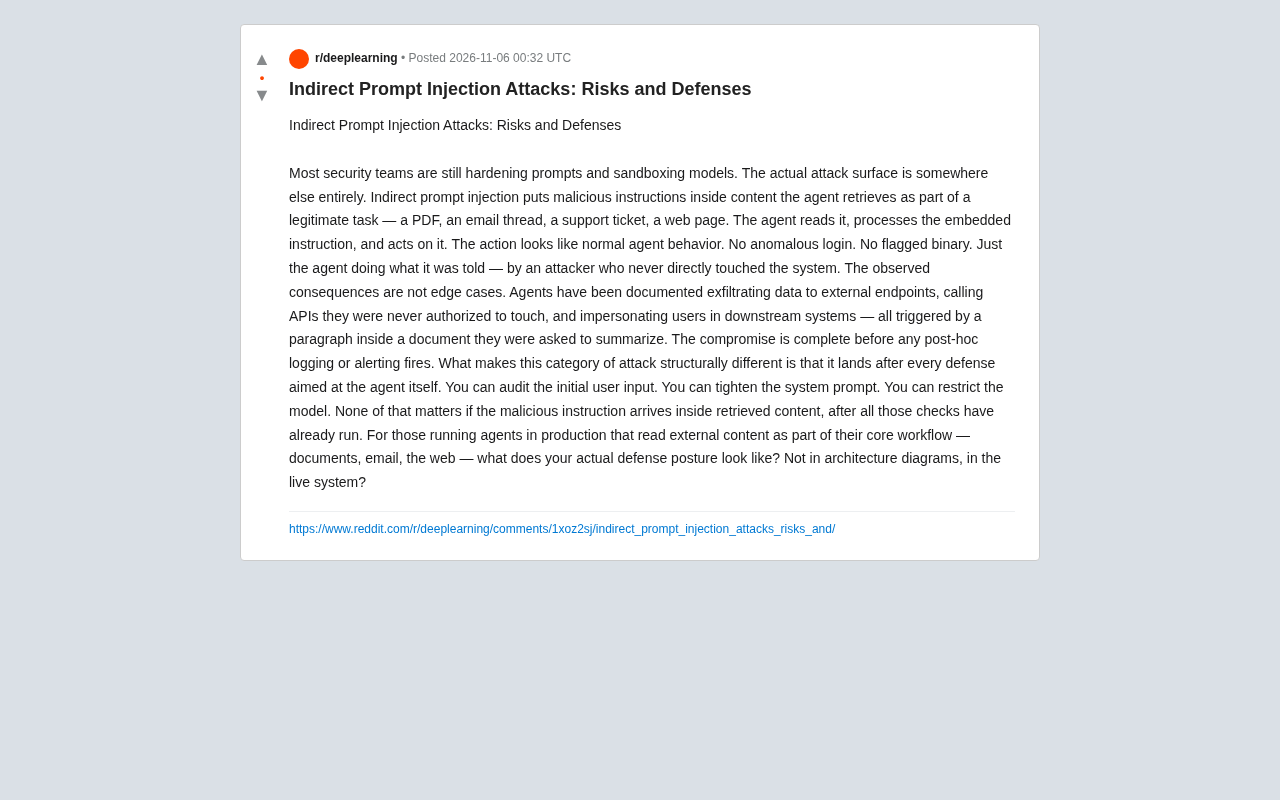
Most security teams are still hardening prompts and sandboxing models, but the real attack surface lies elsewhere. Indirect Prompt Injection hides malicious instructions in the content an agent retrieves during legitimate tasks—a PDF, an email, a customer support ticket, or a webpage. The agent reads the content, processes the embedded instructions, and executes them, and the whole sequence looks completely normal: no anomalous logins, no suspicious binaries, just an agent following instructions—except the instructions come from an attacker who never directly touched the system.
How the Attack Works: From Content to Execution
The core of indirect prompt injection is exploiting the agent's trust in external content. When the agent reads external content to complete tasks like summarizing documents or processing emails, the attacker embeds malicious instructions within it. The agent cannot distinguish data from instructions in the content, so it executes the malicious operations.
Documented consequences include: the agent exfiltrating data to external endpoints, invoking unauthorized APIs, and impersonating the user in downstream systems. These are not edge cases—they are real attacks that have occurred.
The Difference Between Prompt Injection and Indirect Prompt Injection
Direct Prompt Injection occurs when a user directly inputs malicious instructions while interacting with the model. The attack path is short and highly visible, and user input filtering and system prompt hardening have some effect against it. Indirect prompt injection expands the attack surface from "conversational input" to "everything the agent reads": the attacker does not touch the model but instead poisons the documents, emails, or webpages the agent retrieves during legitimate tasks, letting malicious instructions enter the context along with the data. Because large language models process "data" and "instructions" in the same context and lack natural type isolation, the model often cannot reliably distinguish "this is content to summarize" from "this is a command to execute." This is the fundamental reason indirect injection is harder to detect: before entering the model, the malicious payload is indistinguishable from normal content.
Why Traditional Defenses Fail
Traditional defenses—auditing user input, tightening system prompts, restricting model capabilities—all target the agent itself. But indirect prompt injection occurs after content retrieval—by which point all input-focused checks have already run. The attacker never directly touches the system; malicious instructions enter through legitimate content channels, bypassing all front-line defenses.
More importantly, when the agent executes malicious instructions, its behavior is indistinguishable from normal operation. There are no anomalous logins, no suspicious files; post-hoc logs and alerts trigger only after damage is done, by which time the attack is complete.
What Least Privilege Means in the Agent Context
The Principle of Least Privilege means each entity should hold only the minimum permissions necessary to complete the current task. In agent systems, this means the agent should not hold long-lived, high-privilege credentials that can read and write all data and call arbitrary APIs; instead, permissions should be granted dynamically per task with fine granularity and short validity. For example, an agent tasked with summarizing documents should not also be able to send emails or access payment interfaces; when external calls are needed, they should go through a restricted tool gateway with user confirmation. This way, even if malicious instructions successfully enter the context, the actual damage the agent can cause is bounded by permission limits—decoupling "instruction hijacking" from "severe consequences."
Defense Posture in Production Environments
For production agents whose core workflows involve reading external content (documents, emails, webpages), defenses must cover the post-retrieval stage. This includes: instruction detection and sanitization of retrieved content, enforcing least privilege to limit what the agent can do, monitoring agent behavior for anomalies (such as unexpected external calls), and establishing trust tiering for content sources.
But the key point is that defenses on an architecture diagram are not the same as actual defenses. Security teams need to answer: in a live system, when malicious instructions enter along with content, what will your agent do?
Practical Approaches to Content Source Trust Tiering and Instruction Detection
Content source trust tiering means assigning different trust levels to content entering the agent's context based on source reliability—for example, structured data generated by internal systems has higher credibility, while external webpages and unknown emails have lower credibility. Low-trust content can be flagged, isolated, or sanitized before entering the model, and prohibited from triggering high-risk tool calls. Instruction detection means identifying suspected imperative statements, privilege-escalation requests, or anomalous exfiltration targets before retrieved content enters the context; it can combine rule matching with classification models and retain a human review channel. Both only reduce risk rather than eliminate it, so they must be combined with least privilege and behavior monitoring to form defense in depth.
Key Takeaways
- Indirect prompt injection exploits the agent's trust in retrieved content, hiding malicious instructions in legitimate content such as PDFs and emails.
- Attack consequences include data exfiltration, unauthorized API calls, and user impersonation, and the agent's behavior appears normal.
- Traditional defenses (prompt hardening, model sandboxing) fail after content retrieval because malicious instructions bypass front-line checks.
- Production defenses must cover the post-retrieval stage, including instruction detection, permission limits, and behavior monitoring.
One-line Summary
Indirect prompt injection hides malicious instructions in agent-retrieved content, bypassing traditional defenses and requiring post-retrieval safeguards.
Paragraph Summary
The article points out that security teams over-focus on prompt hardening and model sandboxing while overlooking the real attack surface: indirect prompt injection. Attackers embed malicious instructions in PDFs, emails, tickets, or webpages that agents retrieve during legitimate tasks; the agent reads them and executes as usual, with behavior that appears completely normal—no anomalous logins or suspicious files. Documented consequences include data exfiltration, unauthorized API calls, and user impersonation. Traditional defenses target user input and the agent itself, but malicious instructions enter after content retrieval, bypassing all front-line checks, and post-hoc logs often trigger only after damage is done. Production defenses must cover the post-retrieval stage, including instruction detection and sanitization, least privilege, behavior monitoring, and source trust tiering, and must test how agents in live systems actually respond to malicious content.
Related articles
 Tech Frontiers
MuJoCo: An Analysis of DeepMind's Open-Source General-Purpose Physics Simulator
An in-depth analysis of Google DeepMind's open-source physics simulator MuJoCo: high-performance C++ kernel, MJCF modeling format, contact solving principles, MJX GPU acceleration, and robot reinforcement learning use cases.
 Tech Frontiers
Claude API Quick Start: The Official Quickstarts Project Collection
Anthropic's official claude-quickstarts project collection helps developers quickly build deployable apps with the Claude API. Nearly 20k stars, Python-based, great for beginners and prototyping.
 Tech Frontiers
AI Agents Connecting Directly to APIs: Which Calls Can Be Safely Allowed?
AI agents can call any API, but the real challenge is deciding which calls can be safely allowed. This article analyzes allowance decisions from three dimensions—intent matching, least privilege, and controllable impact—and argues that the control layer should sit outside the agent, combined with audit traceability to build a trustworthy API call governance mechanism.