Industrial ReMEmbR: Letting Robot Fleets Share Spatiotemporal Memory

NVIDIA Industrial ReMEmbR extends single-robot memory into shared spatiotemporal memory for robot fleets, with edge encoding and on-demand cloud decoding.
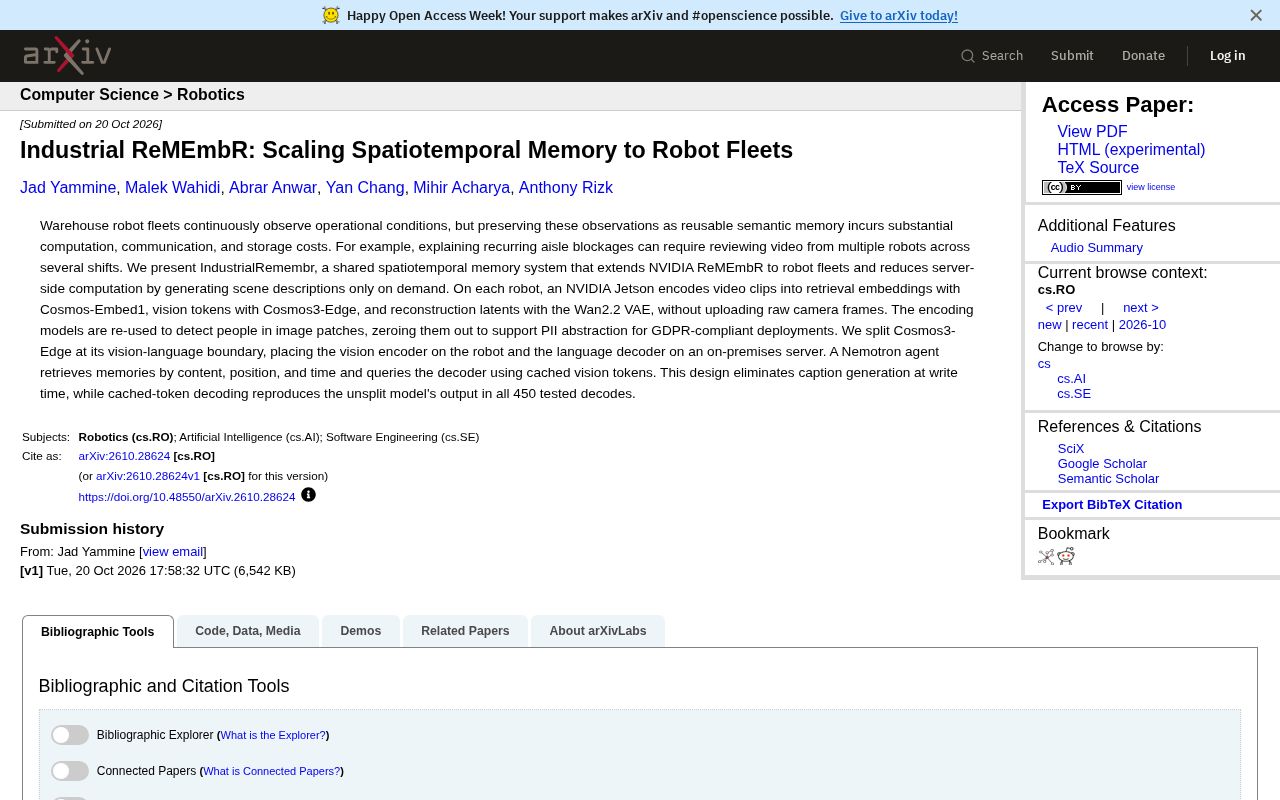
NVIDIA proposes Industrial ReMEmbR, which extends the single-robot memory framework ReMEmbR into a shared spatiotemporal memory pool for robot fleets. Multiple robots write into the same memory, and any robot can retrieve across content, location, and time, turning cross-shift, cross-robot warehouse issues (such as repeated aisle blockages) into questions answerable with a single query. On the robot side, Jetson runs Cosmos-Embed1, Cosmos3-Edge, and Wan2.2 VAE to generate retrieval embeddings, visual tokens, and reconstruction latents respectively, without uploading raw camera frames; the encoding models are also reused to detect and zero out person regions for PII abstraction, supporting GDPR compliance. The system does not generate descriptions at write time, only on demand at query time, and splits Cosmos3-Edge along the vision-language boundary, keeping visual encoding on the edge and language decoding on the server; cached-token decoding matched the unsplit model's output exactly across 450 tests.
Warehouse robot fleets continuously observe their operating environment every day, but turning these observations into reusable semantic memory is extremely costly—compute, communication, and storage costs all grow linearly with fleet size. For example, to explain why a certain aisle keeps getting blocked, one might need to pull video from multiple robots across multiple shifts and review it one by one. NVIDIA's Industrial ReMEmbR attempts to solve this problem: it extends the single-robot memory system ReMEmbR into shared spatiotemporal memory for robot fleets, while significantly reducing server-side compute.
From Single-Robot Memory to Fleet-Shared Memory
ReMEmbR was originally a memory framework for a single robot, with the core idea of letting the robot encode observed scenes into a searchable representation and retrieve them by content, location, and time when needed. The key change in Industrial ReMEmbR is "sharing": multiple robots write into the same memory pool, and any one of them can retrieve observations from other robots.
This addresses a typical pain point in warehouse scenarios. A single robot's field of view and shift are limited, and issues like aisle blockages and equipment anomalies often span multiple robots and multiple time periods. Shared memory makes "what blocked a certain aisle over the past three shifts" a question answerable with a single query, rather than manually reviewing multiple video feeds.
According to the source material, across 450 test decodes, the output from cached-token decoding was exactly identical to that of the unsplit model. This means the split deployment did not sacrifice generation quality.
Robot-Side Encoding: No Raw Footage Uploaded
Industrial ReMEmbR deploys NVIDIA Jetson on each robot, using three types of models to encode video clips into representations for different purposes:
- Cosmos-Embed1: generates embedding vectors for retrieval, enabling memory lookup by content;
- Cosmos3-Edge: generates visual tokens for subsequent language decoding;
- Wan2.2 VAE: generates reconstruction latents, preserving the ability to reconstruct frames.
What all three have in common is that none require uploading raw camera frames. Raw video is large in size and privacy-sensitive; keeping it on the edge side and uploading only compressed representations is a dual consideration of communication cost and compliance in this design.
The material also mentions a clever reuse: the same set of encoding models is used to detect people in image patches and zero out the corresponding regions, achieving PII abstraction. This provides a technical path for GDPR-compliant deployment—what is retained in memory is scene semantics, not identifiable faces or figures.
VAE (Variational Autoencoder) and reconstruction latents: A VAE is an encoder-decoder structure of a class of generative models; its encoder compresses an input image into a low-dimensional continuous distribution representation (usually called a latent), and the decoder reconstructs the original image from that latent. The Wan2.2 VAE here serves as the "compression-reconstruction" channel: the latents it outputs retain enough information to reconstruct the frame, but are far smaller in size than raw pixels, so without transmitting raw frames, downstream systems can still have frame reconstruction or visual understanding capabilities. Unlike embedding vectors used for retrieval, reconstruction latents do not pursue semantic comparability but instead preserve spatial and appearance details as faithfully as possible; the two play complementary roles in the memory pool.
Visual tokens: In multimodal models, the visual encoder splits an image into several patches, each encoded into a vector; these vectors are visual tokens. They essentially "translate" the image into a sequence that the language model can continue processing, allowing the language decoder to perform cross-modal reasoning without needing raw pixels. Caching these tokens avoids repeatedly performing visual encoding during the decoding stage.
On-Demand Description Generation: Moving Compute from Write Time to Query Time
Traditional approaches typically generate a text caption for each video at write time; as fleet size grows, this compute becomes very substantial. Industrial ReMEmbR's choice is: do not generate descriptions at write time, and only generate scene descriptions when there is a query need.
This is precisely the core value of "on-demand generation." The vast majority of warehouse footage may never be retrieved, and pre-generating descriptions for it is wasteful. Deferring compute to query time significantly reduces server-side load.
The trade-off between write-time compute and query-time compute: In memory systems, description generation is a typical case of "precomputation"—generated once at write time and reused directly for subsequent retrieval. The advantage is low and stable query latency; the disadvantage is that the full compute cost is paid regardless of whether retrieval ever happens. On-demand generation shifts the cost to the query path, following a lazy evaluation approach: a description is generated only when a piece of memory is actually hit by a query. In scenarios like warehouses where access distribution is highly skewed, the vast majority of footage is never retrieved for long periods, so the expected cost of a lazy strategy is far lower than pre-generation. The cost is that query latency is no longer constant, and compute queuing may occur during peak periods—which is why the original text mentions the need to validate latency performance.
Splitting at the Vision-Language Boundary: Encoding on the Edge, Decoding in the Cloud
The system splits Cosmos3-Edge along the vision-language boundary: the visual encoder stays on the robot, and the language decoder is placed on the local server. What the robot uploads is compact visual tokens, not pixels.
At query time, a Nemotron agent retrieves memory by content, location, and time, and issues queries to the language decoder using cached visual tokens. Because the language decoder does not need to reprocess images, decoding cost is further reduced. The material emphasizes that this cached-token decoding reproduced the output of the unsplit model across all 450 test decodes—the split deployment introduced no quality loss.
The engineering significance of this architecture is that it splits "memory" into two halves that can be optimized separately: the edge side handles perception and compression, and the server side handles semantics and retrieval. For warehouse operations that need causal investigation across multiple robots and multiple shifts, shared spatiotemporal memory offers a more structured path than manually reviewing footage.
Vision-language boundary: Modern multimodal large models are typically composed of a visual encoder and a language model in series; the former converts images into token sequences, and the latter generates text autoregressively. The interface between the two is the "vision-language boundary." Splitting the model along this boundary means that the inputs and outputs on both sides of the split point are compact token tensors rather than pixels, so they can be deployed on different hardware: the visual encoder is sensitive to compute and bandwidth and is suited to edge devices close to the data source, while the language decoder has a large parameter count and is suited to centralized server deployment. Because both sides communicate through standardized tokens, as long as the tokens are consistent, the split output should be equivalent to the whole model—which is exactly the property the 450-decode consistency test aims to verify.
GDPR and PII abstraction: GDPR requires data minimization and privacy-by-design for personal data. PII abstraction means identifying and erasing personally identifiable information (such as faces and body shapes) before data enters persistent memory, so that only scene semantics are stored. Masking (zeroing out) is a simple and direct abstraction method whose effectiveness depends entirely on the recall of the detection model: a missed detection means raw identity information may still remain in the representation.
Trade-offs Worth Watching
On-demand description generation reduces normal load, but latency performance during query peaks and the validity-period management of cached visual tokens are engineering details that need validation before deployment. PII zeroing depends on the recall of the detection model, and missed detections directly affect compliance. In addition, the 450-decode consistency test covers output consistency and does not yet address memory drift under long-term operation.
Overall, Industrial ReMEmbR points in a clear direction: robot fleet memory should not be an accumulation of raw video, but a layered structure of edge compression, shared retrieval, and on-demand generation.
Related articles

Chain of Thought Isn't Just for AI: How Humans Can Use CoT to Improve Thinking Quality
Chain of Thought isn't just a prompt trick for large models. Starting from a Hacker News discussion, this article analyzes why CoT works for human thinking too, breaks down actionable ways to transfer it, and highlights the key differences between human CoT and machine CoT.
Cloudflare Teams Up with OpenAI: Closi…
Cloudflare Teams Up with OpenAI: Closing the Loop from Vulnerability Discovery to Defense with AI
Cloudflare uses OpenAI Daybreak to investigate security vulnerabilities and generate reviewable remediation plans, while developers use Codex to boost coding efficiency and quality.

Orca Multi-Agent Orchestration in Practice: A Guide to Parallel Collaboration with Claude and Codex
Orca is Stable AI's free open-source agent workbench supporting 34 agents like Claude Code and Codex in parallel. Learn its Git worktree isolation, multi-model orchestration, and mobile management.