Infinite-Parameter LLMs: Dynamically Generating and Adjusting Model Weights from Real-Time Data
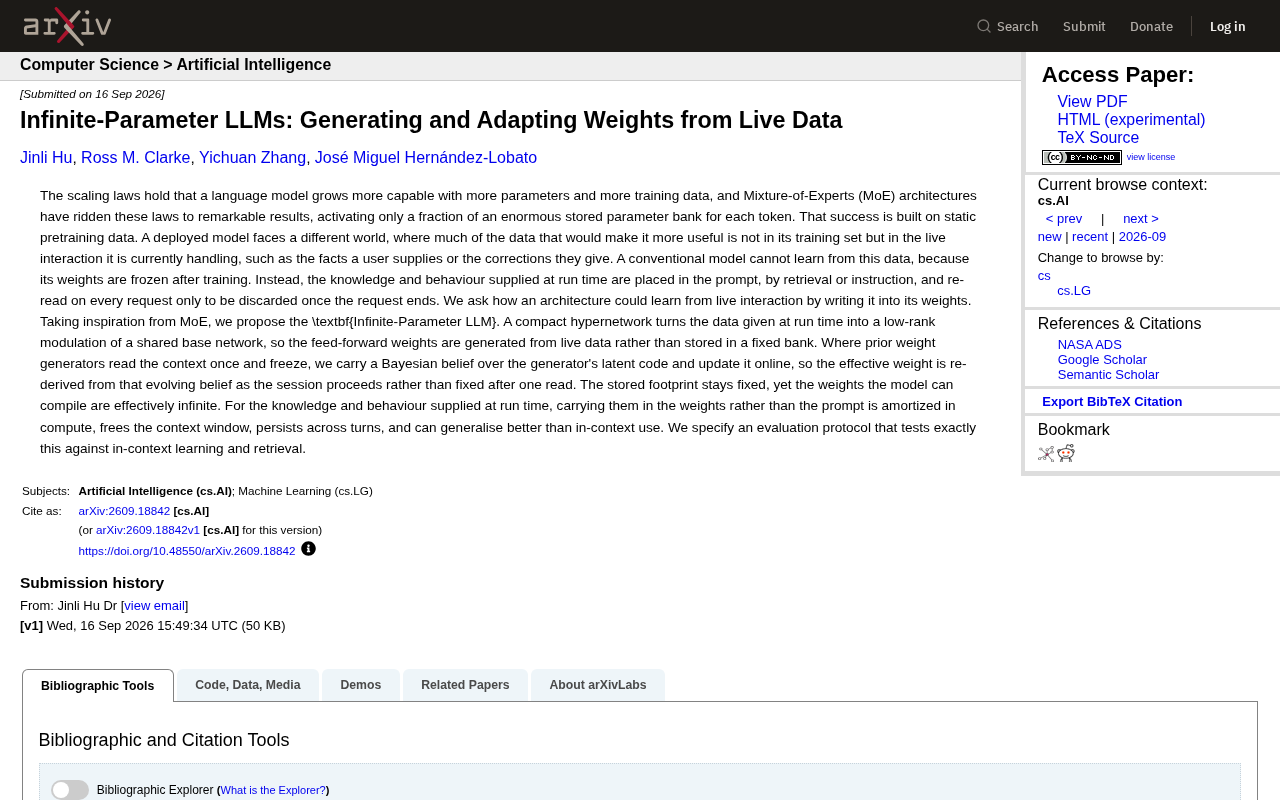
A look at the radical idea of generating LLM weights dynamically from real-time data, rather than storing them as fixed values.
Traditional LLMs freeze their parameters after training, but the "infinite-parameter LLM" concept proposes treating model weights as dynamic function outputs generated from real-time data. This is a radical extension of hypernetworks, RAG, and LoRA, promising continual learning, more efficient use of compute and storage, and native support for personalization. However, output stability risks from dynamic weights, added inference overhead, and catastrophic forgetting in continual learning scenarios are major obstacles to practical implementation. The concept remains at an exploratory stage, and its greatest value may lie in prompting the field to rethink whether weights should be stored or generated.
A Bold Vision: Breaking Free from Fixed Model Weights
The parameters of a traditional large language model (LLM) are frozen once training is complete. Whether we're talking about 7 billion or hundreds of billions of parameters, the model's "knowledge" is essentially locked into its weight matrices. When we talk about Infinite-Parameter LLMs, we're describing a fundamentally different paradigm: model weights are no longer static, fixed values in storage, but can be dynamically generated and continuously adjusted from real-time data.
This idea strikes at a core constraint in current deep learning architectures — the tight coupling between parameter scale and both reasoning capability and knowledge storage. If weights can be generated on demand, a model would theoretically no longer be limited by the fixed capacity determined at training time.
What Does "Generating Weights from Real-Time Data" Actually Mean?
The central idea is to treat model weights as a function output rather than a stored entity. In other words, some or all of a model's parameters can be produced by a generative mechanism based on the current input context, retrieved external data, or real-time signals.
How It Differs from Existing Approaches
Several existing techniques already explore this direction:
- Hypernetworks: A smaller network generates the weights of another network — an early implementation of the "weight generation" concept.
- Retrieval-Augmented Generation (RAG): Supplements a model's static knowledge with external knowledge bases, but does not alter the weights themselves.
- Parameter-efficient fine-tuning (e.g., LoRA): Stacks lightweight, trainable low-rank adapter layers on top of a frozen backbone to enable lightweight adaptation.
The "infinite-parameter" vision is more radical than any of these — it aims to make weight generation a standard, built-in mechanism of model operation rather than an add-on module. As new data streams in, the relevant weights can be constructed in real time, effectively lifting the ceiling imposed by a fixed parameter count.
Hypernetworks were formally introduced by David Ha et al. in 2016. The core idea is to use a small "meta-network" to output the weights of a target network, rather than directly learning those target weights. This allows the same set of meta-network parameters to generate different weight configurations under different conditions — essentially compressing the "parameter space" into a more compact generative function. Hypernetworks have been experimentally validated in continual learning, neural architecture search, and multi-task learning, but due to limitations in generation quality and stability, they have yet to become a mainstream architectural component. Understanding hypernetworks is a crucial foundation for grasping the conceptual lineage of "infinite parameters" — the latter can be seen as pushing the hypernetwork idea to its extreme: no longer just using a small network to generate a small network, but using real-time external data as a conditioning signal to continuously drive the dynamic construction of large-scale weights.
Potential Value and Applications
If this paradigm can be realized, the implications would be profound. The primary benefit is continual learning: a model could absorb new information after deployment without requiring full retraining. This is especially critical for applications that must handle rapidly changing domains like finance, news, and software development.
A second benefit is the reallocation of storage and compute efficiency. When weights can be generated on demand, a model no longer needs to hard-code all of its knowledge into fixed parameters. This could allow lightweight models to demonstrate capabilities far exceeding what their nominal parameter count would suggest.
Finally, this mechanism naturally supports personalization and domain adaptation. Different users and different contexts could trigger different weight-generation pathways, allowing a single base model to exhibit highly customized behavior.
Real-World Technical Challenges
As compelling as the vision sounds, a significant gap exists between concept and engineering reality.
Stability is the foremost obstacle. How can dynamically generated weights guarantee consistency and reliability in model outputs? If the effective parameters may change with every inference pass, the predictability of model behavior would be severely compromised.
Computational overhead is equally unavoidable. Generating weights in real time introduces additional compute during inference, which works against the goal of inference efficiency. Finding the right balance between dynamism and speed is a critical engineering challenge.
Then there's the classic problem of catastrophic forgetting — when a model continuously adjusts its weights from new data, preventing the erosion of previously acquired core capabilities remains an unsolved challenge in continual learning research.
A Grounded Perspective
It's worth noting that this topic remains largely at the conceptual and exploratory stage. The original discussion attracted limited attention in the technical community (only a handful of votes on HackerNews with no in-depth comments), suggesting that the maturity and verifiability of concrete proposals are still to be determined.
The phrase "infinite parameters" carries a degree of marketing flair. In practice, real systems are more likely to feature finite but scalable weight-generation mechanisms, not literally infinite ones. For researchers and engineers tracking frontier architectures, this direction is worth following closely — but with a measured eye toward assessing its practical feasibility and real-world impact.
The true value of this kind of exploration may not lie in immediately replacing existing architectures, but in pushing the field to rethink a foundational concept in deep learning: should weights be stored, or should they be generated?
Catastrophic Forgetting is a classic pain point in neural network continual learning: when a network updates its parameters on a new task, it severely overwrites the weight distributions associated with old tasks, causing a sharp degradation in previously learned capabilities. This phenomenon stems from the shared nature of neural network parameters — the same set of weights simultaneously encodes multiple functions, and new gradient updates inevitably interfere with stored knowledge. Proposed mitigation strategies include Elastic Weight Consolidation (EWC), Progressive Neural Networks, and memory replay, but completely solving this problem in large-scale language models remains an open research question. For the dynamic weight generation paradigm, the risk of catastrophic forgetting manifests in a more subtle form: if real-time-generated weights lack a mechanism to constrain them with respect to the historical knowledge distribution, the base model's capabilities could be quietly eroded each time weights are refreshed. This is a systemic risk that any engineering effort in this direction must confront head-on.
Related articles

Waymo Restarts San Antonio Operations: Back on the Road Five Months After Flood Incident
Waymo resumes San Antonio Robotaxi service ~5 months after a vehicle was swept away in flooding. A look at what happened, why it took so long, and what it means for AV safety in extreme weather.
What Is AIOps? How AI Is Reshaping IT Operations
AIOps applies AI and machine learning to IT operations for anomaly detection, alert noise reduction, and root cause analysis — shifting teams from reactive to proactive.

CCC Sends Its Invitation: 40C3 Hacker Congress Themed "Model Citizens"
CCC announces its 40th Chaos Communication Congress (40C3) under the theme "Model Citizens," inviting hackers worldwide to examine surveillance and algorithmic governance.