INKBOT: Bridging the Gap Between Human Intent and Model Reasoning with a Structured Intermediate Layer

INKBOT inserts a visual intent layer so humans can review and correct model understanding before AI execution begins.
Independent developer Thomas Coates built INKBOT to address the "alignment gap" between human intent and model inference in multimodal AI. The core idea is to insert an intermediate layer before final generation: parsing vague natural language into "functional tokens," producing an inspectable Visual Brief, and letting users catch structural misunderstandings before costly generation begins. The system deliberately stores human-confirmed intent separately from raw model inference to create a stable constraint baseline. Implemented as a local-first single webpage file, the author has open-sourced it and is actively seeking critical community feedback — especially on its limitations at scale.
An Old Problem Haunting Multimodal AI
Multimodal AI systems can generate complex code or images in an instant, yet one persistent pain point remains unsolved: what humans actually mean and what models actually infer are often two very different things. Independent developer Thomas Coates shared his project INKBOT on Reddit's machine learning community, aimed squarely at tackling this "alignment gap."
His observation is straightforward — the dominant approach today is single-shot prompting. A user describes what they need, the model generates a massive final artifact in one go, and the user then circles back to patch up the mistakes. This pattern pushes correction costs to the very end, and forces ordinary users to learn how to be "prompt engineers."
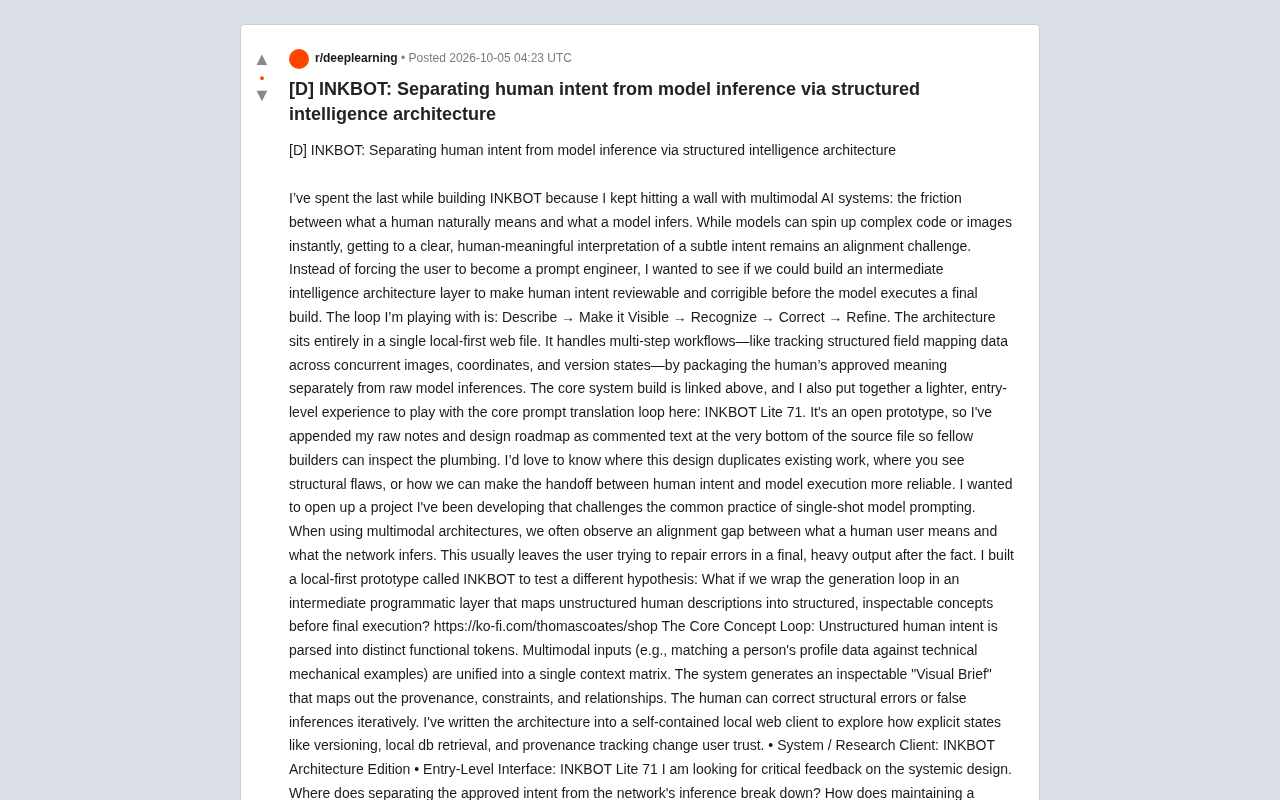
INKBOT proposes a different path: rather than making humans accommodate the model, it inserts an intelligent intermediate layer before the model executes its final build — one that makes human intent inspectable and correctable.
The "alignment gap" here refers specifically to the semantic mismatch between user intent and model output, which is distinct from the "value alignment" problem commonly discussed in AI safety. This is an engineering-level interaction distortion: the user says A, the model interprets it as B, and generates C. This kind of drift is especially pronounced in multimodal systems, where cross-modal semantic mapping — such as translating a text description into image composition logic — inherently carries vast ambiguity. The fundamental flaw of the single-shot prompting paradigm is that it compresses what should be a dialogic process of "requirement clarification" into a one-time input, leaving all uncertainty to the model's black-box inference. Users only discover the mismatch after receiving the final output — when the cost of correction is highest.
Core Design: Making Intent Visible Before Execution
The interaction loop the author proposes follows a clear chain: Describe → Make it Visible → Recognize → Correct → Refine.
The critical steps are the first two. In traditional workflows, a human's vague description is fed directly to the model, with no visibility into what happens in between. INKBOT instead parses the unstructured human description into a set of "functional tokens" first, then unifies multimodal inputs (such as matching a person's profile data with technical/mechanical reference examples) into a single context matrix.
On top of this, the system generates an inspectable Visual Brief that surfaces the provenance of the requirements, the constraints, and the relationships between elements. Users can correct structural errors or model misinterpretations at this stage — rather than waiting until after the heavy final artifact has been generated.
"Functional tokens" are the core unit of abstraction in INKBOT's design. They refer to decomposing unstructured natural language descriptions into minimal units with clear semantic roles — for example, breaking "make a tech-themed product poster" into "style: tech", "type: poster", "subject: product" as independently reviewable fields. This approach has precedents in NLP, similar to Semantic Role Labeling, but INKBOT's focus isn't linguistic analysis — it's making these structured units visible and editable for users, forming a human-confirmed "requirements contract" before generation begins. The context matrix encodes multiple input streams (text, image examples, profile data, etc.) into a single retrievable structure, preventing information from different modalities from being silently dropped during transmission.
Storing "Approved Intent" Separately from "Raw Inference"
One of the most noteworthy aspects of the INKBOT architecture is its deliberate separation of human-approved meaning from the model's raw inference.
The author explains that the entire system is written into a local-first single webpage file, designed to handle multi-step workflows — such as tracking structured field-mapping data across multiple concurrent images, coordinates, and version states. By explicitly managing state through versioning, local database retrieval, and provenance tracking, the author wants to explore a question: how does user trust in the system change when these states become explicitly visible?
This touches on a long-overlooked engineering detail. A model's inferences are inherently volatile and unreliable, while human-confirmed intent should serve as a stable anchor. Mixing the two makes it difficult to determine whether an error stems from "the user not being clear enough" or "the model not understanding correctly." By separating them, the system gains a reliable baseline for constraining subsequent generation.
What Feedback the Author Is Actually Seeking
This is an open prototype project. The author has embedded his raw notes and design roadmap as comments at the bottom of the source file, making it easy for other developers to "inspect the plumbing." He has also built a lighter entry-level version, INKBOT Lite, for people to experience the core prompt translation loop first.
He posted several specific questions inviting critical community feedback:
- Where does this design overlap with existing work?
- Under what circumstances does separating "approved intent" from "network inference" break down?
- How does maintaining a stateful revision history change how a model is steered across long-horizon tasks?
The author explicitly states that this is an independent, non-commercial research prototype, unaffiliated with and not endorsed by any major model provider.
A Brief Assessment
INKBOT's approach isn't isolated. From LangChain's chain-based orchestration to various human-in-the-loop review mechanisms, the industry has long been trying to add controllable intermediate layers to model black-box processes. What sets INKBOT apart is its focus on intent visualization and state separation, implemented in a minimalist local single-file form that lowers the barrier for other developers to examine and experiment with.
That said, the real challenges with this type of design tend to emerge at scale: when field mappings, version branches, and provenance chains grow complex, will the Visual Brief itself become a new source of cognitive overhead? And will the process of structuring intent into functional tokens introduce new information loss? These are questions worth continued exploration by the community.
For developers focused on AI alignment and human-computer interaction engineering, INKBOT offers a concrete, decomposable experimental specimen. It may not be the final answer, but it frames the problem with enough clarity to matter.
The Human-in-the-Loop (HITL) paradigm that INKBOT belongs to is a class of system architectures that embed human judgment at critical nodes within automated processes, widely used in data annotation, content moderation, and high-stakes decision support. Its core assumption is that for decisions where model confidence is insufficient or consequences are irreversible, proactive human confirmation is less costly than after-the-fact correction. Orchestration frameworks like LangChain decompose complex tasks by defining "chains" and "agents," allowing tool calls or human review nodes to be injected at intermediate steps. INKBOT differs from these frameworks in that its intervention point isn't mid-execution — it's at the requirement parsing stage. It attempts to have humans confirm what the model "understands" before the model begins to "do" — a far more upstream intervention strategy.
Related articles

Chain of Thought Isn't Just for AI: How Humans Can Use CoT to Improve Thinking Quality
Chain of Thought isn't just a prompt trick for large models. Starting from a Hacker News discussion, this article analyzes why CoT works for human thinking too, breaks down actionable ways to transfer it, and highlights the key differences between human CoT and machine CoT.
Cloudflare Teams Up with OpenAI: Closi…
Cloudflare Teams Up with OpenAI: Closing the Loop from Vulnerability Discovery to Defense with AI
Cloudflare uses OpenAI Daybreak to investigate security vulnerabilities and generate reviewable remediation plans, while developers use Codex to boost coding efficiency and quality.

Orca Multi-Agent Orchestration in Practice: A Guide to Parallel Collaboration with Claude and Codex
Orca is Stable AI's free open-source agent workbench supporting 34 agents like Claude Code and Codex in parallel. Learn its Git worktree isolation, multi-model orchestration, and mobile management.