Inkling 2 Mini Lands on Ollama: 26B Open-Source Model Supports Windows and Linux

Ollama launches the 26B Inkling 2 Mini — runs on 32GB, custom-kernel speedup on Mac.
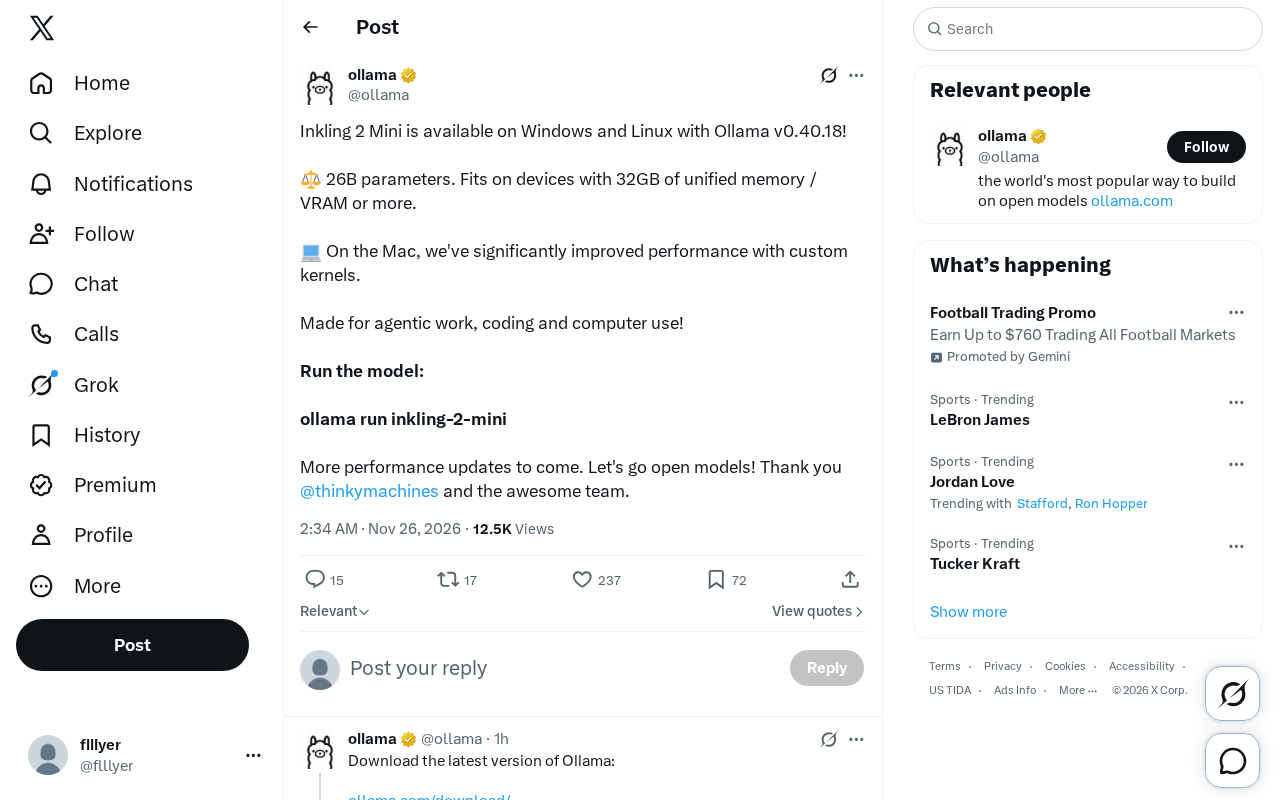
Ollama v0.40.18 officially launches the 26B-parameter Inkling 2 Mini, supporting Windows and Linux and running on devices with 32GB of unified memory or VRAM. Designed for agentic work, coding, and computer use, it compromises between capability and local deployment cost. The Ollama team says custom kernels significantly boost Mac performance via lower-level Metal optimization. A single `ollama run inkling-2-mini` gets it running, with more performance updates to come. The article notes that mid-sized, workflow-oriented open-source models are emerging rapidly, lowering the local deployment barrier as competition shifts from parameter counts to engineering experience.
The open-source model ecosystem has welcomed a new member. Ollama v0.40.18 has officially launched Inkling 2 Mini, a 26B-parameter model with support for both Windows and Linux, offering local-deployment developers a new option.
26B parameters, runs on 32GB of memory
Inkling 2 Mini's sizing is quite pragmatic. At 26B parameters, it's not the kind of large model that requires stacking multiple GPUs to run — the official guidance is clear: any device with 32GB of unified memory or VRAM or more can run it.
That threshold isn't particularly demanding given today's hardware landscape. High-end Apple Silicon machines, workstations with large-VRAM discrete GPUs, and some high-memory mini PCs all fall within the supported range. For developers who want to run a reasonably capable model locally, it's an option worth paying attention to.
The difference between unified memory and VRAM: The article lumps "32GB unified memory or VRAM" together as the same threshold, but from an engineering standpoint the two aren't equivalent. Unified memory is a feature of SoC architectures like Apple Silicon, where the CPU and GPU share the same physical memory, so model weights don't need to be shuttled between VRAM and main memory — meaning 32GB of unified memory can be used almost entirely for loading the model. On traditional x86 + discrete GPU platforms, however, model weights must reside in VRAM, with system memory only handling loading and scheduling — so 32GB of VRAM corresponds to a large-VRAM graphics card or professional card. Additionally, a 26B model requires roughly 52GB of storage at FP16; running it on a 32GB device typically means 4-bit quantization (roughly 13–15GB of weights) plus KV Cache and context overhead. Understanding this is essential to judging whether your device can truly "run it."
Custom kernels on Mac deliver significant performance gains
The Ollama team specifically noted that Mac performance has been significantly improved through custom kernels. Apple chips' unified memory architecture has always been an advantage for local inference, and custom kernels mean the team has done lower-level optimization for the Metal backend rather than simply applying a generic implementation.
The official announcement doesn't give specific numbers, but the wording "significantly improved" indicates this isn't a minor patch. For Mac users, better inference speed on the same hardware directly affects day-to-day responsiveness.
The significance of Metal and custom kernels: Metal is Apple's low-level graphics and compute API and the only efficient path for invoking the GPU for inference on Mac. A "kernel" refers to a compute function executed on the GPU — operators such as matrix multiplication, attention computation, and normalization. Generic inference frameworks often use a single cross-platform kernel set that may not fully exploit Apple chips' SIMD width, memory bandwidth, and on-chip cache hierarchy on Metal. Custom kernels mean rewriting key operators for the Metal backend — for example, using threadgroup partitioning better suited to Apple GPUs, leveraging simdgroup matrix instructions, and reducing VRAM round-trips for intermediate results. Such optimizations can typically deliver substantial throughput gains, but they must be maintained per platform — which is also a key battleground where runtime tools differentiate themselves.
Built for agentic work, coding, and computer use
Inkling 2 Mini's positioning is clear: designed for agentic work, coding, and computer use. These three areas happen to be the most fiercely contested scenarios in open-source models today — tool calling, code generation, and getting models to operate computer interfaces.
At 26B, the model strikes a compromise between capability and cost. It may not match top-tier closed-source models, but for local execution where data never leaves the machine, this scale is often more practical than chasing maximum parameter counts. The Thinky Machines team's investment in this model also shows that the agentic direction is attracting more developers focused specifically on it.
What agentic work and computer use are: Agentic work means the model no longer just does single-turn Q&A, but acts as an "agent" that autonomously plans multi-step tasks, calls external tools (search, code execution, file operations), and adjusts strategy based on intermediate results until the goal is achieved. This shifts the demand on models from "generate good answers" to "reliably produce structured tool calls, maintain goals over long horizons, and recover from failures." Computer use is the extreme form of this direction: the model directly observes screenshots and outputs mouse clicks, keyboard input, and other actions to operate GUI software on a human's behalf. Such tasks place high demands on visual understanding, coordinate localization, and the accuracy of action sequences, with little tolerance for error. The 26B scale is seen as a compromise because it can carry a certain amount of multimodal and tool-calling capability while still running within a single machine's memory budget — suitable for scenarios sensitive to data privacy and requiring offline automation.
Run it with a single command
Getting started continues Ollama's signature simplicity:
ollama run inkling-2-mini
No complicated configuration process — Windows and Linux users can pull the model after updating to v0.40.18. The team also said more performance updates are coming and publicly voiced support for open-source models.
How Ollama distributes models: The reason ollama run inkling-2-mini works in a single line comes down to Ollama's Modelfile and OCI-style layered distribution mechanism. Models are split into weight layers, template layers, and parameter configuration layers; pulls download and cache incrementally by layer, and updating a model only requires replacing the changed parts. At runtime, Ollama automatically detects the hardware (Metal, CUDA, ROCm, or CPU-only) and selects the appropriate backend and quantization format to load. This "download and run" experience encapsulates the otherwise tedious environment setup, dependency management, and format conversion involved in model deployment — and it's the key to rapidly bringing new models to Windows, Linux, and macOS. For developers, this means they can focus on agent logic and application integration rather than repeatedly setting up inference environments.
Competition in local open-source models is accelerating
The release of Inkling 2 Mini isn't a sensational event in itself, but it reflects a trend: mid-sized open-source models aimed at real workflows are emerging rapidly, and runtime tools like Ollama are standardizing the "download and run" experience.
As 26B-class models can run smoothly on 32GB devices and receive low-level optimization for different platforms, the barrier to local deployment keeps falling. For developers, this means more room to experiment; for the open-source model ecosystem, it means competition is shifting from parameter counts to engineering experience.
One-line Summary
Ollama launches the 26B-parameter Inkling 2 Mini, runs on 32GB of memory, with custom-kernel acceleration on Mac.
Paragraph Summary
Ollama v0.40.18 has officially launched the 26B-parameter Inkling 2 Mini, supporting Windows and Linux, and running on devices with 32GB of unified memory or VRAM. The model is designed for agentic work, coding, and computer use scenarios, striking a compromise between capability and local deployment cost. The Ollama team says the Mac platform gains significant performance improvements through custom kernels, indicating lower-level optimization for the Metal backend. Getting started remains simple — a single ollama run inkling-2-mini pulls and runs it — with more performance updates to come. The article argues that mid-sized open-source models aimed at real workflows are emerging rapidly, the barrier to local deployment keeps falling, and competition among open-source models is shifting from parameter counts to engineering experience.
Related articles

Nothing CMF Buds 2A Drops to $17.89 on Black Friday: A New Low for ANC Earbuds
Nothing CMF Buds 2A wireless earbuds Black Friday deal: just $17.89 on Amazon, about $11 off retail and a record low. ANC earbuds at an entry-level price.

When AI Creation Gets Accused of "Spitting": Hacker News Heats Up Over the Glaude Controversy
A Hacker News post, "Spitting in the Face of Glaude," sparks debate on AI creation transparency and attribution ethics. This analysis examines the blurred creator identity behind the controversy and offers practical advice for AI content production.

Akai Embraces Custom Firmware: MPC Sample 1.4 Lets Users AI-Program Their Sampler
Akai embraces the modding community with MPC Sample 1.4 firmware, supporting vibe-coded custom firmware and effects. We analyze the impact of this open strategy on music hardware and AI-assisted programming.