Inqueria: The AI Tool That Interviews Users Like a Trained Researcher

Inqueria uses an AI moderator with adaptive probing to run 50 user interviews overnight, with built-in privacy redaction and anti-bias analysis.
Inqueria is a user research tool centered on an AI moderator, designed to solve the high cost and slow pace of traditional in-depth interviews. Its three key differentiators are: adaptive follow-up questioning that dynamically adjusts based on respondent answers; a privacy-first architecture that redacts PII before transcripts enter the LLM; and theme extraction with traceable source quotes that explicitly surfaces dissenting respondents to counter confirmation bias. The product promises 50 interviews in a single night, representing an order-of-magnitude efficiency gain. Currently in early Product Hunt stages, the central question is whether its AI probing quality and theme reliability can genuinely approach human research standards.
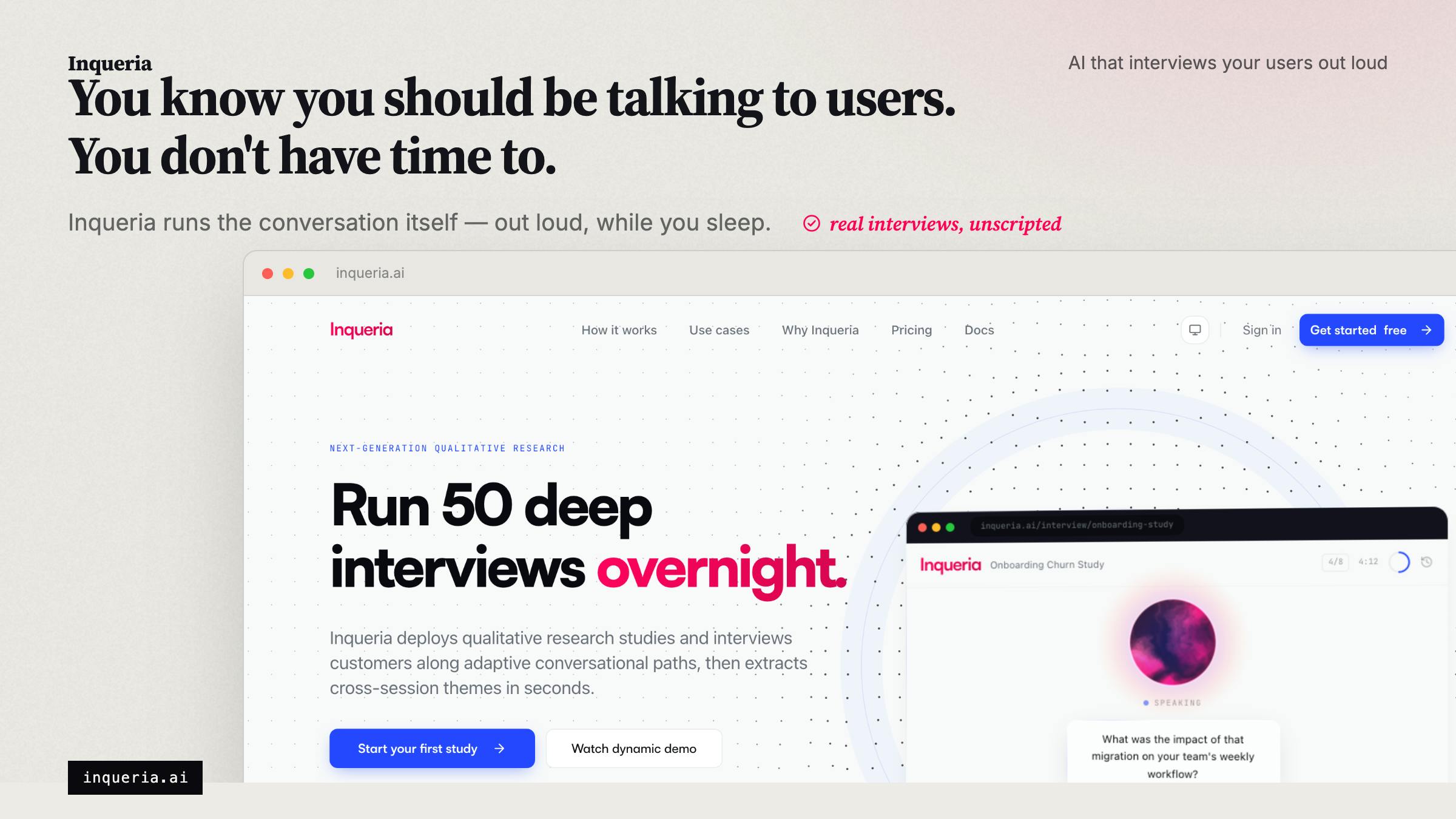
User research has long faced an uncomfortable reality: truly valuable in-depth interviews are expensive and time-consuming. A single round of qualitative interviews with just five participants — from scheduling and recruitment to execution — can easily consume an entire month. Inqueria, which recently debuted on Product Hunt, aims to redesign this workflow using an AI moderator. It bills itself as interviewing users "like a trained researcher" and promises to complete 50 interviews overnight.
Adaptive Interviewing: More Than Just a Smarter Survey
What sets Inqueria apart from traditional surveys or simple AI chatbots is its "adaptive" capability. The product description emphasizes that it dynamically adjusts follow-up questions based on each respondent's answers, simulating the real-time probing, clarification, and deep-diving that a skilled researcher does in the field.
This cuts to the heart of qualitative research: a good interview isn't about reading from a script — it's about knowing when to dig deeper when a participant reveals something interesting. Static surveys simply can't do this, and that's exactly the gap Inqueria aims to fill with large language model (LLM) conversational capabilities. For teams that want to collect user insights at scale without sacrificing conversational depth, this positioning is remarkably precise.
The core methodological difference between in-depth interviews (IDIs) in qualitative research and quantitative surveys comes down to meaning-making versus variable measurement. Experienced interviewers rely on "Probing Techniques" in the field — including silent probes (letting respondents fill the silence), elaboration probes ("Could you be more specific?"), and reflection probes (repeating a respondent's key words to prompt elaboration). LLMs are technically capable of generating follow-up questions based on prior context, but their probing logic derives from statistical patterns in training data — not from reading the current respondent's emotional state or non-verbal cues. As a result, AI moderators still fall short of human researchers in highly emotional, culturally nuanced, or sensitive interview scenarios.
Privacy-First: PII Redacted Before the Model Sees a Word
In any AI product that processes user conversations, privacy is an unavoidable concern. Inqueria's approach is worth noting: it claims to complete PII (Personally Identifiable Information) redaction within its own system before any model ever touches the transcript.
This means respondents' names, contact details, and other sensitive data are never directly exposed to the underlying LLM. For enterprise users operating under compliance requirements, this "privacy-first" architectural design is a genuine procurement factor — not marketing copy. It places the responsibility for data governance at the very front of the model pipeline, reducing the risk surface for sensitive information exposure.
PII (Personally Identifiable Information) is a foundational concept in privacy compliance, typically covering names, phone numbers, email addresses, physical addresses, ID numbers, and other data that can directly or indirectly identify a specific individual. When enterprises evaluate AI tools, regulations like GDPR and CCPA require data processors to demonstrate accountability for how user data flows through their systems. Inqueria's claimed "pre-model redaction" architecture corresponds to a well-established Data Minimization principle — passing only the minimum information necessary to downstream systems. Technically, this is typically implemented via regex matching, NER (Named Entity Recognition), or dedicated redaction libraries that replace sensitive fields with placeholders before text enters the LLM inference pipeline. For regulated industries like healthcare, finance, and HR, this architecture is a threshold requirement for compliant deployment — not an optional add-on.
Theme Extraction with Traceable Source Quotes
Completing the interviews is just the first step. The real research value lies in distilling conclusions from large volumes of conversation. Inqueria converts each interview into "themes," each accompanied by the exact source quotes that support it.
Going further, it cross-validates each theme against all transcripts and proactively surfaces respondents who hold dissenting views. This feature reflects genuine research methodology awareness — it directly combats the most common bias in qualitative analysis: confirmation bias, where researchers tend to see only the evidence that supports their existing hypotheses. By explicitly surfacing opposing voices, Inqueria returns the judgment of "does this conclusion hold up?" back to the user. The product tagline "Interviews that Hold Up" is a direct nod to this design.
Confirmation Bias is one of the most well-documented biases in cognitive psychology — the tendency to seek out, interpret, and remember information that aligns with one's existing beliefs while ignoring or discounting contradictory evidence. In qualitative research, this bias is especially pronounced: when manually coding interview content, researchers often unconsciously give more weight to voices that support product hypotheses. Traditional countermeasures include multi-coder independent analysis (inter-rater reliability), Negative Case Analysis, and Member Checking. Inqueria's algorithmic approach to surfacing dissenting respondents partially automates Negative Case Analysis — but the underlying theme clustering algorithm may itself introduce new biases, such as undersampling minority viewpoints or over-relying on semantic similarity. Users should remain clear-eyed about the algorithm's limitations.
Repricing the Cost of Scale and Efficiency
Inqueria's value proposition is straightforward: 50 interviews overnight, not five interviews over a month. This is fundamentally a repricing of the user research cost structure.
The bottleneck in traditional interviewing has never been the act of asking questions itself — it's the long chain of recruitment, scheduling, execution, transcription, and coding. When AI takes over interview moderation and preliminary analysis, sample sizes can scale from single digits to dozens or even hundreds, bringing qualitative insights statistically closer to generalizable conclusions. Of course, whether an AI moderator can truly replicate the in-the-moment judgment of a seasoned researcher remains the core question these products need to prove with real-world results.
The Reality of an Early-Stage Product
By Product Hunt's metrics, Inqueria is clearly early-stage — 12 upvotes, 3 comments, ranked 14th on its launch day, built by Samrendra Singh, and categorized under UX and Artificial Intelligence. These numbers suggest it hasn't yet built significant market traction, and product maturity and real-world usage feedback remain to be validated.
For user researchers, product managers, and UX teams, the direction Inqueria represents — AI-moderated interviews + privacy redaction + traceable thematic analysis — genuinely addresses industry pain points. Whether it can truly replace or meaningfully supplement human interviews depends on the quality of its adaptive follow-up questions and the reliability of its theme extraction. This type of tool is worth watching, but before deploying it in high-stakes decision-making contexts, it's worth running a small-scale validation to check how closely its outputs align with human-conducted research.
Related articles

JobRunner MCP Server: AI Agents Can Now Fix Failed Java Jobs
JobRunner launches an open-source MCP server enabling AI agents to view cluster status, diagnose failures, and recover Java jobs—incident response from any cloud coding environment or existing agent.

MLAI Digital Launches 9 Security Agents: MCP Server Safeguards the Full Lifecycle of Agentic AI
MLAI Digital launches Security MCP Server with nine built-in specialized security agents covering vulnerability discovery, attack simulation, prompt injection detection, API and infrastructure assessment, and accelerated remediation—embedding security validation across the full Agentic AI lifecycle from development to production.

Running Isaac Lab on H100 GPUs: Exploring Better Approaches
Exploring optimization methods for running Isaac Lab on NVIDIA H100 GPUs, including MIG configuration, mixed precision, TensorRT acceleration, and community experience to improve robotics simulation and reinforcement learning efficiency.