Inside Agent Team Hiring: New Opportunities in AI Agent Development

An internal Agent team hiring tweet reflects AI agents moving from experimentation to production and rising talent demand.
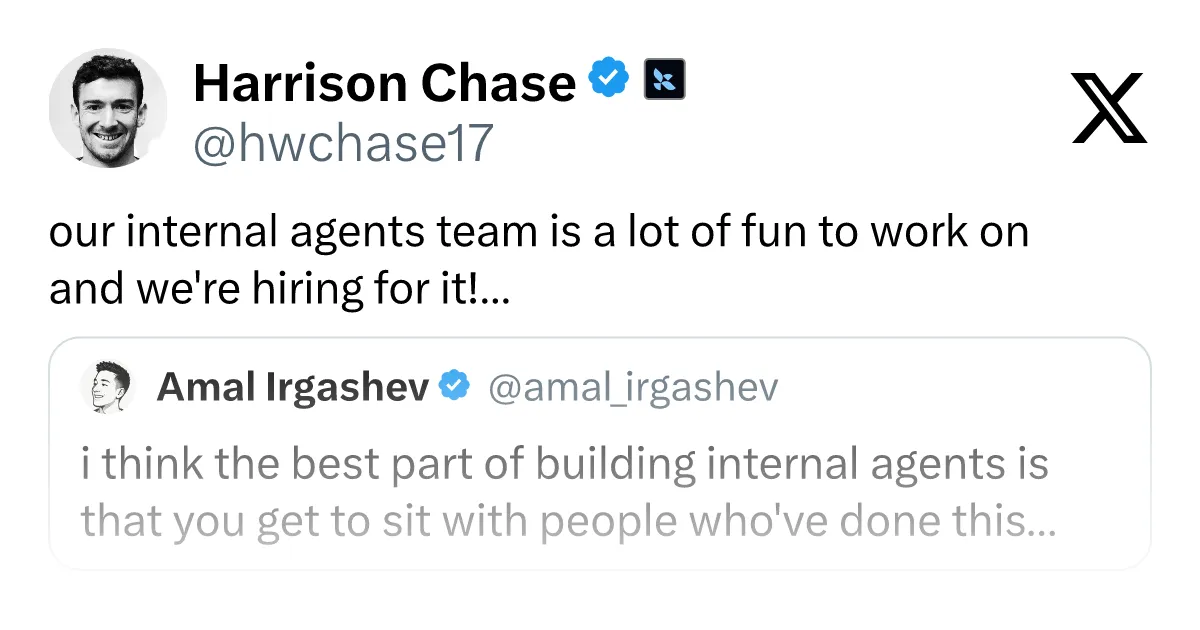
The article uses a Twitter hiring post from an internal Agent team as a starting point, noting the team emphasized fun work and is recruiting. It analyzes that internal Agent teams build and optimize AI agent systems that autonomously execute tasks, make decisions, and interact with their environment; as large models improve, Agents have huge potential in automation, customer service, and data analysis. The emphasis on "fun" suggests a culture of innovation and collaboration, and the post hints at technical directions such as Agent architecture design, system integration, and optimizing autonomy and accuracy—signaling more jobs and fiercer competition in the AI talent market.
In today's fast-iterating AI landscape, internal Agent (intelligent agent) teams are becoming the core force driving enterprise automation and intelligence. Recently, a hiring post from Twitter drew attention: a team publicly stated that working on its internal Agent team is full of fun and is recruiting related talent. Although brief, the post reflects the vigorous growth of the AI agent field and the rising demand for talent.
Why Are Internal Agent Teams Drawing So Much Attention?
Internal Agent teams are typically responsible for building and optimizing AI agent systems that can autonomously execute tasks, make decisions, and interact with their environment. As large model capabilities improve, Agent technology shows enormous potential in scenarios such as process automation, customer service, and data analysis. The hiring post's emphasis on "work full of fun" suggests a team culture that likely values innovation, collaboration, and technical exploration—attractive to engineers seeking technical challenges.
From an industry trend perspective, AI agents are moving from experimentation to production environments. Enterprises increasingly rely on agents to handle repetitive work, enhance decision support, and even create new interaction paradigms. As a result, the role of internal Agent teams is becoming more critical: they need not only technical expertise but also a deep understanding of business scenarios.
AI Agent (intelligent agent) refers to a software system that uses a large language model as its reasoning core and is capable of perceiving its environment, planning autonomously, and invoking tools to execute multi-step tasks. Unlike traditional chatbots that only handle single-turn Q&A, Agents typically possess capabilities such as memory, task decomposition, tool invocation (e.g., search, code execution, API access), and self-reflection, enabling them to complete end-to-end processes with minimal human intervention. Common architectures include ReAct (alternating reasoning and action), Plan-and-Execute (plan first, then execute), and multi-agent collaboration patterns. Their capability ceiling depends both on the underlying model's reasoning and instruction-following level and on tool interface design and error-handling mechanisms, so engineering-side system design is often as important as model selection.
Technical Signals Behind the Hiring Post
Although the tweet did not disclose specific positions or requirements, the phrase "internal Agent team" points to several key directions: first, Agent architecture design, including multi-agent collaboration, task planning, and execution; second, integration with existing systems to ensure Agents operate safely and reliably; third, continuous optimization of agent autonomy and accuracy. These challenges require candidates to have solid programming skills, an understanding of AI models, and system design experience.
In addition, the link in the hiring post may point to job details, but the original material did not provide more content. It is reasonable to infer that the team may be involved in cutting-edge Agent research and applications, offering technical talent the opportunity to participate in building systems from 0 to 1.
Multi-Agent collaboration refers to a system composed of multiple Agents, each with its own role, that accomplish tasks together through division of labor, message passing, and result aggregation—for example, one responsible for planning, one for retrieval, and one for validation. Compared with a single agent, it can reduce the pressure on a single context window and improve task parallelism and auditability, but it also introduces new difficulties: communication protocols and state synchronization between agents, task allocation and conflict resolution, increased overall latency and invocation costs, and difficulty pinpointing responsibility when errors occur. Therefore, production-grade multi-agent systems usually require accompanying orchestration frameworks, log tracing, and evaluation benchmarks—which is also the core manifestation of an internal Agent team's engineering capability.
Task Planning is the Agent's ability to break down user goals into executable sub-steps and advance them step by step. Common approaches include chain-of-thought-style decomposition, tree search, and using external planners to generate structured steps. Its difficulties lie in the need to dynamically revise plans based on execution feedback, to have retry and fallback strategies when tool calls fail or return anomalies, and to control the number of steps to avoid runaway costs and latency. The accompanying evaluation is equally critical—reproducible task sets are needed to measure success rate, step count, and human takeover rate; otherwise, improvements in autonomy cannot be verified or iterated.
Implications for the AI Talent Market
This hiring post is a microcosm of the growing demand for AI talent. As Agent technology matures, related positions will increase and competition will intensify. For job seekers, paying attention to opportunities in internal Agent teams means entering the frontier of AI applications; for enterprises, building efficient Agent teams requires attracting talent with both algorithmic and engineering capabilities and fostering a culture that encourages experimentation.
In short, hiring dynamics in internal Agent teams are worth the attention of technical professionals—they may signal the direction of the next wave of AI adoption.
One-line Summary
A hiring tweet from an internal Agent team reflects AI agents moving from experimentation to production and the rising demand for talent.
Paragraph Summary
The article takes a hiring post from Twitter about an internal Agent team as its starting point, noting that the team publicly emphasized that the work is full of fun and that it is hiring. Although brief, the post reflects the vigorous growth of the AI agent field and the demand for talent. The author analyzes that internal Agent teams are responsible for building and optimizing AI agent systems that can autonomously execute tasks, make decisions, and interact with their environment. As large model capabilities improve, Agents have enormous potential in process automation, customer service, data analysis, and other scenarios; the emphasis on "fun" also suggests a culture that values innovation, collaboration, and technical exploration. The article further reads from the hiring language several technical directions—Agent architecture design, integration with existing systems, and continuous optimization of autonomy and accuracy—and points out that for the AI talent market this means more related positions and fiercer competition, which technical professionals should watch.
Related articles

Fifty Years Studying Power: Robert Caro's Writing and Insights on Power
Robert Caro reflects on 50 years studying power: Lyndon Johnson's persuasion and leverage, Robert Moses's transformation from idealist to ruthless builder, the dilemmas of large-scale construction, and his methods of compressing themes and solitary focus in biography writing.

Can a $20,000 Robot Do Your Chores? The Test Results Are Surprising
A YouTube test video shows how a $20,000 robot responds to commands like washing dishes, turning off lights, taking out trash, and feeding the dog. This article analyzes its real capability boundaries, the state of voice interaction technology, and how far household robots are from mainstream adoption.
The Complete Guide to Running AI Models Locally: Inference Engines and Tool Stack Explained
A systematic breakdown of the complete local LLM tool stack: from PyTorch and GGML compute libraries to llama.cpp, vLLM, SGLang inference engines and Ollama, LM Studio wrapper layers, with benchmark data on performance differences and selection logic.