Inside Google's Global Data Center Network: The Computational Backbone of the AI Era

How Google's global data center network became the central battleground for AI-era computing power.
This article examines Google's global data center footprint as an entry point into the strategic importance of physical infrastructure in the AI era. Data center geography balances service latency, disaster recovery, and data compliance, while generative AI training's exponential compute demands have made power supply, thermal cooling, and high-speed networking new dimensions of technical competition. Energy consumption and sustainability represent long-term industry challenges: tech giants like Google are pledging renewable energy use while leveraging AI itself to optimize data center operations — yet their demands on local power grids, water, and land continue to draw scrutiny from communities and regulators. For end users and developers alike, this vast infrastructure network directly determines service responsiveness, availability, and the soundness of cloud architecture decisions.
The Computing Race Behind the Global Data Center Map
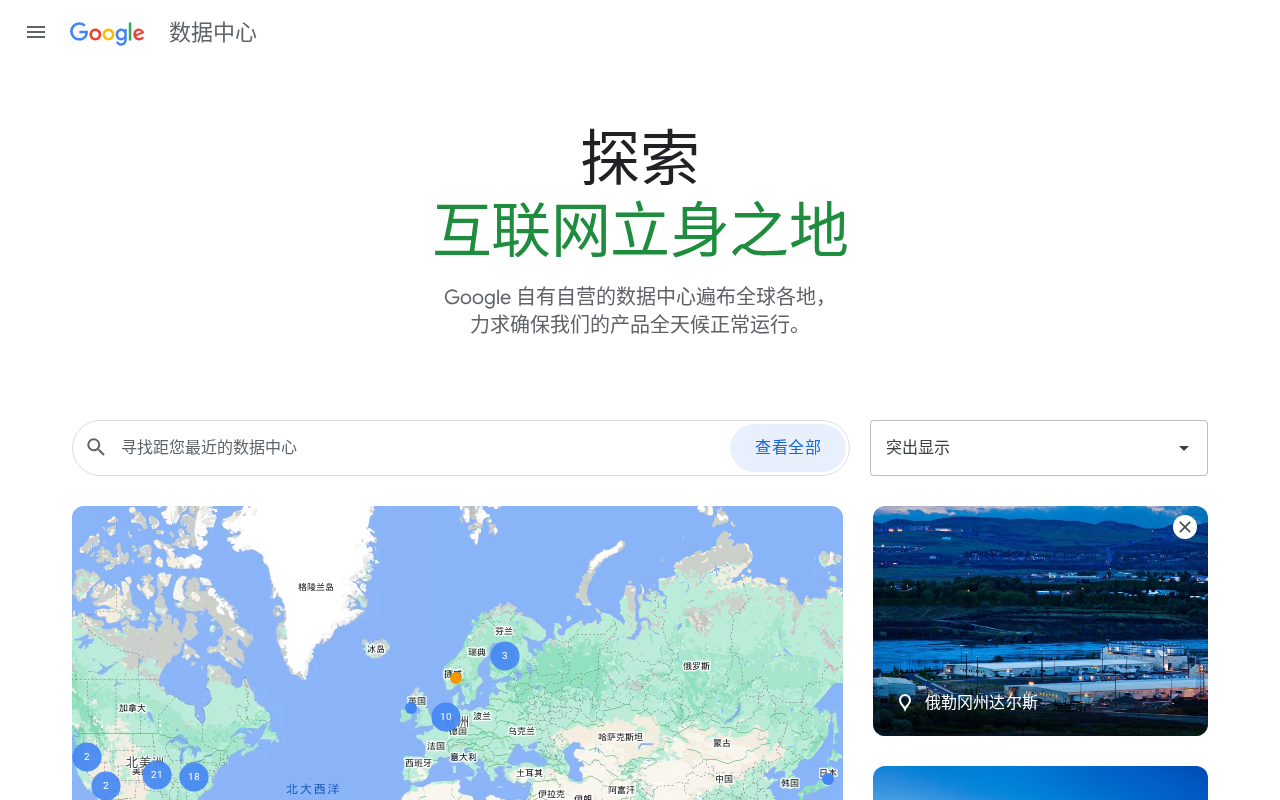
Google's worldwide network of data centers has become the physical skeleton supporting its search, cloud, and artificial intelligence businesses. As AI model training drives exponential growth in compute demand, the geographic distribution, scale, and energy efficiency of data centers have moved from behind-the-scenes infrastructure concerns to a core competitive battleground for tech giants.
This piece draws on a Hacker News community discussion focused on Google's global data center footprint. While the original source is fairly sparse, it touches on a topic worth exploring in depth: in the age of generative AI, how does the physical infrastructure of major tech companies actually underpin the digital services we use every day?
Why Data Centers Have Become Critical to the AI Race
Training a large language model requires tens of thousands of accelerator chips working in concert, running continuously for weeks or even months. This means data centers must not only provide massive amounts of compute, but also solve the accompanying engineering challenges of power supply, thermal cooling, and network bandwidth.
Google distributes its data centers across multiple regions — North America, Europe, Asia, and South America — both to reduce service latency and serve users locally, and to address disaster recovery redundancy and regulatory compliance. Different countries and regions have their own legal requirements around data storage and privacy protection, and localized data centers help companies meet data sovereignty regulations.
From a technical standpoint, a distributed data center network can also shift computational workloads across time zones, taking advantage of electricity price fluctuations and periods of renewable energy availability — optimizing overall operating costs and carbon footprint in the process.
One of the core metrics for measuring data center efficiency is PUE (Power Usage Effectiveness) — the ratio of a data center's total energy consumption to the actual energy consumed by IT equipment. A perfect score is 1.0, meaning all power goes to computing with zero overhead; the industry average typically hovers around 1.5, while some of Google's facilities have pushed PUE below 1.1. AI training clusters also rely heavily on high-speed interconnect networks (such as Google's proprietary Jupiter network architecture) to link thousands of GPUs and TPUs into a unified compute pool. Network bandwidth and latency directly determine the efficiency ceiling for distributed training — which is why a data center is far more than a "warehouse of machines." Its internal network topology design is itself a core competitive advantage.
The Dual Challenge of Energy Consumption and Sustainability
As AI training scales up, the energy consumption of data centers has become an increasingly pressing issue. Companies like Google have made public commitments to renewable energy and have worked to improve performance-per-watt through advanced cooling technologies and custom-designed chips.
Google previously deployed machine learning systems to optimize its data center cooling strategies, reportedly achieving significant reductions in cooling energy consumption. This reflects a broader trend: AI is not just what data centers serve — it is also becoming a tool for optimizing how data centers operate.
However, community discussions also remind us that data centers' demands on local power grids, water resources, and land are drawing increasing scrutiny. In some locations, residents and regulators have raised concerns about the environmental impact of large-scale data centers. Striking a balance between expanding compute capacity and sustainable development is a long-term challenge the entire industry must confront.
The cooling approach a data center uses directly affects its energy consumption, with mainstream solutions evolving from traditional air cooling toward more efficient liquid cooling technologies. Liquid cooling comes in two main forms: cold plate (routing coolant lines directly against chips) and immersion cooling (submerging entire servers in dielectric fluid). The latter can theoretically reduce heat dissipation energy consumption by over 90%, though retrofit costs are extremely high. Google has also adopted free cooling strategies at some facilities — drawing in outside air when ambient temperatures are low enough to reduce mechanical refrigeration usage. Notably, AI accelerators (GPUs, TPUs) have power densities far exceeding those of traditional servers, with single-rack power consumption reaching 30–100 kW. This places demands on cooling infrastructure that far surpass anything in the past, and it is one of the primary drivers behind current data center siting decisions and infrastructure upgrades.
What This Means for Everyday Users and Developers
For end users, Google's dense global data center footprint translates to faster service response times and higher availability. Whether you're running a search query, streaming video, or using cloud-based AI inference, that experience is underpinned by this vast network.
For developers and enterprise customers, the geographic location of data centers has direct implications for cloud service latency, compliance, and cost structure. When choosing cloud service regions, understanding the distribution of the underlying infrastructure helps inform more sound architectural decisions.
The concepts of Availability Zones and Regions in cloud services derive directly from the physical layout of data centers. A "region" typically contains multiple geographically isolated "availability zones" (i.e., independent data center facilities) connected to one another via low-latency dedicated links. Deploying applications across multiple availability zones allows developers to implement automatic failover when a single data center experiences an outage, meeting high-availability requirements (SLAs of 99.99% and above). For latency-sensitive applications — such as real-time voice, online gaming, or financial transactions — choosing the region closest to your target users can compress round-trip latency from hundreds of milliseconds down to single-digit milliseconds. That difference is often decisive in terms of user experience.
Conclusion
Data centers are the invisible foundation of the digital world. Google's global footprint reflects the fierce competition among tech giants for physical compute capacity in the AI era, and raises a host of questions around energy, environment, and regulation. As AI applications become ever more widespread, these colossal structures operating quietly in the background deserve far more of our attention.
Note: This article is based on materials from a Hacker News community discussion. The original source is limited in detail; some analysis reflects broader industry context and extended interpretation.
Related articles

Felix Rieseberg Personal Homepage
Felix Rieseberg's personal homepage sparks attention on Hacker News. This article covers the Slack engineer's technical background, the rise and fall of nativefier, and the value of a developer homepage as a tech calling card.

@ai-sdk/vue 3.0.306 Patch Release Syncs with [email protected] Update
@ai-sdk/vue 3.0.306 released, synced with [email protected]. A routine patch release for the Vercel AI SDK ecosystem with no public API changes; the Vue adapter layer stays version-aligned with the core package.

Gemini 4 Argon API Launches: The Era of Million-Token Output Begins
Google launches Gemini 4 Argon with sparse MoE architecture, up to 1M output tokens, and a 68.90% Vals Index score, available across API, AI Studio, and the Gemini app.