Inside OpenAI's Software Factory: AI Agents Across the Entire Development Pipeline

OpenAI's Software Factory embeds AI Agents from code generation to production, forming a self-improving development loop.
OpenAI has built an AI-driven development system called the Software Factory, embedding AI Agents at every stage — from requirements and code generation (Codex) through CI, multi-agent code review, risk-based auto-merging, production deployment, and incident monitoring — forming a closed loop where production issues feed back into Codex as new tasks. Key innovations include specialized agents for data, infrastructure, cloud, and security reviewing PRs in parallel, a risk classification system that auto-merges safe changes while flagging risky ones for human review, and a Severity Bot that investigates incidents and recommends rollbacks. A technical blogger demonstrated these concepts through three live demos, concluding that risk-based auto-merging and automated on-call bots are the most immediately actionable practices for everyday developers.
Software development is being reshaped by AI Agents. An article from The Pragmatic Engineer reveals how OpenAI has built what it calls a "Software Factory" — embedding AI agents into every stage of the development lifecycle, from coding and testing to code review, deployment, and production monitoring. This isn't just an OpenAI experiment; it represents the direction software engineering is heading, and the world's top companies are already leading the charge.
This article is based on a technical blogger's breakdown and live demonstrations of that piece. It outlines the core architecture of OpenAI's Software Factory and explores how these ideas can be applied to individual and team workflows.
What Is OpenAI's Software Factory?
At a high level, OpenAI's Software Factory isn't fundamentally different from most teams' existing development processes — but it makes intelligent upgrades at key checkpoints.
The process begins with a "Builder" — notably not called an "engineer," because the person submitting tasks could be an engineer, a product manager, or anyone else on the team. The builder sends requirements to Codex to generate code. This feeds into a continuous integration (CI) system for building and testing. The agent iterates through this loop multiple times until it produces a shippable code change.
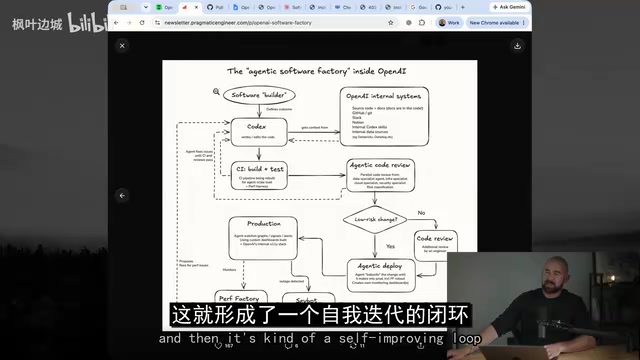
The real cleverness isn't in the code writing itself — it's that AI Agents are embedded across the entire pipeline from requirements to production, forming a self-improving feedback loop: bugs, incidents, and performance regressions in production are fed back into Codex as new tickets, re-entering the pipeline.
Codex is OpenAI's code generation model capable of automatically generating, completing, and modifying code based on natural language descriptions or existing code context. Built on a large language model (LLM), it supports dozens of programming languages. Within the Software Factory architecture, Codex isn't just a "code completion tool" — it's the core execution engine of the entire pipeline. After a builder submits requirements, Codex generates the initial code, then iterates based on CI feedback until it produces a mergeable change. This is fundamentally different from traditional one-shot generation: Codex here is a continuously active, autonomous unit that responds to test failures and production incidents, not a plugin that assists humans in writing code.
Continuous Integration (CI) is a software engineering practice where developers frequently merge code into the main branch, with each merge triggering automated builds and tests to surface problems early. In the Software Factory, the CI system acts as the "referee" for the agent's iteration loop — only changes that pass all CI checks (compilation, unit tests, integration tests, etc.) are eligible to proceed to the next stage. This is why, even in the demo, PRs classified as low-risk still require CI to go green before being auto-merged.
Multi-Agent Code Review
Using AI for code review is no longer novel, but OpenAI's approach is worth paying attention to — rather than deploying a single "review agent," they use multiple agents, each specialized in a different domain.
These include: a data expert, an infrastructure expert, a cloud services expert, and a security expert. Review tasks are broken down across multiple dimensions, with different agents each responsible for examining their area of the code change. This division of labor makes reviews more targeted and more closely mirrors how different roles collaborate to gatekeep quality in a real team.
As the volume of AI-generated code grows dramatically, the biggest pain point for human developers is the mountain of Pull Requests (PRs) that are simply impossible to review in time. OpenAI's multi-agent review is designed precisely for this high-throughput scenario.
Risk Classification: Letting Agents Auto-Merge Low-Risk Changes
The most interesting design element in the entire system is risk classification.
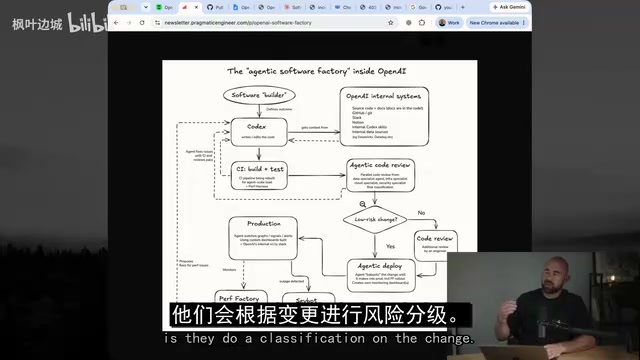
The system first determines whether a change is low-risk or high-risk, then decides whether to allow the agent to auto-merge and auto-deploy. Many people instinctively resist the idea of merging code without human review — but as the blogger points out, forcing a full human review cycle for something like a documentation fix or a minor bug patch is unnecessary overhead.
Risk is relative. Whether a change is "low-risk" or "high-risk" depends entirely on your business context:
- If you're an indie developer making changes to your own project on GitHub, the real-world risk of merging the wrong PR is quite low.
- If you're Amazon building cloud services, a single change could take down an entire region for thousands of users — a completely different risk profile.
The classic example of a high-risk change is anything that touches infrastructure or databases — these changes can have severe consequences if they go wrong and should always require human review.
Production Monitoring: Severity Bot and Automated On-Call
Another highlight of the Software Factory is the "Severity Bot" — an AI Agent that continuously monitors the production environment. It can detect errors, automatically investigate incidents, determine how to respond, and take action to help on-call engineers resolve outages.
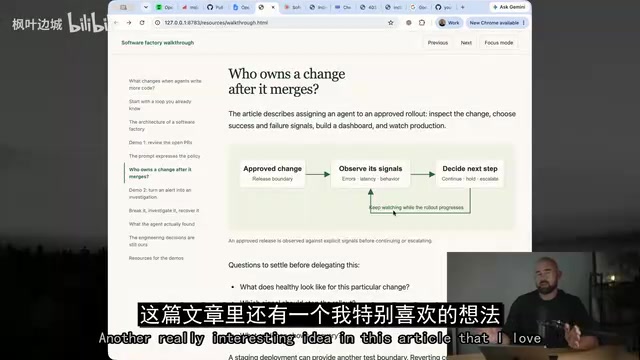
The blogger is especially excited about this, having spent years in cloud operations and knowing firsthand that on-call engineers can receive hundreds or even thousands of alerts per day. AI Agents have a natural advantage in incident investigation: they can rapidly scan logs and metrics, perform correlation analysis across multiple data sources, and handle work that humans struggle to do effectively under the pressure of an active incident.
OpenAI also has a "Performance Factory" that runs performance tests in production, feeding any regressions or errors back to Codex. This again reinforces the closed-loop nature of the entire factory — code is continuously pushed to production, AI Agents intervene at every step, and problems are fed back into the pipeline, forming a self-improving cycle.
On-call refers to the practice of engineers taking turns being responsible for responding to production incidents, typically requiring acknowledgment within a set timeframe (e.g., 15 minutes), around the clock including nights and holidays. On-call engineers must quickly diagnose root causes and decide on remediation under intense pressure. In large systems, alert noise (false positives or low-priority alerts) is another serious problem, as it can bury genuinely critical incidents in a flood of notifications — a phenomenon known as "alert fatigue."
SRE (Site Reliability Engineering) is an engineering discipline pioneered and popularized by Google, centered on applying software engineering methods to operations problems and quantifying system reliability through SLOs (Service Level Objectives). The "SRE-style Agent" in Demo 2 draws on the SRE philosophy — automating high-repetition work like log querying, metric correlation, and incident severity assessment, freeing engineers from mechanical troubleshooting to focus on decisions that genuinely require human judgment.
Three Reusable Live Demos
The blogger used three live demonstrations to show how these ideas can be applied to individual workflows.
Demo 1: Automated PR Review and Merging
The first demo uses a Codex automation script that iterates through all open PRs, calls a classifier to determine risk level and apply labels, then has the agent automatically merge low-risk changes that have passing tests, while leaving high-risk changes to await human approval.
In the demo, some seemingly simple changes are classified as low-risk but are not merged because CI checks are failing — if CI were green, they would be auto-merged.
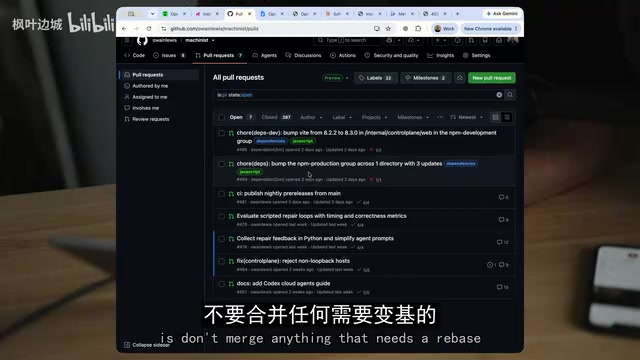
One practical rule of thumb: never auto-merge any change that requires a rebase or update, because these operations may alter actual code and carry higher risk. The blogger recommends only auto-merging changes that are genuinely safe.
Demo 2: Automated On-Call Alert Bot
The second demo builds an SRE-style agent for monitoring production systems. The architecture runs on Google Cloud: alerts are pushed into a Pub/Sub queue, and an agent built with ADK (Agent Development Kit) reviews the issue, examines logs, metrics, and version revisions, assesses what happened, and stores the analysis for human review.
In the demo, the system returns 500 errors, and the agent correctly triages the incident, recommending "restoring traffic to the previously healthy version" — i.e., a rollback — which is exactly the right course of action. On-call engineers can also follow up with the agent to ask how to execute the rollback.
Pub/Sub (Publish-Subscribe pattern) is a messaging architecture where producers (Publishers) publish messages to a topic, and consumers (Subscribers) receive messages asynchronously after subscribing to that topic — the two sides are decoupled and unaware of each other. Google Cloud Pub/Sub is a managed implementation of this pattern. In the demo's architecture, production alerts are pushed into a Pub/Sub queue, fully decoupling alert generation from agent processing — even if the agent processes slowly, alerts are never lost, and multiple agents can consume different types of alerts in parallel. ADK (Agent Development Kit) is a Google-developed framework for building AI Agents, providing foundational capabilities like tool calling, memory management, and multi-step reasoning, enabling developers to implement complex automation logic without building agent infrastructure from scratch.
Demo 3: AI Agent-Assisted Production Deployment
The third concept involves using an AI Agent in production deployments. The blogger admits that a year ago this would have seemed reckless, but today he finds it entirely reasonable: use deterministic code to execute releases while letting the agent monitor the production environment in ways humans simply cannot match — the agent can build its own dashboards, monitor metrics, logs, and telemetry, and immediately roll back changes the moment it detects an error.
Which Ideas Should You Adopt Right Now?
The concept the blogger most wants to recommend to everyday developers is the risk classification mechanism. The setup cost is relatively low, yet the payoff is significant: if you're using agents to generate large volumes of small, easily reviewable PRs each day, auto-merging can dramatically improve development throughput and cycle time.
He's quick to note that this is highly context-dependent: if you're working on a high-risk, operations-intensive system, you should retain more human review; if it's a side project or simple tasks, having agents merge directly is more realistic at this stage.
The other strong recommendation is a production monitoring agent. In high-throughput, high-ops-pressure environments, an automated on-call agent that can help you diagnose problems is enormously valuable. These systems used to be very difficult to get right, but OpenAI's approach provides a workable template: the agent investigates incidents, makes remediation recommendations, and can answer follow-up questions — dramatically accelerating incident response times.
Software engineering is moving toward a new paradigm where AI Agents participate in every stage of the process, and OpenAI's Software Factory offers a clear roadmap for getting there.
Related articles

Chain of Thought Isn't Just for AI: How Humans Can Use CoT to Improve Thinking Quality
Chain of Thought isn't just a prompt trick for large models. Starting from a Hacker News discussion, this article analyzes why CoT works for human thinking too, breaks down actionable ways to transfer it, and highlights the key differences between human CoT and machine CoT.
Cloudflare Teams Up with OpenAI: Closi…
Cloudflare Teams Up with OpenAI: Closing the Loop from Vulnerability Discovery to Defense with AI
Cloudflare uses OpenAI Daybreak to investigate security vulnerabilities and generate reviewable remediation plans, while developers use Codex to boost coding efficiency and quality.

Orca Multi-Agent Orchestration in Practice: A Guide to Parallel Collaboration with Claude and Codex
Orca is Stable AI's free open-source agent workbench supporting 34 agents like Claude Code and Codex in parallel. Learn its Git worktree isolation, multi-model orchestration, and mobile management.