Instagram AI Label Strikes Again: The Deep-Rooted Causes Behind Mislabeling Real Photos as AI-Generated

Instagram's AI labels are mislabeling real photos, exposing deep flaws in detection technology
Instagram's AI content detection system is experiencing widespread failures, incorrectly labeling genuine photographs as AI-generated. The issue stems from over-reliance on metadata and inability to distinguish AI-assisted editing from fully synthetic content. As modern editing tools integrate AI features, creators face reputational damage and potential algorithmic penalties from false labels.
Instagram AI Labeling Crisis: An Out-of-Control Mislabeling Fiasco
Instagram's AI content labeling was supposed to be a beneficial feature—helping users quickly identify content synthesized by generative AI, providing a layer of protection in an era where distinguishing real from fake information has become increasingly difficult.
Generative AI refers to artificial intelligence systems capable of creating new content, including text generation models (like the GPT series), image generation models (like Midjourney, DALL-E, Stable Diffusion), and video generation models. These technologies learn from massive datasets to generate realistic images, text, and even video content. Since 2022, generative AI tools have experienced explosive growth in capability, with generated content reaching levels of realism that are nearly indistinguishable to the naked eye. This has led to increasingly serious issues like misinformation spread, deepfakes, and copyright disputes, prompting major platforms to explore AI content labeling mechanisms in an attempt to find balance between technological progress and information authenticity.
However, over the past few weeks, this AI detection system appears to have descended into chaos. According to user feedback, Meta's system has been automatically applying "AI Content" labels to numerous images that were neither created nor edited by generative AI. In other words, genuinely photographed pictures, conventionally edited images, and even some works created entirely by humans are being incorrectly marked as "AI-generated."
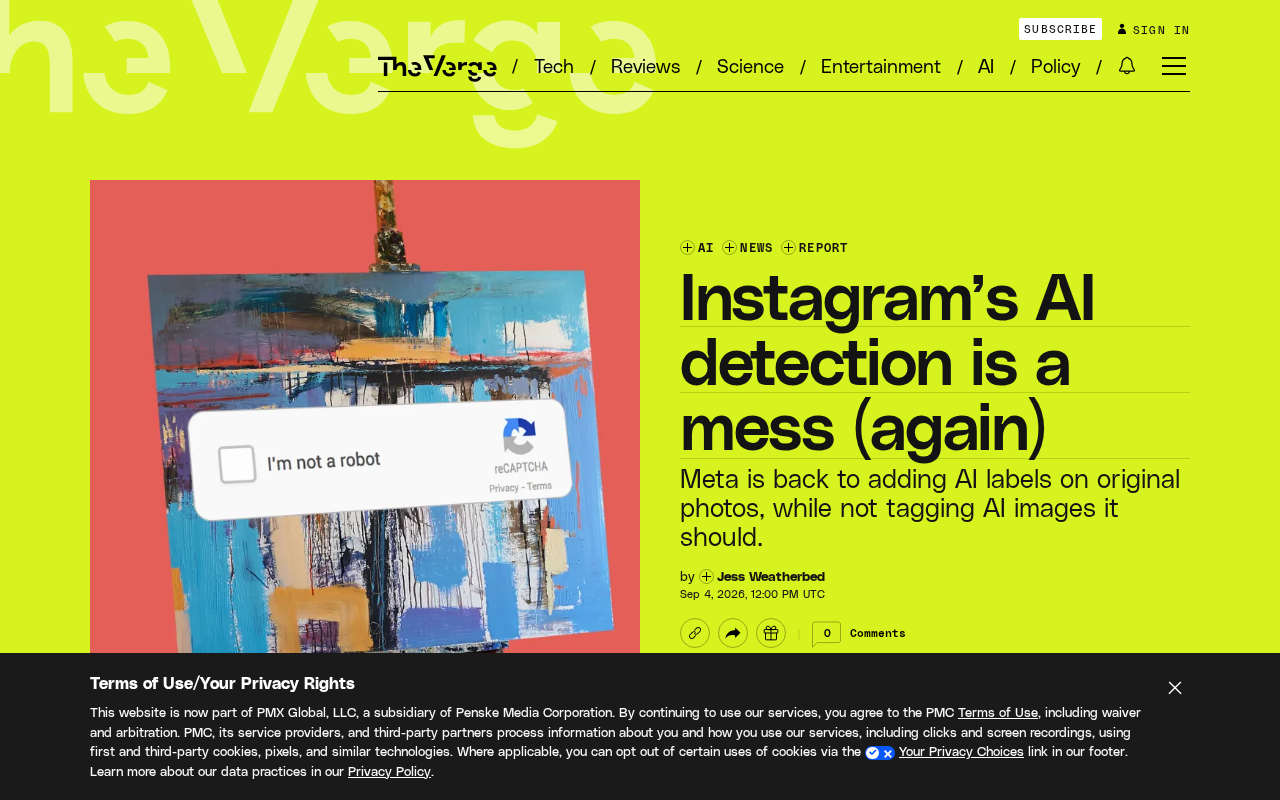
This isn't Instagram's first misstep with AI detection. Meta has previously faced user backlash over AI label misjudgments, and now history is repeating itself—the recurring nature of the problem is deeply concerning.
Why Do AI Label Errors Occur So Frequently?
The Detection Trap of Metadata Dependence
Instagram's AI detection mechanism relies heavily on metadata embedded in image files and industry standards like C2PA content credentials.
Metadata is descriptive information embedded in digital files, including shooting device, time, location, editing software, and modification records. For image files, common metadata formats include EXIF, IPTC, and XMP. C2PA (Coalition for Content Provenance and Authenticity) is an industry alliance established in 2021 by Adobe, Microsoft, BBC, and other organizations, aiming to create unified content provenance standards. The C2PA standard embeds encrypted "Content Credentials" in content, recording the complete history chain from creation to editing, theoretically enabling tracing of every modification. However, this standard is still in the adoption phase, with variations in implementation across software vendors, and metadata itself can be deleted or forged, creating inherent limitations for metadata-based detection.
When an image is processed through certain editing software, even if only using ordinary cropping, color adjustment, or retouching tools, these applications may write markers containing "AI" references or generative feature tags into the file. The problem is that Meta's system often cannot distinguish between "part of the image used AI-assisted tools" and "the entire image was generated from scratch by AI"—two fundamentally different situations. As long as related markers are detected, the system applies a blanket "AI Content" label, leading to widespread false positives.
The "Collective Punishment Effect" of Mainstream Editing Tools
Today, from Adobe Photoshop to various mobile editing apps, virtually all integrate AI-based features like intelligent background removal, content-aware fill, and AI noise reduction.
Modern image editing software has widely integrated AI features that dramatically improve editing efficiency but also blur the line between "human creation" and "AI generation." Adobe Photoshop's "Generative Fill" can intelligently fill blank areas after removing objects; "Content-Aware Fill" can automatically remove unwanted elements; AI noise reduction and super-resolution technology can significantly enhance image quality. Mobile editing apps like Snapseed and Lightroom Mobile have also introduced AI sky replacement, portrait enhancement, intelligent cutout, and other features. These tools often require just one click to operate, and users may unconsciously use AI-assisted functions. More critically, when these editing programs process images, they write related markers into the metadata, and platform detection systems often cannot distinguish between "using AI tools for local repairs" and "completely generating an image from scratch with AI"—two fundamentally different scenarios.
Photographers can hardly avoid touching these features during normal post-processing, and once they do, their work may be judged as "AI content" by Instagram's system. This creates an absurd situation: a professional photographer's genuine photo, merely because they used an AI tool to remove a single unwanted object from the frame, gets marked by the platform as "AI-generated," lumped together with completely fabricated composite images.
What Mislabeling Means for Instagram Creators
For creators who rely on Instagram to distribute content, being incorrectly labeled with an AI tag is no small matter.
Reputation and trust damaged. Photographers and visual artists often regard "authenticity" as the core value of their work; an incorrect AI label causes audiences to question the originality of their work, directly harming the creator's professional reputation.
Content distribution potentially affected. While Meta hasn't explicitly stated whether AI labels reduce content recommendation priority, in a context where platforms increasingly emphasize content authenticity, labeled content faces potential algorithmic downranking risk.
Social platforms like Instagram employ complex algorithmic recommendation systems to determine content exposure. These algorithms comprehensively consider user interaction history, content quality assessment, posting time, topic trending, and other multidimensional factors. Although Meta hasn't publicly confirmed whether AI labels affect content distribution, platform algorithms generally tend to promote "authentic" and "high-quality" content. Against the backdrop of Meta's stated commitment to combating AI-generated misinformation, content marked as "AI Content" faces potential algorithmic downranking risk—meaning reduced display frequency in users' Feeds and Explore pages. For creators and brands relying on Instagram for exposure, even minor algorithmic downranking can lead to significant drops in reach and engagement rates, directly impacting their commercial value and influence. This uncertainty intensifies creator anxiety about mislabeling issues.
The credibility of the labeling system is diluted. When mislabeling becomes widespread, the credibility of AI labels themselves declines. If users discover that numerous real photos are all marked with "AI" labels, they'll eventually choose to ignore the label, causing it to lose its intended warning significance.
The Fundamental Dilemma Facing AI Content Labeling
Detection Technology Remains Immature
Instagram's repeated failures expose the technical bottlenecks the entire industry faces in AI content detection. Currently, whether using metadata-based tracking or image feature-based algorithmic recognition, neither approach can achieve both accuracy and comprehensiveness.
AI content detection faces two major technical paths, each with advantages and disadvantages. Metadata-based detection relies on marker information embedded in files—simple and direct, but with obvious flaws: metadata is easily deleted (through screenshots or re-saving) and prone to misidentification (markers from normal editing tools are treated as AI evidence). Algorithm-based detection analyzes image characteristics (like noise distribution, frequency domain features, pixel consistency, etc.) to identify AI-generated content, but this method faces the challenge of "adversarial evolution"—generative models continuously improve to mimic real photo characteristics, requiring detection algorithms to update constantly to keep pace. Even trickier is judging mixed content: after a real photo undergoes multiple rounds of AI-assisted editing, its features contain both authentic and AI-generated traces, making it difficult for algorithms to reach clear judgments. Academic research shows that current state-of-the-art AI detection models often have accuracy rates below 80% when facing the latest generation techniques—far from reaching reliable application standards.
Metadata approaches are easily circumvented—simply removing metadata can evade detection—and easily cause false positives, with markers from normal editing tools treated as evidence of AI generation. Pure algorithmic detection faces the challenge of continuously evolving generative models and increasingly blurred boundaries between real and fake images.
The Challenge of Defining "AI-Assisted Editing" vs. "AI-Generated"
The more fundamental question is: in today's world where AI tools are deeply integrated into the creative process, how exactly should we define "AI content"?
- Does a photo whose resolution was enhanced with AI count as AI content?
- What if you only used AI to remove a single power line?
- What if the composition is human but the sky was AI-replaced?
This line is extremely blurry in reality, and the crude judgment standards Meta currently employs clearly cannot handle this complexity. This also explains why the platform finds itself in the dilemma of "either mislabeling too much or missing too much."
Platforms Need More Refined AI Labeling Solutions
For Meta to emerge from this predicament, it needs to implement more refined design in its labeling system:
- Tiered labeling: Distinguish between "completely AI-generated" and "partially edited with AI tools" with different label wording
- Appeals mechanism: Provide creators with more convenient channels to appeal and manually remove incorrect labels
- Industry collaboration: Establish more reliable, unified content provenance standards to prevent metadata written by various editing software from being misinterpreted by platforms
While content credential standards like C2PA are headed in the right direction, they still require extensive refinement and improvement in practical implementation.
Ultimately, AI content labeling is a well-intentioned initiative aimed at helping users distinguish truth from fiction in an environment flooded with synthetic content. But if executed too hastily, it creates more chaos, harms creator interests, and ultimately reduces this feature to window dressing. Instagram's latest AI detection failure serves as a profound warning to all social platforms.
Key Takeaways
- Instagram's AI detection system is repeatedly mislabeling genuine photos as AI-generated content, exposing fundamental flaws in current detection approaches
- The root cause lies in over-reliance on metadata and inability to distinguish between AI-assisted editing and fully AI-generated content
- Modern editing tools widely integrate AI features, making it nearly impossible for creators to avoid triggering false positive labels
- Mislabeling damages creator reputation, potentially affects content distribution, and undermines the credibility of the labeling system itself
- Current AI content detection technology remains immature, facing challenges from both metadata manipulation and algorithmic limitations
- The boundary between "AI-assisted" and "AI-generated" is inherently ambiguous and requires more nuanced definitions
- Platforms need tiered labeling systems, robust appeals mechanisms, and industry-wide collaboration to create effective AI content identification
Related articles

Workbuddy for Absolute Beginners: How a Desktop AI Agent Fits Into Real Workflows
A beginner's guide to the Workbuddy desktop AI agent: installation, claiming credits, file management, and building automated workflows—compared with CodeX for fit and cost, helping professionals shift from AI question-askers to AI managers.

OpenAI's New Agent Stack: Computer Use, Decisions API, and Ultra-Fast Workflows
OpenAI Dev Day unveiled a new agent stack: Computer Use outperforms humans, Decisions API delivers ultra-low-latency classification via Luna, Agents API opens the same Computer Use capabilities, and GPT-6.1 Sol costs only one-seventh of Astra. Core updates, benchmark data, and developer insights.

Liang Wenfeng Open-Sources DeepInfo Inference Framework, Takes On U.S. Ban
DeepSeek open-sources its DeepInfo inference framework after its models, featuring GPU/CPU cross-pipelining, small-model prediction with large-model verification, and full Huawei Ascend and NVIDIA chip support—facing the U.S. federal ban head-on. This article analyzes its significance for AI deployment and open-source strategy.