Instatic: The Open-Source AI-Driven Visual CMS Taking On Webflow/WordPress
Instatic: The Open-Source AI-Driven Vi…
Instatic: an Agentic, self-hosted open-source visual CMS challenging Webflow, Framer, and WordPress.
Instatic is an Agentic, self-hosted open-source visual CMS that outputs clean static pages and positions itself as an alternative to Webflow, Framer, and WordPress. With built-in users, roles, plugins, content, and database management, and built in TypeScript, it has earned 4,000+ GitHub Stars, reflecting trends toward open-source, AI-native, and static-first architecture.
An Open-Source Rising Star Aiming Directly at Webflow, Framer, and WordPress
In the realm of website-building tools, Webflow, Framer, and WordPress have long held dominance. Each has its strengths, but their pain points are equally apparent: Webflow and Framer are closed-source SaaS services where user data is hosted on third-party platforms, and subscription fees keep climbing as features expand. WordPress, while open-source and flexible, suffers from a bloated architecture and a chaotic plugin ecosystem, making performance optimization and security maintenance a persistent burden.
Against this backdrop, the GitHub project CoreBunch/Instatic has quickly gained traction. Positioned as an "open-source alternative to Webflow, Framer, and WordPress," it is an Agentic, self-hosted visual CMS capable of outputting clean static pages. The project has already garnered around 4,027 Stars and 382 Forks, with a single-day gain of as many as 179 Stars—a clear sign of surging community interest.
Core Positioning: Agentic + Self-Hosted + Static Output
Instatic's differentiated competitive edge can be broken down into three key directions that together form the core value distinguishing it from traditional CMS platforms.
AI Agent-Driven Content Management
"Agentic" is Instatic's most eye-catching label. This means it is not a traditional passive CMS, but rather integrates AI agent capabilities into the content creation and website-building workflow. Users can generate pages, adjust layouts, and manage content through natural language instructions—no longer relying entirely on manual drag-and-drop and item-by-item configuration. This approach aligns closely with the software industry's ongoing evolution toward being "AI-native"—tools are shifting from being "objects to operate" into "collaborative partners."
Data Sovereignty Through Self-Hosting
Unlike SaaS products such as Webflow and Framer, Instatic emphasizes being self-hosted. Users can deploy the entire system on their own servers, retaining full control over their content, databases, and user data. For enterprises with data privacy needs or high compliance requirements, or for developers unwilling to be locked into long-term platform subscription fees, this is a highly attractive feature.
Outputting Clean Static Pages
Another major technical highlight of Instatic is its ability to output clean static pages. Static pages mean faster loading speeds, lower server overhead, stronger security (no dynamic backend execution, dramatically reducing the attack surface), and more SEO-friendly performance. This stands in sharp contrast to WordPress's traditional architecture, which relies on database queries and PHP rendering, and it aligns with the recent technical trends of JAMstack and static site generation.
Feature Completeness: More Than Just a Page Editor
Instatic is not merely a page-building toy, but a relatively complete content management system. The core modules officially listed include:
- Users: Multi-user support, ideal for team collaboration scenarios
- Roles: Role-based permission management, allowing fine-grained control over members' operational scope
- Plugins: An extensible plugin system, leaving room for functional expansion
- Content: Structured content management capabilities
- Database: Built-in data storage support
"Users, roles, plugins, content, database, it's all there."—the project team summarizes its completeness with this line. This indicates that Instatic aims to match the ecosystem breadth of WordPress, rather than merely staying at the level of a Framer-style design tool.
Tech Stack: Full-Stack TypeScript
Instatic is developed in TypeScript, in line with the mainstream choice for modern full-stack web projects. TypeScript's type-safety features help maintain large codebases and lower the barrier for community contributors—a solid choice for an open-source project aiming for long-term operation.
Reflecting Three Major Industry Trends
Instatic's rise is no accident; it reflects several noteworthy structural shifts currently underway in the web tooling space:
First, the wave of open-source alternatives replacing closed-source SaaS continues to grow. As Webflow and Framer keep raising their subscription barriers, the developer community's demand for self-hostable, lock-in-free alternatives is increasingly strong.
Second, AI agents are reshaping traditional tool categories. Even a seemingly mature domain like CMS is beginning to be redefined by the "Agentic" concept. Whoever can first deeply integrate AI capabilities with the content management experience may gain the upper hand in the next round of competition.
Third, static-first architecture is returning to the mainstream. Under the triple pressures of performance, security, and cost, static page output has once again become a key selling point for website-building tools, and the JAMstack philosophy is gaining wider recognition.
Worth Watching, but Still Needs Validation
Although Instatic is highly appealing at the conceptual level, publicly available information remains relatively limited. The project's actual maturity, the concrete effectiveness of its AI agent features, the richness of its plugin ecosystem, and its stability in production environments all still require more real-world testing. Around 4,000 Stars indicates it has attracted community attention, but it still has a long way to go before it can truly shake WordPress's install base of hundreds of millions.
For developers and teams looking to break free from platform lock-in, pursue data sovereignty, and who have expectations for AI-assisted website building, Instatic is undoubtedly an open-source project worth watching and trying. The direction it represents—open-source, self-hosted, AI-native, static output—may well be the core paradigm of the next generation of content management systems.
Related articles
Insufficient Source Material: A Tweet With No Substantive Content
A single tweet reading 'Available until the goblins notice.' with two unexpanded links provides no substantive content to write an article from.
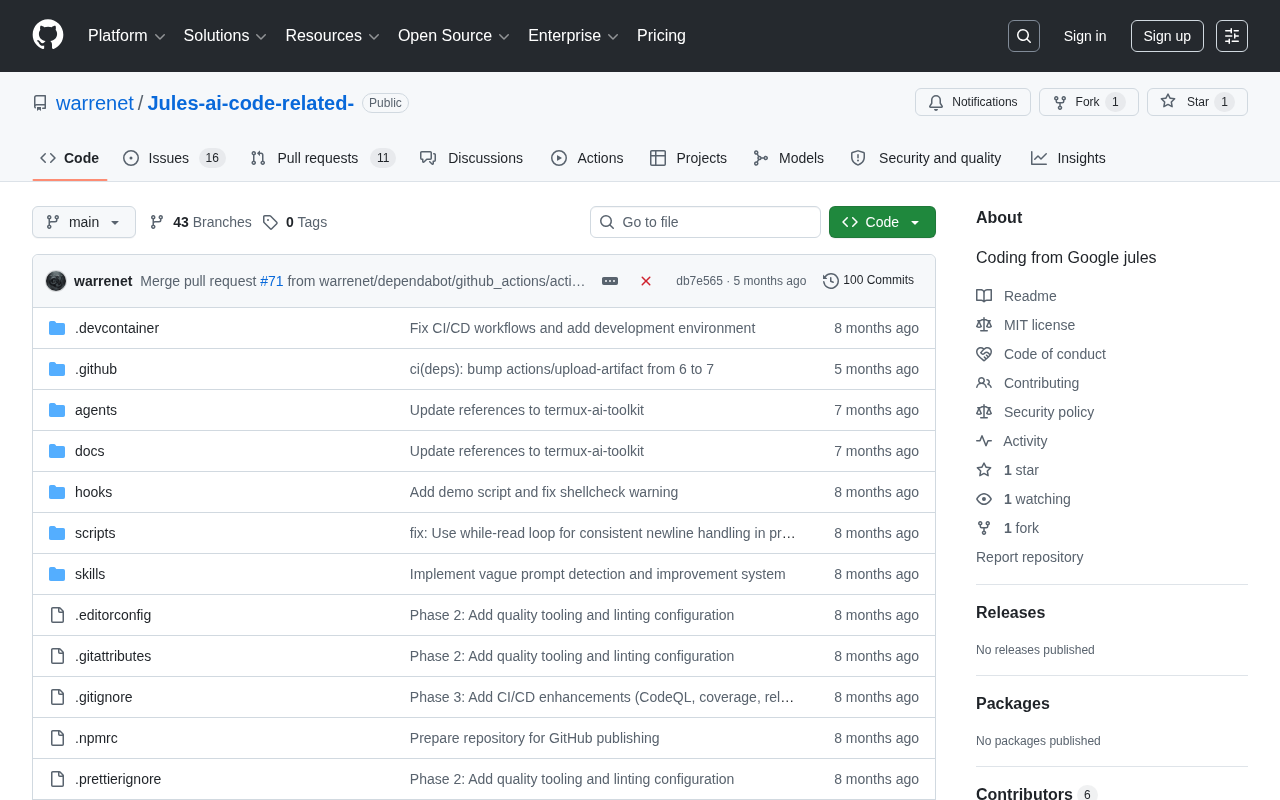
Google Jules AI Coding Assistant: A Quick Look at an Open-Source Practice Repo
A look at a small GitHub repo centered on Google Jules, an autonomous AI coding agent. Explores what Jules does, the repo's practical value, and how to evaluate early-stage AI tool projects.
GitHub Project Overview: prateek0221/jules — Critically Lacking Information
The GitHub repo prateek0221/jules has only 1 star, no code, and no README. We review available info and provide background on Google's Jules AI coding agent.