InstructReplay: A Replay Strategy to Preserve General Capabilities During Factual Fine-Tuning

InstructReplay narrows the general capability drop from factual fine-tuning from 28.1 to 2.4 points by replaying the model's own answers to general instructions.
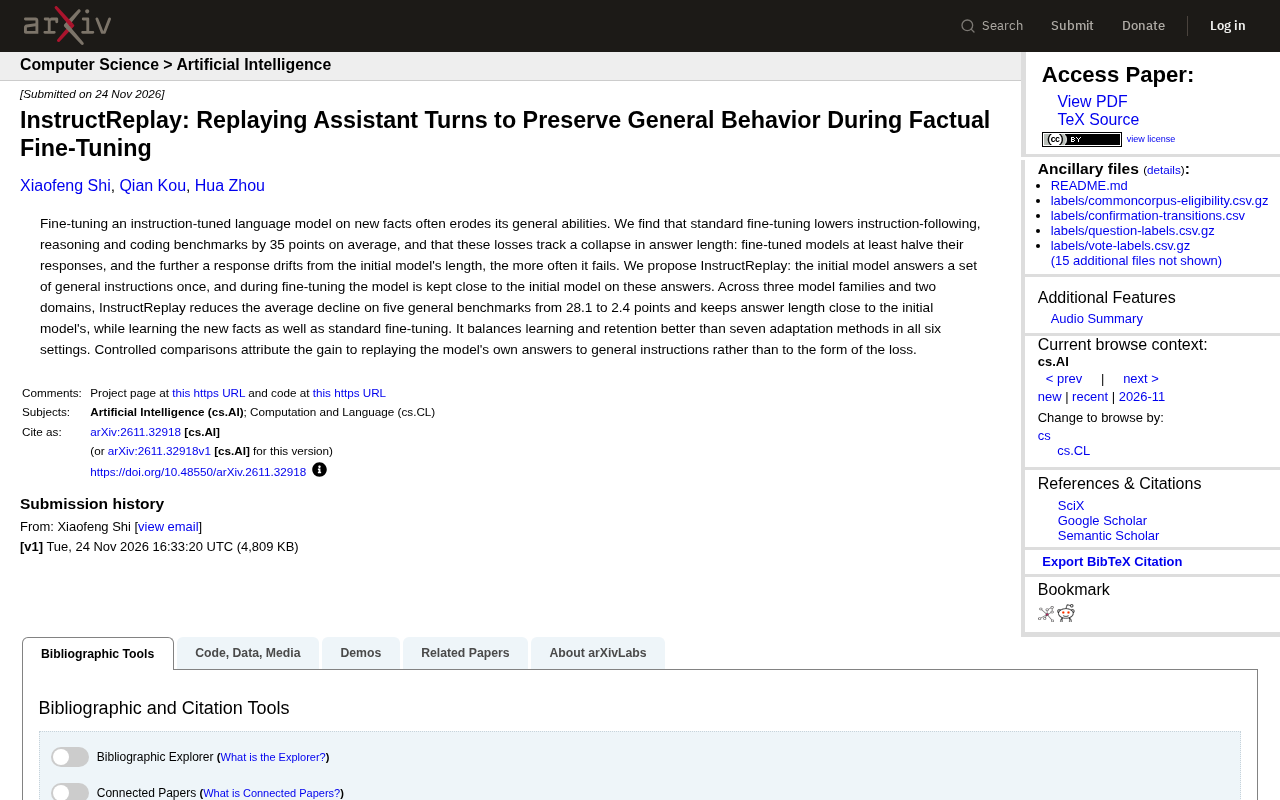
Standard factual fine-tuning causes instruction models to drop an average of 35 points on general benchmarks, closely tied to halved response length and output style shift. InstructReplay lets the model "review" its own original answers to general instructions during fine-tuning as a behavioral anchor against output distribution drift. Experiments show it reduces the average drop on five general benchmarks from 28.1 to 2.4 points while new-fact learning matches standard fine-tuning, outperforming seven adaptation methods across six settings. The key finding is that the gain comes from replaying the model's own answers itself, not the loss function form. This offers a low-cost path for teams needing continuous knowledge injection.
When fine-tuning instruction models to learn new facts, general capabilities often suffer a sharp decline. A new study offers a simple yet effective solution: let the model "review" its own original answers to general instructions during fine-tuning.
The Problem: Why Factual Fine-Tuning Harms General Capabilities
The research team found that standard fine-tuning causes an average drop of 35 points on instruction-following, reasoning, and coding benchmarks. This decline is not coincidental—it is closely tied to the collapse of response length: after fine-tuning, model responses shrink to at least half their original length, and the further the response length deviates from the initial model, the higher the failure frequency.
This reveals an easily overlooked mechanism: when learning new facts, the model systematically alters its output style—becoming shorter and more concise—and this style shift itself undermines performance on general tasks that require detailed reasoning and complete steps.
Catastrophic Forgetting is a classic phenomenon in neural network fine-tuning: when a model continues training on new tasks or new data, its parameters adjust substantially to fit the new distribution, causing previously learned capabilities to be overwritten. In instruction fine-tuning scenarios, this problem is particularly pronounced because the general instruction-following, reasoning chain generation, and coding abilities the model originally acquired through large-scale instruction data are significantly weakened by small amounts of factual fine-tuning. The "response length halving" observed in this paper is a behavioral manifestation of catastrophic forgetting—the model's output distribution drifts overall toward a terse style, while general tasks precisely depend on detailed reasoning steps. Understanding this mechanism helps recognize that factual fine-tuning harms general capabilities not because the new knowledge itself is harmful, but because the fine-tuning process inadvertently reshapes the model's output style.
InstructReplay's Approach: Let the Model Replay Its Own Answers
InstructReplay's method is straightforward. First, have the initial model answer a set of general instructions and save those responses. Then, during factual fine-tuning, additionally constrain the model's outputs on these general instructions to stay as close as possible to the initial model's answers.
This means the fine-tuning objective is no longer just "learn new facts" but also "don't forget old habits." The general instruction set serves as a behavioral anchor, preventing the model's overall output distribution from drifting as it absorbs new knowledge.
Key Finding: Replaying "Its Own Answers" Is What Matters
The research team conducted controlled comparisons and found that the gain comes from the act of "replaying the model's own answers to general instructions" itself, not from the specific form of the loss function. In other words, what matters is not how you constrain, but what content you constrain on—using the model's own outputs as reference is more effective than any elaborate loss design.
This conclusion has practical significance: it reduces the complexity of implementing the method and explains why a simple replay mechanism can work.
Behavioral Anchor is a technical approach for constraining drift in a model's output distribution. In continual learning or fine-tuning, parameter updates change the model's response patterns to various inputs, even inputs unrelated to the fine-tuning data. The behavioral anchor approach is: select a set of representative inputs (such as general instructions), record the initial model's outputs on these inputs, then apply constraints during subsequent training so that model outputs remain as consistent as possible with the anchor. InstructReplay uses the general instruction set and its initial answers as the anchor, preventing the model's overall output style from shifting as it absorbs new facts. Unlike parameter regularization methods, behavioral anchors act directly in output space, more intuitively protecting the model's behavioral characteristics.
Self-Distillation refers to the technique of training a model using its own (or its own earlier version's) outputs as supervision signals. In InstructReplay, the initial model's answers to general instructions are used as soft labels, and during fine-tuning the current model's outputs are constrained to approximate these soft labels. This is similar to the idea in knowledge distillation where a teacher model provides soft labels, but here the teacher and student are different versions of the same model. The advantage of self-distillation is that soft labels contain rich information from the model's own output distribution (such as style, level of detail, and reasoning structure), which preserves original behavior more effectively than hard labels or manually designed loss functions. The research team's controlled comparisons show that the gain comes primarily from the self-distillation mechanism of "replaying its own answers," rather than the specific form of the loss function.
Experimental Results: General Capability Drop Narrowed from 28.1 to 2.4 Points
Across three model families and two domains, InstructReplay reduced the average drop on five general benchmarks from 28.1 points to 2.4 points, while keeping response length close to the initial model's level and achieving new-fact learning performance comparable to standard fine-tuning.
In all six settings, its ability to balance learning and retention outperformed seven adaptation methods. This means InstructReplay is not trading "learning less" for "forgetting less"—it preserves general capabilities without sacrificing new knowledge acquisition.
Why It Matters
Continuously updating model knowledge is a common need in practical deployment, but every factual fine-tuning comes with general capability loss, and the cumulative cost is significant. InstructReplay offers a low-cost path: just one round of collecting general instruction answers, which can then be reused throughout subsequent fine-tuning.
For teams that need to frequently inject new knowledge, this could change the reactive cycle of "fine-tune, evaluate, roll back."
Limitations and Open Questions
The study covered three model families and two domains; whether it applies equally to a broader range of model scales and task types is not concluded in the original paper. How the size and diversity of the general instruction set affect results also requires further exploration.
One-line Summary
InstructReplay narrows the general capability drop caused by factual fine-tuning from 28.1 to 2.4 points by replaying the model's own answers to general instructions.
Paragraph Summary
Standard factual fine-tuning causes instruction models to drop an average of 35 points on general benchmarks, closely tied to halved response length and output style shift. InstructReplay proposes letting the model "review" its own original answers to general instructions during fine-tuning, using them as a behavioral anchor to constrain output distribution drift. Experiments show the method reduces the average drop on five general benchmarks from 28.1 to 2.4 points, while new-fact learning performance is comparable to standard fine-tuning and outperforms seven adaptation methods across six settings. The key finding is that the gain comes from the act of replaying the model's own answers itself, not the specific form of the loss function. This method offers a low-cost path for teams that need to continuously inject new knowledge.
Related articles

Michael Nielsen Takes Down His Classic Neural Network Textbook, Sparking Community Discussion
Michael Nielsen's classic free textbook Neural Networks and Deep Learning has been taken offline, sparking discussion on Hacker News about the reasons and impact.

Inside the AI Training Data Market: The Trade-off Between Exclusivity and Discounts
G2i founder Gabe Greenberg reveals the dual-track pricing of the AI training data market: labs pay a premium for exclusive data or accept discounts that allow others to buy it.

SessionGraph: Unifying All Coding Agent Sessions in One Interactive Graph
SessionGraph aggregates coding agent sessions into an interactive graph, helping developers review, debug, and manage AI coding workflows across sessions. This article examines its positioning, value, and open questions.