Intel Connection 2026: How Intel Is Empowering Developers in the AI Era

Intel uses OpenVINO Day 0 support and edge-cloud collaboration to bring AI to local hardware and close the developer ecosystem loop.
Intel is advancing local AI deployment on two fronts: technically, the OpenVINO toolkit delivers Day 0 hardware support for new models like Qwen Image 2.1 and MiniCPM 5 2B, enabling zero-token-cost inference across AIPC CPU/GPU/NPU hardware; an edge-cloud paradigm combines cloud LLMs for planning with local compute for high-frequency execution. On the ecosystem side, Intel has launched an AI Ambassador Program and partnered with Volcengine, ModelScope, and Honor to host developer communities, competitions, and workshops — moving AI deployment from technical demos into real-world business applications.
When most people think of Intel, they picture that familiar processor sticker on their laptop. From the notebook on your desk to the servers powering your favorite websites, Intel chips have long underpinned our digital world. But as we enter the AI era, this semiconductor giant is quietly shifting roles — moving beyond being a pure hardware supplier to become an ecosystem builder that connects models, agents, and developers.
At the AI Developer Zone of Intel Connection 2026, that transformation took shape in the form of hands-on, interactive applications. Bilibili creator Everett (胡同学) visited the show floor and captured Intel's clear strategy for AI deployment across several key areas.
Day 0 Model Support: Getting New Capabilities Running on Local Hardware Faster
Whenever a new model launches, the first question everyone asks is: "How much more powerful is it?" But raw capability only matters if you can actually run it — and run it well — on real hardware. That's one of the core problems Intel is solving.
A highlighted demo at the show featured Qwen Image 2.1 (通义千问Ad Image 2.1), which has received Day 0 support via OpenVINO on Intel hardware platforms, allowing developers to start experimenting the moment a model drops. Similarly, MiniCPM 5 2B from ModelBest (面壁智能) has also been optimized for on-device deployment, and is already capable of running local tool-calling and other Agent tasks on the edge.
A desktop mini-app built on MiniCPM 5 2B was demonstrated live, letting users interact directly with the model — all inference happening entirely on-device.
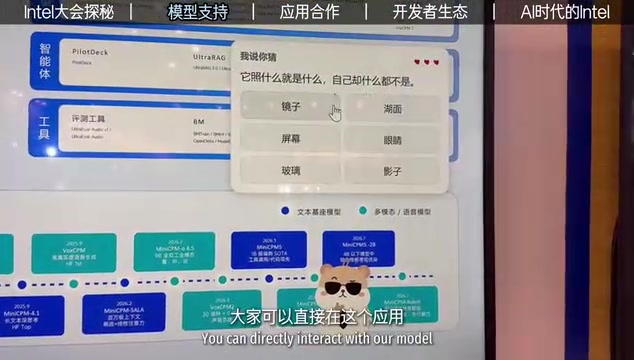
This "Day 0 support" strategy carries significant weight. It closes the gap between model release and developer usability, creating tighter collaboration between homegrown Chinese models and Intel hardware.
Background: "Day 0 support" is a key competitive metric in the chip ecosystem. After a model launches, developers who download the weights can still run into serious friction — operator incompatibilities, precision loss, or poor inference speed — if the target hardware platform hasn't been properly optimized. By collaborating with model teams ahead of release and shipping an OpenVINO-optimized version on launch day, Intel effectively eliminates the gap between "model available" and "model actually usable." The "2B" in MiniCPM 5 2B refers to approximately 2 billion parameters. With dedicated edge optimization, this size can run real-time inference on the NPU of a consumer AIPC, while supporting complex Agent capabilities like Tool Use — which allows the model to call external functions or APIs during a conversation, forming the foundation for autonomous agent applications.
OpenVINO and AIPC: Local Inference, Zero Token Costs
The developer zone also featured plenty of hands-on experiences. One motion-sensing game — built with Trae — had players doing shoulder exercises in front of a webcam to control a "Gold Miner" character onscreen, launching ropes in sync with their movements. Nearby, a neon brick-breaker game leveraged OpenVINO under the hood.
These games illustrate the development advantages of Intel's AIPC platform. Using Intel's open-source OpenVINO AI software toolkit, combined with Day 0 model support, developers can build interactive applications that run across the CPU, GPU, and NPU of the latest AIPC hardware — completely locally, with no token costs for end users.
Once you understand the division of labor between AI models and chips, the logic behind Intel's partnerships with Agent platforms like Trae and Marvis becomes clear: models handle intelligence, chips handle efficient execution, and local deployment removes the cost concerns of cloud API calls entirely.
Background: OpenVINO (Open Visual Inference and Neural network Optimization) is Intel's open-source inference optimization toolkit. Its core function is to convert trained AI models (supporting PyTorch, TensorFlow, ONNX, and other major frameworks) into a format optimized for efficient execution on Intel hardware. It automatically identifies and schedules tasks across the CPU, integrated GPU, and NPU (Neural Processing Unit) based on each unit's strengths — delivering near-dedicated-AI-accelerator inference performance without relying on cloud services. AIPC is Intel's personal computing platform standard designed for local AI computation, with the defining feature being a built-in NPU — a dedicated compute unit designed for low-power, sustained AI inference that works alongside the CPU and GPU, enabling AI tasks to run for extended periods on laptops and other endpoint devices without draining the battery. For developers, the OpenVINO + AIPC combination means inference latency, cost, and privacy risks all stay local — no per-call token fees, no sending user data to the cloud.
Edge-Cloud Collaboration: A New AI Cooperation Paradigm
One unavoidable question in application development is: how should local and cloud workloads be divided?
Intel's AI Innovation Ambassador Program was officially announced at the event, with educator Peng Chao (彭超老师) joining as one of the inaugural ambassadors. He shared concrete edge-cloud collaboration scenarios for AIPC, describing a "Coworker"-style model where the edge handles execution and the cloud handles orchestration.
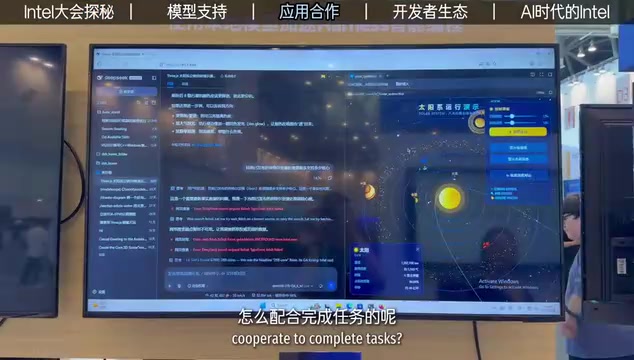
Specifically, the cloud uses the powerful DeepSeekAd V4.1 Flash to break tasks down in exhaustive detail, while the edge relies on local compute for execution — completely free of token costs, allowing multiple iterations to achieve better code execution results before the cloud model performs a final review.
This "cloud planning + edge execution" paradigm neatly combines the reasoning power of large models with the cost advantages of local compute, making it one of the most representative engineering approaches of the AIPC era.
Background: The edge-vs-cloud divide is fundamentally a trade-off between where compute lives and how costs are structured. Cloud-based large models like DeepSeek V4.1 Flash are massively capable but incur token costs on every call, plus network latency. Edge models run on the user's local device with fixed inference costs (hardware depreciation), making them well-suited for high-frequency, iterative tasks. The "cloud planning + edge execution" paradigm exploits this difference: complex task decomposition and final validation are handled by the cloud's stronger model (fewer calls, manageable token spend), while the repetitive, trial-and-error code execution loop runs entirely locally (zero marginal cost). This architecture is especially valuable in Agent scenarios — completing a single task can require dozens or even hundreds of intermediate inference steps. Running all of them in the cloud causes token costs to accumulate rapidly; pushing the execution layer to the edge dramatically cuts running costs without sacrificing task quality.
From Hands-On Practice to Go-to-Market Support: Closing the Developer Ecosystem Loop
Technology alone isn't enough. What developers really care about is whether their apps can actually ship, where to turn when they get stuck, and how to get feedback once something is built. Intel addressed these pain points with a comprehensive support structure at the event.
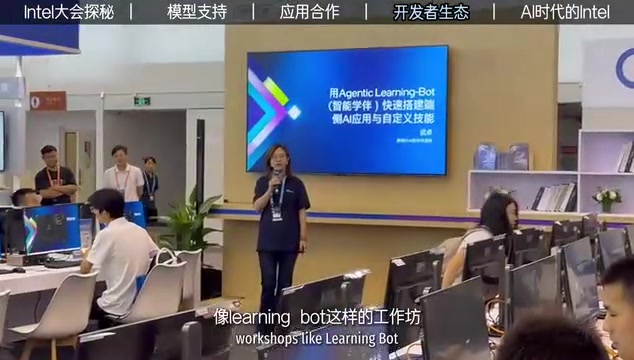
Workshops like LearningBot offered hands-on practice sessions where developers could try building edge AI applications and custom skills under instructor guidance.
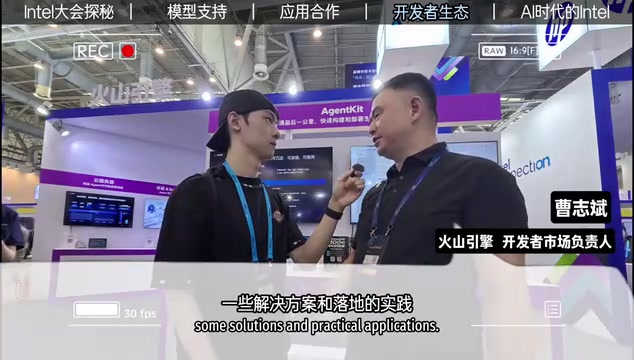
On the go-to-market side, the conference announced the Honor × Intel AI Manufacturing Innovation Competition, along with a partnership between Intel and the Volcengine (火山引擎) Agent community. Dr. Cao from the Volcengine Agent community noted that the Volcengine developer portal now features a dedicated Intel content section, where developers can explore details of the joint Volcengine-Intel solutions. The two companies also plan to co-host local developer meetups in multiple cities, with experts from both Volcengine and Intel sharing practical insights on combining cloud and Intel technologies.
Real Needs, Real Products: Developers Showcasing Their Work
Some developers arrived at the event with finished work in hand. At the grand finale of the Intel and ModelScope (魔搭) Joint Agent Skill Innovation Competition, contestants demonstrated their skills live to judges and engaged in direct discussion.
One standout project addressed pre-delivery validation for high-stakes reports — procurement audits, contract documents, and bid specifications — born from a real pain point at a mining company client. Faced with enormous volumes of data and audit reports, manual review had become overwhelming. The developer tackled this from a very focused angle, building a skill that reduces repetitive work by automatically checking reports for discrepancies and procurement issues.
This kind of application, rooted in genuine business needs, illustrates exactly where Intel's ecosystem strategy is aimed: not stacking up technical buzzwords, but putting AI capabilities to work on concrete problems.
Closing Thoughts: From Chip Stickers to Solving Real Problems
After walking through the entire AI Developer Zone, Intel's role in the AI era comes into much sharper focus — working alongside model makers, Agent platform partners, and developers to genuinely bring AI capabilities onto our own computers.
In the past, most of us came to know Intel through that little chip logo on our machines. Going forward, what reintroduces Intel may well be the AI applications built by today's developers — the ones that solve actual, everyday problems.
Related articles

Chain of Thought Isn't Just for AI: How Humans Can Use CoT to Improve Thinking Quality
Chain of Thought isn't just a prompt trick for large models. Starting from a Hacker News discussion, this article analyzes why CoT works for human thinking too, breaks down actionable ways to transfer it, and highlights the key differences between human CoT and machine CoT.
Cloudflare Teams Up with OpenAI: Closi…
Cloudflare Teams Up with OpenAI: Closing the Loop from Vulnerability Discovery to Defense with AI
Cloudflare uses OpenAI Daybreak to investigate security vulnerabilities and generate reviewable remediation plans, while developers use Codex to boost coding efficiency and quality.

Orca Multi-Agent Orchestration in Practice: A Guide to Parallel Collaboration with Claude and Codex
Orca is Stable AI's free open-source agent workbench supporting 34 agents like Claude Code and Codex in parallel. Learn its Git worktree isolation, multi-model orchestration, and mobile management.