Intel CPU Price Increase of 10%: Strategic Transformation and Market Impact Analysis
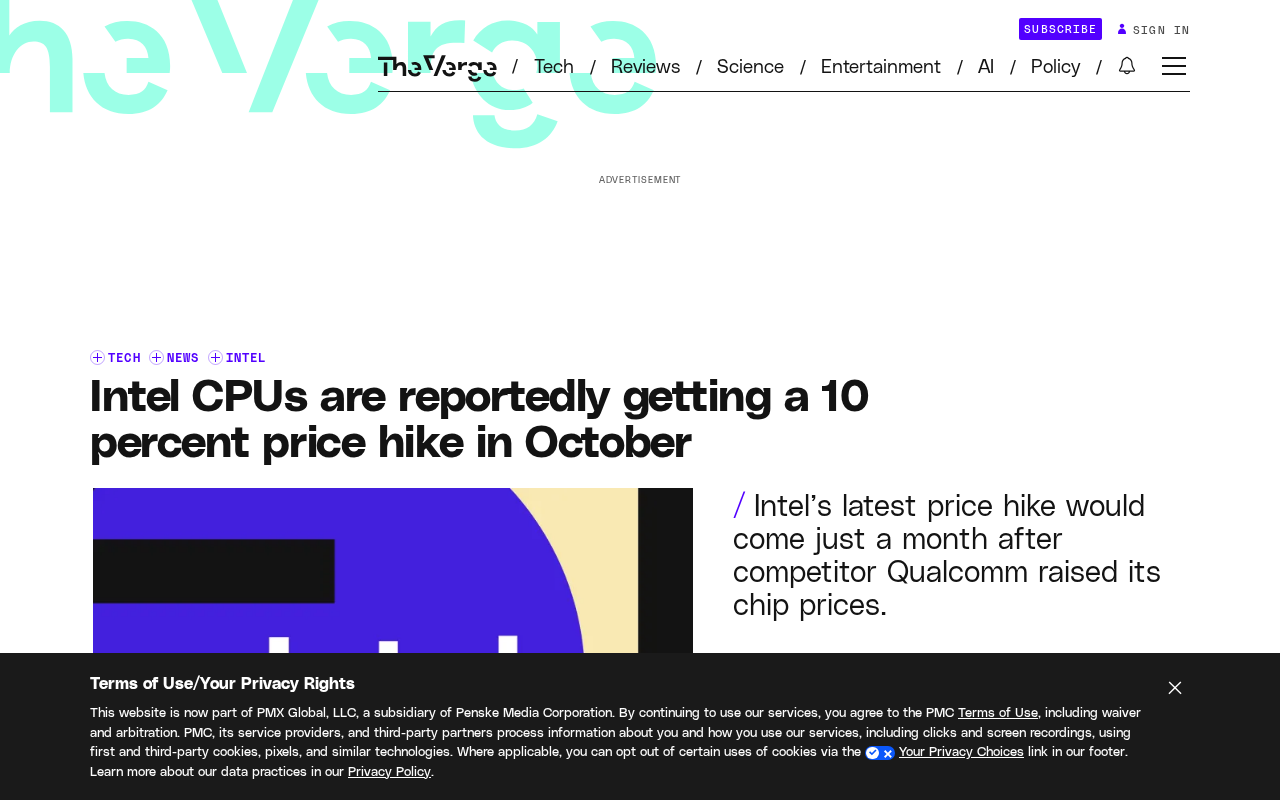
Intel raises CPU prices 10%, pivoting from market share strategy to profit maximization amid industry shifts
Intel is implementing a ~10% price increase on PC processors, marking a strategic shift from market share focus to profit optimization. This move comes as AMD gains ground with competitive Ryzen processors and Intel invests heavily in advanced process technology and AI accelerators. The price hike will impact both DIY builders and OEM manufacturers, potentially benefiting AMD's value proposition while funding Intel's technology investments.
Intel CPU Price Adjustment Background
According to Digitimes, Intel plans to raise prices on its PC processor product line by approximately 10% in the coming weeks. This is not Intel's first price increase this year—the company has already implemented a similar price hike earlier. This adjustment marks a significant strategic shift in Intel's PC CPU business: moving from a low-price strategy focused on market share to pursuing higher profit margins per unit.
This pricing strategy adjustment comes at a time when Intel faces multiple challenges. On one hand, AMD continues to pressure the high-performance processor market. Intel and AMD are the two major competitors in the x86 architecture processor market. Intel has long dominated the market, but since AMD launched its Zen architecture-based Ryzen processors in 2017, the market landscape has changed significantly. AMD partnered with TSMC on process technology, pioneering adoption of advanced 7nm and 5nm processes, gaining advantages in power efficiency and multi-core performance. According to Mercury Research data, AMD's desktop CPU market share has grown from less than 10% in 2016 to approximately 20-25% in 2023, and its EPYC processors in the server market continue to eat into Intel Xeon's share.
On the other hand, Intel's own process technology progress and capacity planning require substantial capital investment. Process technology is a core metric for measuring chip manufacturing technology, typically expressed in nanometers (nm) representing the characteristic size of transistors. More advanced processes mean more transistors can be integrated in the same area, delivering higher performance and lower power consumption. Intel was long a leader, but encountered technical bottlenecks at the 10nm node, resulting in an abnormally extended 14nm process lifecycle. Currently, Intel is advancing Intel 4 (corresponding to industry 7nm) and Intel 3 processes, and plans to introduce 18A (1.8nm class) process between 2025-2027. Each generation of advanced process development requires billions of dollars in investment, and building an advanced process fab requires over $20 billion. Improving profit structure through higher CPU prices has become a pragmatic choice for Intel at this stage.
Impact of Price Increase on Market and Consumers
A 10% price increase has significant impact on the complete system market. Taking a mid-range processor as an example, if the current price is 2,000 RMB, after the price increase it will reach 2,200 RMB. This not only directly affects the purchase cost for DIY system builders, but also cascades to OEM manufacturers' complete system pricing strategies.
OEM (Original Equipment Manufacturer) refers to brand system manufacturers like HP, Dell, and Lenovo. These manufacturers purchase processors from chip suppliers like Intel, assemble them into complete computer systems, and sell them. CPUs typically account for 15-25% of complete system material costs, second only to displays. When processor prices rise 10%, if OEM manufacturers choose to fully pass on costs, a 5,000 RMB laptop might increase by 75-125 RMB. However, in actual markets, OEM manufacturers often buffer price pressure by compressing costs of other components, optimizing product mix, or sacrificing some profit.
Potential Market Reactions
For consumers, the following market reactions may be seen in the short term:
- Rush to purchase existing inventory products
- Some users switching to AMD platforms
- System manufacturers balancing costs through other configuration adjustments
Interestingly, Intel's move may also provide AMD with greater market opportunity. If AMD maintains its current pricing strategy, its value proposition will be further highlighted. Because the PC market is highly competitive and demand is price elastic, price transmission is not a simple linear relationship but a complex game process, which could have profound impact on competitive dynamics.
Semiconductor Industry Trends and Future Outlook
Intel's pricing decision reflects the complex situation facing the semiconductor industry. The global chip industry is undergoing a paradigm shift from pursuing scale to pursuing profit. After experiencing demand surges during the pandemic and subsequent market corrections, chip manufacturers are universally focusing more on financial health rather than pure shipment volume growth.
Industry Change Trends
From a long-term industry development perspective, this pricing strategy adjustment may signal:
- Overall price center of PC hardware market moving upward
- Manufacturers focusing more on profit contribution from high-end product lines
- Optimization of product lifecycle management strategies
For Intel, the additional funds obtained through price increases will help its R&D investment in emerging areas such as advanced processes, AI accelerators, and discrete graphics cards. AI accelerators are hardware optimized specifically for artificial intelligence computing, including GPUs, TPUs, NPUs, etc. With the rise of large language models and generative AI, traditional CPUs are inefficient at handling large-scale parallel computing. Intel is entering this market through multiple product lines: the Gaudi series targets data center AI training, Habana Labs provides inference acceleration solutions, and integrated GPU Meteor Lake and Arrow Lake processors target edge AI applications. Heterogeneous computing refers to combining processing units of different architectures such as CPUs, GPUs, and specialized accelerators in the same system, dynamically allocating computing resources based on task characteristics. This represents the evolution trend of computing architecture from general-purpose processing to specialized acceleration.
This is a strategic choice seeking balance between short-term market pressure and long-term technology competition. Intel needs to invest heavily in these emerging areas to compete with rivals like NVIDIA and AMD, which is also one of the motivations for its price increase to improve cash flow. Consumers and market participants need to closely monitor the actual implementation of this October price adjustment and its chain reactions.
Related articles

Knockin': AI Business Cards That Make Your Personal Bio Intelligent
Knockin' transforms traditional bios into interactive AI business cards where visitors can chat to learn about your expertise and book meetings directly.

Switch Open Source Tool: Bringing AI Agents into Team Collaboration Platforms
Switch is an open source tool that integrates AI Agents as named participants into Slack, Teams, Discord, and other collaboration platforms, supporting multi-framework compatibility and self-hosted deployment. It reached #1 on Product Hunt.

Matrox's Transformation: From Consumer Graphics Pioneer to Professional Graphics Solutions Provider
Matrox was a major player in 1990s consumer graphics cards but exited mainstream markets due to 3D performance competition, successfully transforming into a professional graphics solutions provider. This article reviews Matrox's transformation journey and analyzes its differentiation strategy in multi-monitor output, video walls, and AV over IP.