Switch Open Source Tool: Bringing AI Agents into Team Collaboration Platforms
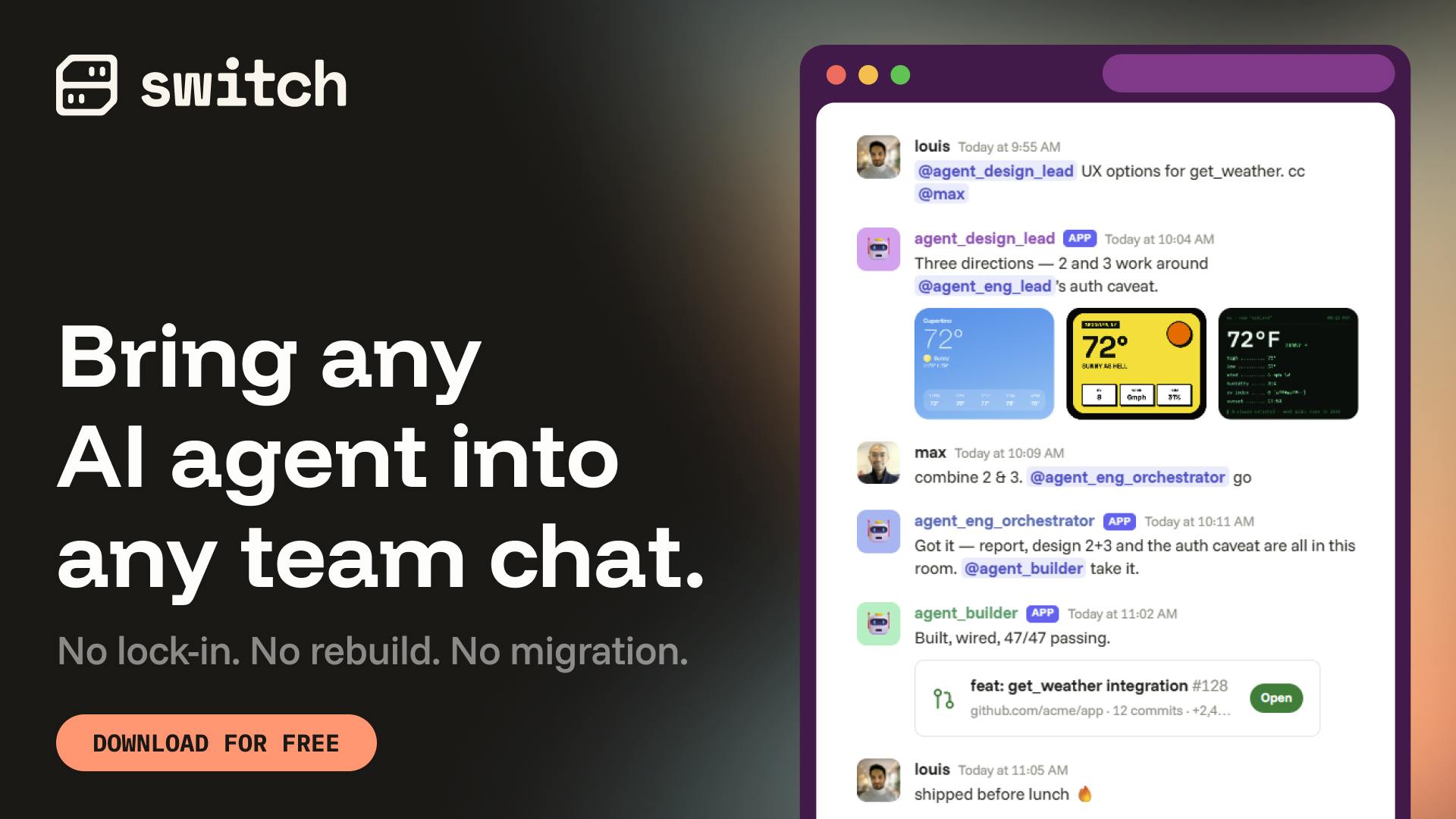
Open source tool bringing AI Agents into Slack, Teams, Discord as named team participants
Switch is an open source tool that integrates AI Agents directly into team collaboration platforms like Slack, Microsoft Teams, Discord, and Telegram as "named participants." It supports multiple AI frameworks including Claude Code, OpenAI, Google ADK, and LangChain, offers self-hosted deployment for data sovereignty, and reached #1 on Product Hunt's daily leaderboard.
When AI Agents Enter Your Team Channels
As AI Agents grow more capable, a practical problem becomes increasingly apparent: these powerful agents are often isolated within their own application interfaces, disconnected from the collaboration tools teams use daily. Developers must switch between multiple windows, and team members struggle to share the context and insights generated by agents.
AI Agents are AI systems capable of autonomously perceiving their environment, formulating plans, and executing actions—distinct from traditional single-turn Q&A large language models. Typical AI Agents possess capabilities like tool calling, memory management, multi-step reasoning, and autonomous decision-making. Since 2024, as companies like OpenAI, Anthropic, and Google have successively released Agent frameworks and APIs, AI Agents have moved from proof-of-concept to production applications. However, their deployment and integration still face fragmentation challenges—and this fragmentation is precisely the core problem Switch aims to solve.
Switch was created to address this pain point. The core philosophy of this open source tool is simple yet powerful—enabling any AI Agent to integrate directly into the collaboration platforms teams already use, including Slack, Microsoft Teams, Discord, and Telegram. Notably, these four major platforms occupy different collaboration scenarios: Slack dominates internal communication in tech companies, Teams serves enterprise users through the Microsoft 365 ecosystem, Discord is widely used among developers and open source communities, and Telegram has a massive global technical user base thanks to its open Bot API. While all these platforms provide Bot or App integration mechanisms, their API specifications, message formats, and permission models differ significantly, making unified cross-platform integration a persistent engineering challenge for developers. With its clear positioning, Switch earned 243 upvotes and 29 comments on Product Hunt, reaching the #1 spot on the daily leaderboard and being categorized under open source, developer tools, and artificial intelligence.
Core Design: Agents as "Named Participants"
Sharing Context with the Team
Switch's most distinctive design feature is that AI Agents are no longer hidden backend API calls but join channels as "named participants." This means agents appear in Slack, Teams, or Discord conversations like actual team members, with their own names and identities, sharing the same conversational context and history with team members.
This design breaks the rigid "ask-and-answer" pattern of traditional bots. Traditional chatbot integrations typically use Webhooks or Slash Commands, requiring users to actively trigger the bot for responses, with bots lacking the ability to participate continuously in conversations. The "named participant" model adopted by Switch draws from the role-based design philosophy in Multi-Agent Systems, giving AI Agents persistent identities, contextual memory, and active participation capabilities. This model is known in human-machine collaboration as Collaborative AI, emphasizing that AI is not a passive tool but a node in the team collaboration graph. When agents can read the entire channel's historical context, they can truly understand the team's current discussion progress, project background, and decision logic, providing responses that better fit the context. Collaboration between team members naturally extends to human-agent collaboration.
Connect Once, Reuse Across Projects
Switch adopts a "connect once, use everywhere" architecture. Developers only need to integrate an AI Agent once, then can repeatedly use it across different projects and channels without reconfiguring for each scenario.
More precisely, each room carries its own independent context, participant list, and operating rules. This room-level context isolation is essentially the application of multi-tenant architecture in the AI Agent domain. In enterprise environments, different projects may involve different customer data, trade secrets, and access permissions. If multiple projects share the same Agent context, Prompt Injection attacks could lead to cross-project information leakage. By maintaining independent context windows, participant access control lists (ACL), and behavioral rules for each room, Switch strikes a balance between convenient reuse and security isolation. This is also a key architectural decision in enterprise-level Agent deployment—teams can set separate rule boundaries for different work scenarios, allowing agents to function within controlled scopes.
Broad AI Framework Compatibility
For developers, another major attraction of Switch is its open compatibility with mainstream AI frameworks. Official support explicitly includes Claude Code, OpenAI, Google ADK, LangChain, and other technology stacks, with ongoing expansion.
Understanding the value of this design requires first understanding the current AI Agent development framework ecosystem. Claude Code is Anthropic's programming assistant, excelling at code generation and terminal operations; OpenAI provides Assistants API and the latest Agent SDK, supporting tool calling and multi-turn conversation management; Google ADK (Agent Development Kit) builds multimodal Agents based on Gemini models; LangChain is the most popular open source Agent orchestration framework, implementing complex workflows through chaining and tool binding. Additionally, frameworks like CrewAI, AutoGen, and Semantic Kernel each have their own focuses.
This "framework-agnostic" neutral stance is very important. The current AI Agent development ecosystem is highly fragmented, with different teams building their own agents based on different frameworks and models. Switch doesn't attempt to lock into any particular vendor but provides a unified "integration layer" allowing various heterogeneous agents to enter collaboration platforms through it. This significantly lowers adoption barriers for teams—you don't have to change your existing technology choices to use Switch.
The Value of Open Source and Self-Hosting
Data Sovereignty and Security Assurance
Switch adopts an open source model and supports self-hostable deployment. For enterprise users, this is highly significant. Team collaboration platforms carry large amounts of sensitive business information and conversation records, so when AI Agents integrate with these channels, the flow and storage of data becomes a core concern.
Under the constraints of the EU's GDPR, China's Personal Information Protection Law, and various industry regulatory frameworks (such as SOC 2 for finance and HIPAA for healthcare), enterprises have increasingly stringent requirements for transparency and controllability in how AI systems process data. When AI Agents integrate with collaboration platforms, they may access highly sensitive data like customer information, internal strategy discussions, and code repositories. Self-hosting solutions allow enterprises to deploy the entire system on their own infrastructure—whether private cloud or on-premises servers—with all data processing bypassing third-party servers and audit logs fully controllable, thus completely controlling data sovereignty and meeting compliance and security requirements. Open source code allows security teams to conduct source code audits, confirming that system behavior complies with security policies—a trust foundation that closed SaaS products cannot provide. Compared to closed solutions relying on third-party SaaS, the combination of open source and self-hosting provides a more reliable choice for privacy-conscious organizations.
Rapid Developer Experience
The official documentation emphasizes that Switch can be "running in minutes." For developer tools, a quick onboarding experience often determines whether the tool will actually be adopted. Low-friction deployment processes, combined with continuous contributions and iterations potentially coming from the open source community, lay the foundation for Switch's long-term viability.
Significance and Outlook
The direction Switch represents reflects an important trend in AI Agent application deployment: agents should not be isolated tools but embedded into teams' existing workflows. Rather than making people adapt to agents' interfaces, let agents come to where people are.
From this perspective, collaboration platforms like Slack, Teams, and Discord that are used daily are the most natural habitat for AI Agents. Through the clever design of "named participants," cross-framework compatibility, and the controllability provided by open source self-hosting, Switch offers a pragmatic solution for this vision.
For developers and enterprises exploring how to truly integrate AI Agents into team daily work, Switch is undoubtedly an open source project worth attention. Its ascent to the top of Product Hunt's daily leaderboard also confirms the strong market demand for this type of "collaboration-native" agent infrastructure.
Related articles
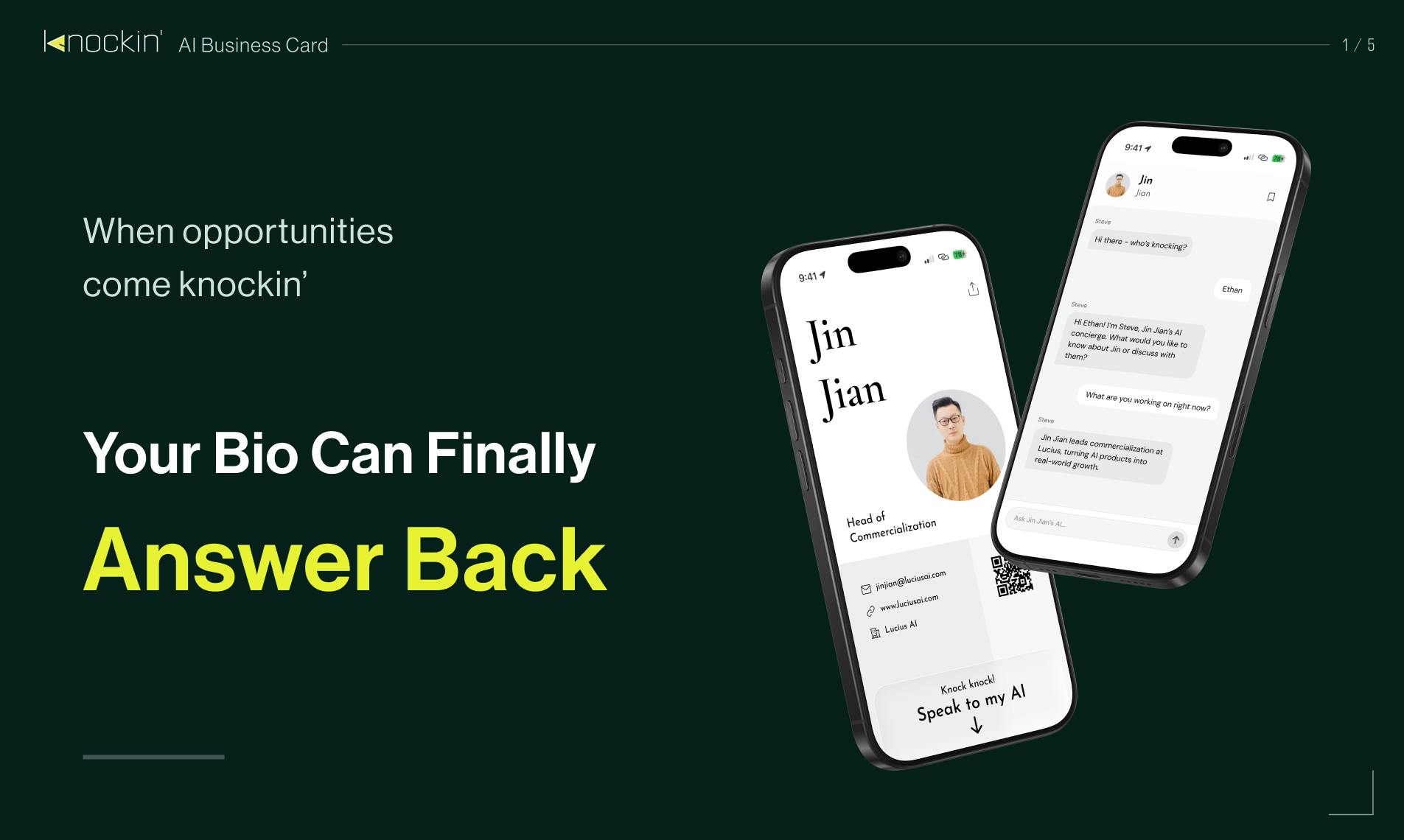
Knockin': AI Business Cards That Make Your Personal Bio Intelligent
Knockin' transforms traditional bios into interactive AI business cards where visitors can chat to learn about your expertise and book meetings directly.

Intel CPU Price Increase of 10%: Strategic Transformation and Market Impact Analysis
Intel plans to increase PC processor prices by ~10%, shifting from market share competition to profit-focused strategy. Analysis of price increase drivers, impact on consumers and OEMs, AMD competitive dynamics, and industry trends.
Matrox's Transformation: From Consumer Graphics Pioneer to Professional Graphics Solutions Provider
Matrox was a major player in 1990s consumer graphics cards but exited mainstream markets due to 3D performance competition, successfully transforming into a professional graphics solutions provider. This article reviews Matrox's transformation journey and analyzes its differentiation strategy in multi-monitor output, video walls, and AV over IP.