Intel GPU D-Series Launches: Large-Memory AI Inference Without HBM

Intel D270 targets agentic and long-context inference with large-capacity memory and no HBM.
Intel quietly launched the data center GPU D270 on Product Hunt, emphasizing large-memory inference without HBM for agentic AI, long-context, and high-concurrency serving. Inference workloads prioritize memory capacity, concurrency, and cost per unit power, while HBM capacity scaling is costly and supply-concentrated. D270 reflects AI chips diverging by workload, but key specs like bandwidth and software maturity remain undisclosed.
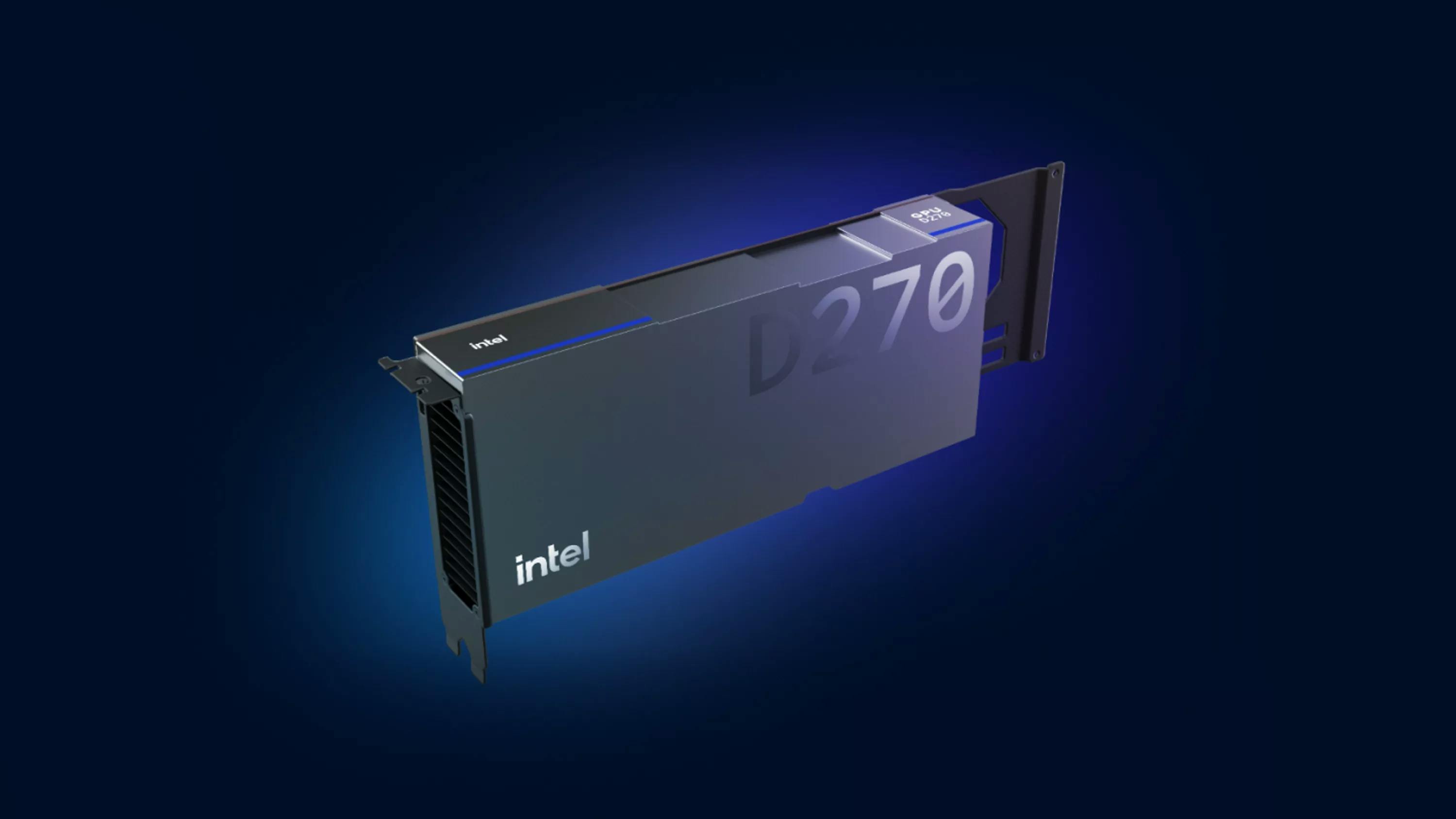
Intel has quietly launched a highly targeted data center GPU on Product Hunt — the D270. Instead of chasing the extreme bandwidth of HBM (High Bandwidth Memory), this product focuses on "large-memory inference without HBM," aimed squarely at agentic AI, long-context, and high-concurrency serving scenarios. With HBM supply tight and costs high, this approach deserves a closer look.
Why does "no HBM" become a selling point?
Today's mainstream AI accelerator cards almost invariably tout HBM. From H100 to MI300, HBM's bandwidth advantages have indeed driven dramatic gains in training performance. But the demand curve for inference differs from training. Inference cares more about: whether a sufficiently large model and a sufficiently long context can fit into memory, and how many concurrent requests can be served per unit of power.
HBM's pain point is the extremely high cost of capacity scaling. Each GB of HBM costs far more than GDDR or LPDDR, and the packaging process is complex with concentrated production capacity. For enterprises deploying large numbers of inference nodes, memory capacity often affects total cost of ownership more than peak bandwidth. Intel's D270 chooses to bypass HBM and build large capacity using more mature memory solutions — essentially a re-balancing of trade-offs aimed at inference economics.
The official description repeatedly emphasizes "practical power and cost," indicating this product does not intend to compete head-on with the H100 in the training market, but rather to carve out a slice of the price-performance sweet spot in inference infrastructure.
HBM (High Bandwidth Memory) is a memory technology that vertically stacks DRAM chips using through-silicon vias (TSVs) and packages them adjacent to the GPU/accelerator die via a silicon interposer. Compared with traditional GDDR or LPDDR, HBM can deliver several times to dozens of times the bandwidth within a tiny physical footprint while significantly reducing energy per bit transmitted — this is precisely the key to the dramatic data throughput gains of training cards like the H100 and MI300. But the cost is obvious: HBM requires 2.5D/3D advanced packaging, production capacity is highly concentrated among a few memory manufacturers, cost per GB is far higher than ordinary memory, and capacity scaling is often limited by per-die capacity and the number of stacks a package can accommodate. Understanding this is essential to seeing why "bypassing HBM and using mature memory to build capacity" is a deliberate economic trade-off in inference scenarios, not a simple technical downgrade.
D270's positioning: agents and long context
Agentic AI has been the clearest growth driver for inference workloads over the past two years. An agent workflow often requires multiple rounds of tool calls, state maintenance, and long conversation memory, consuming far more memory than single-turn Q&A. Long context is similar — when the context window expands from 8K to 128K or even longer, KV Cache memory overhead grows linearly, and memory capacity directly determines how long a context and how high a concurrency level can be supported.
D270 writes these two scenarios into its product positioning, showing that Intel's observations about inference workloads are specific. High-concurrency serving further points to the throughput problem in real deployments: the larger a single card's memory, the more requests can reside simultaneously, and the stronger the service capacity per unit time.
The key question here is whether the actual bandwidth of a no-HBM solution can meet the latency requirements of these scenarios. Large memory solves the "fits" problem, but "runs fast" still requires empirical data verification. Intel has disclosed limited information so far, and this is the part of D270 most in need of observation.
KV Cache (key-value cache) is key to understanding long-context memory overhead. In Transformer inference, the model caches the Key and Value vectors for each generated token to avoid redundant computation, reducing autoregressive decoding from O(n²) to approximately linear complexity. But the cost is that cache size grows linearly with context length and the number of concurrent requests: the longer the sequence and the more simultaneous requests, the more memory consumed. Taking a 70B-class model as an example, a single request with 128K context can have a KV Cache reaching several GB, and accumulated overhead under high concurrency is very substantial. Therefore, in long-context and high-concurrency serving, memory capacity often becomes the bottleneck earlier than peak bandwidth — this is the realistic basis for D270's emphasis on large memory capacity.
Diverging paths for inference chips
D270's emergence reflects a larger industry trend: AI chips are moving from "one card for everything" toward differentiation by workload. Training chips pursue extreme bandwidth and interconnect, while inference chips are beginning to stratify — some prioritizing low latency, some large capacity, some low power.
The no-HBM inference card is not Intel's invention, but it means something different when promoted by a vendor with a complete data center ecosystem. Intel has its Xeon product line on the CPU side, along with accumulated expertise in networking and software stacks. If D270 can synergize with existing infrastructure, it will appeal to budget-sensitive customers whose workloads are primarily inference.
Another background factor that cannot be ignored is the HBM supply landscape. HBM capacity has long been controlled by a few manufacturers, with large fluctuations in lead times and prices. An inference product line that does not depend on HBM has a natural advantage in supply chain resilience — a practical consideration for inference clusters that need large-scale deployment.
Total cost of ownership (TCO) is the core metric when data centers procure inference cards, typically including hardware purchase, power consumption, rack space, cooling, and operations labor across the full lifecycle. Inference clusters often require large-scale deployment, and small differences in per-card cost and power consumption are amplified by cluster scale — therefore "how many concurrent requests can be served per unit of power" affects the actual bill more than "how high is peak compute." The no-HBM approach trades cheaper memory for larger capacity, and if it can support target concurrency at acceptable latency, it can form a TCO advantage. This also explains why inference chips are stratifying along dimensions such as "capacity-first," "latency-first," and "power-first."
Questions that need answering
Public information about D270 remains sparse. Specific memory capacity, bandwidth parameters, supported model precisions, and software stack maturity — the metrics that determine real-world usability — have not yet been fully disclosed. Its traction on Product Hunt (72 upvotes, 1 comment) also indicates it has not yet entered mainstream discussion.
For developers, the biggest concern is the software ecosystem: compatibility with mainstream inference frameworks, maturity of the compiler toolchain, and migration cost for existing models. Intel has stumbled on GPU software stacks in the past, and whether D270 can avoid the same pitfalls is more worth watching than hardware specs.
From a product strategy perspective, D270's choice to launch on Product Hunt rather than through traditional data center product channels itself reveals a tentative intent — first gauge the developer community's reaction, then decide the pace of subsequent investment. Whether this product succeeds ultimately depends on its measured inference price-performance and how much patience Intel is willing to invest in the software ecosystem.
One-line Summary
Intel D270 enters the agentic and long-context inference market with large-capacity memory and no HBM.
Paragraph Summary
Intel quietly launched the data center GPU D270 on Product Hunt, emphasizing "large-memory inference without HBM" and targeting agentic AI, long-context, and high-concurrency serving. The article notes that inference workloads care more about memory capacity, concurrency, and cost per unit of power, while HBM has high capacity-scaling costs and concentrated production. No-HBM solutions offer potential advantages in inference price-performance and supply chain resilience. D270's positioning reflects AI chips moving from "one card for everything" toward differentiation by workload. However, key parameters such as memory bandwidth and software stack maturity have not been disclosed, and actual inference performance and ecosystem migration costs remain to be verified; the launch channel also suggests a tentative approach.
Related articles

JobRunner MCP Server: AI Agents Can Now Fix Failed Java Jobs
JobRunner launches an open-source MCP server enabling AI agents to view cluster status, diagnose failures, and recover Java jobs—incident response from any cloud coding environment or existing agent.

MLAI Digital Launches 9 Security Agents: MCP Server Safeguards the Full Lifecycle of Agentic AI
MLAI Digital launches Security MCP Server with nine built-in specialized security agents covering vulnerability discovery, attack simulation, prompt injection detection, API and infrastructure assessment, and accelerated remediation—embedding security validation across the full Agentic AI lifecycle from development to production.

Running Isaac Lab on H100 GPUs: Exploring Better Approaches
Exploring optimization methods for running Isaac Lab on NVIDIA H100 GPUs, including MIG configuration, mixed precision, TensorRT acceleration, and community experience to improve robotics simulation and reinforcement learning efficiency.