IntellAgents.io: One AI Agent to Rule Every Customer Channel

IntellAgents.io uses one AI agent to unify phone, social DMs, and web chat with a single knowledge base for 24/7 multilingual support.
IntellAgents.io is an omnichannel AI customer service platform whose core pitch is a single AI agent managing voice calls (including outbound), WhatsApp, Instagram, Facebook, Telegram, and website chat. All channels share one knowledge base, enabling consistent responses across every touchpoint in up to 36 languages. It targets three key pain points for SMBs and growth-stage companies: overlapping tool subscription costs, low cross-channel maintenance efficiency, and after-hours customer churn. The product ranked #15 on Product Hunt with 73 upvotes, but the real bar for omnichannel integration lies in per-channel depth — especially the technical complexity and compliance risks of voice and outbound calling.
IntellAgents.io: One AI Agent to Rule Every Customer Channel
Most businesses operate in a state of fragmented chaos when it comes to customer communication: one system for phone support, another for WhatsApp, yet another standalone tool for the website chat widget. Each channel operates in its own silo, with scattered knowledge bases and mounting operational costs. IntellAgents.io, which recently debuted at #15 on Product Hunt, aims to put an end to this fragmentation with a single, unified AI agent.
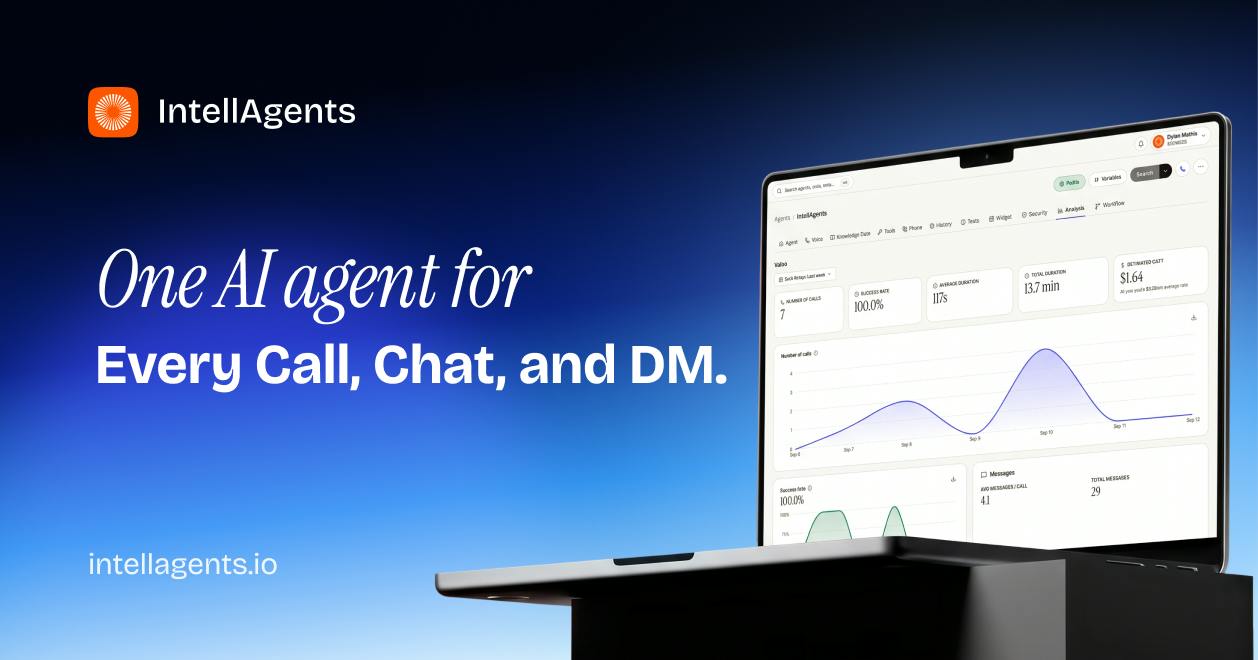
Product Positioning: One Agent, Every Channel
IntellAgents.io's core pitch is refreshingly direct — "One AI agent for every call, chat, and DM." It consolidates all the communication channels that would otherwise require multiple tools into a single platform, including:
- Voice calls: Both inbound (receiving calls) and outbound (proactive dialing)
- Instant messaging: WhatsApp, Instagram, Facebook, Telegram
- Website live chat: In-browser chat widgets
All of these channels share the same underlying knowledge base. Businesses configure their knowledge content once, and the AI agent maintains consistent, 24/7 responses across every channel.
Multilingual Support and a Unified Knowledge Base
The product claims to support real-time conversations in up to 36 languages. For cross-border e-commerce and multinational service businesses, language coverage often determines whether a customer service tool is viable at all. Traditional approaches typically require separate deployments or dedicated staff for each language; IntellAgents bakes multilingual capability directly into a single agent.
The "unified knowledge base" is a critical design choice for this category of product. One of the most persistent headaches for businesses is inconsistency across channels — the website says one thing, WhatsApp says another. By sharing a single knowledge base, IntellAgents attempts to eliminate this inconsistency at the architectural level, while also reducing maintenance overhead: update once, and all channels sync immediately.
The "unified knowledge base" typically relies on a Retrieval-Augmented Generation (RAG) architecture under the hood: company documents, FAQs, and product descriptions are vectorized and stored in a vector database. When a user asks a question, relevant passages are retrieved in real time and injected into the large language model's context, producing accurate and traceable answers. This represents a fundamental improvement over earlier "rule tree" chatbots — no need to manually author conversation branches for every possible question, and knowledge updates require only document edits rather than model retraining. That said, RAG quality depends heavily on how well-structured the knowledge base is and how precise the retrieval algorithm is. In multilingual scenarios, aligning the same semantic content across vector spaces in different languages adds another layer of complexity. When evaluating tools like this, key factors to examine include how knowledge is imported, which document formats are supported, and how traceable the generated answers are.
The Real Pain Points It Addresses
Small and mid-sized businesses and high-growth companies frequently face three layers of pressure around customer communication: stacking subscription costs from multiple tools, low efficiency in cross-channel coordination, and customer churn from missed inquiries outside business hours.
IntellAgents' product logic targets all three directly:
- Cost reduction — one platform replaces multiple tool subscriptions
- Efficiency gains — a unified knowledge base eliminates duplicate configuration and cross-channel calibration
- Always-on availability — the AI agent is online 24/7, covering all time zones and after-hours demand
Full-chain coverage from voice calls to social media DMs means this isn't just another "chatbot" — it's positioning itself as the unified communication gateway for businesses.
Observations and Considerations
It's worth noting that the success or failure of omnichannel integration products rarely hinges on how many channels they support, but rather on the actual integration quality and conversational experience within each channel. Voice customer service imposes far higher demands on latency, semantic understanding, and interruption handling than text chat does. Behind the headline number of 36 languages, the maturity and performance across each language may vary considerably.
Furthermore, deploying an AI agent for outbound calling introduces compliance and user acceptance challenges — outbound telemarketing is heavily regulated in many jurisdictions. When evaluating a platform, businesses should look beyond channel breadth and focus on the depth of refinement in their core channels.
The 73 upvotes IntellAgents received on Product Hunt suggests genuine market demand for this kind of "all-in-one AI customer service" solution. Whether IntellAgents — built by founder Vilen Bezhanyan — can hold its ground in the intensely competitive customer communications space will ultimately come down to real-world product performance.
Voice AI customer service is technically far more complex than text-based chat. Voice requires solving end-to-end latency (ideally under 500ms — anything more and conversations feel noticeably choppy), ASR robustness against accents and background noise, NLU handling of colloquial and spoken language, and TTS naturalness. Perhaps most critically, it requires proper "barge-in" handling: when a user interrupts while the AI is speaking, the system must stop immediately and respond — not finish its own sentence first. Current voice AI products vary significantly in how well they handle this. On the compliance front, outbound calling is tightly regulated in major markets including China, the US, and the EU. For example, the US FTC's Telemarketing Sales Rule requires explicit disclosure when a caller is an automated system, and the EU's GDPR places clear constraints on automated decision-making. The compliance costs and legal risks of outbound voice features are not trivial and deserve serious attention.
Summary
IntellAgents.io represents a broader trend in AI customer service: the evolution from "single-channel chatbots" toward "omnichannel unified agents." Its value proposition is clear — one agent, one knowledge base, 24/7 multilingual coverage across every channel. For businesses struggling with fragmented tooling, it's a compelling consolidation play worth watching. But its real-world experience and actual performance across each channel still need more user feedback before any firm conclusions can be drawn.
Related articles

Chain of Thought Isn't Just for AI: How Humans Can Use CoT to Improve Thinking Quality
Chain of Thought isn't just a prompt trick for large models. Starting from a Hacker News discussion, this article analyzes why CoT works for human thinking too, breaks down actionable ways to transfer it, and highlights the key differences between human CoT and machine CoT.
Cloudflare Teams Up with OpenAI: Closi…
Cloudflare Teams Up with OpenAI: Closing the Loop from Vulnerability Discovery to Defense with AI
Cloudflare uses OpenAI Daybreak to investigate security vulnerabilities and generate reviewable remediation plans, while developers use Codex to boost coding efficiency and quality.

Orca Multi-Agent Orchestration in Practice: A Guide to Parallel Collaboration with Claude and Codex
Orca is Stable AI's free open-source agent workbench supporting 34 agents like Claude Code and Codex in parallel. Learn its Git worktree isolation, multi-model orchestration, and mobile management.