Interactive Essays: A New Content Creation Paradigm Worth Diving Into

Interactive essays merge text with interactive elements, transforming passive reading into active understanding.
Interactive essays deeply integrate written narratives with interactive visualizations, animations, and simulators, enabling readers to actively experience complex concepts. Rooted in cognitive science and Bret Victor's Explorable Explanations, this format delivers far deeper understanding than traditional text. With AI tools lowering creation barriers, now is the ideal time to explore this high-impact content paradigm.
What Are Interactive Essays?
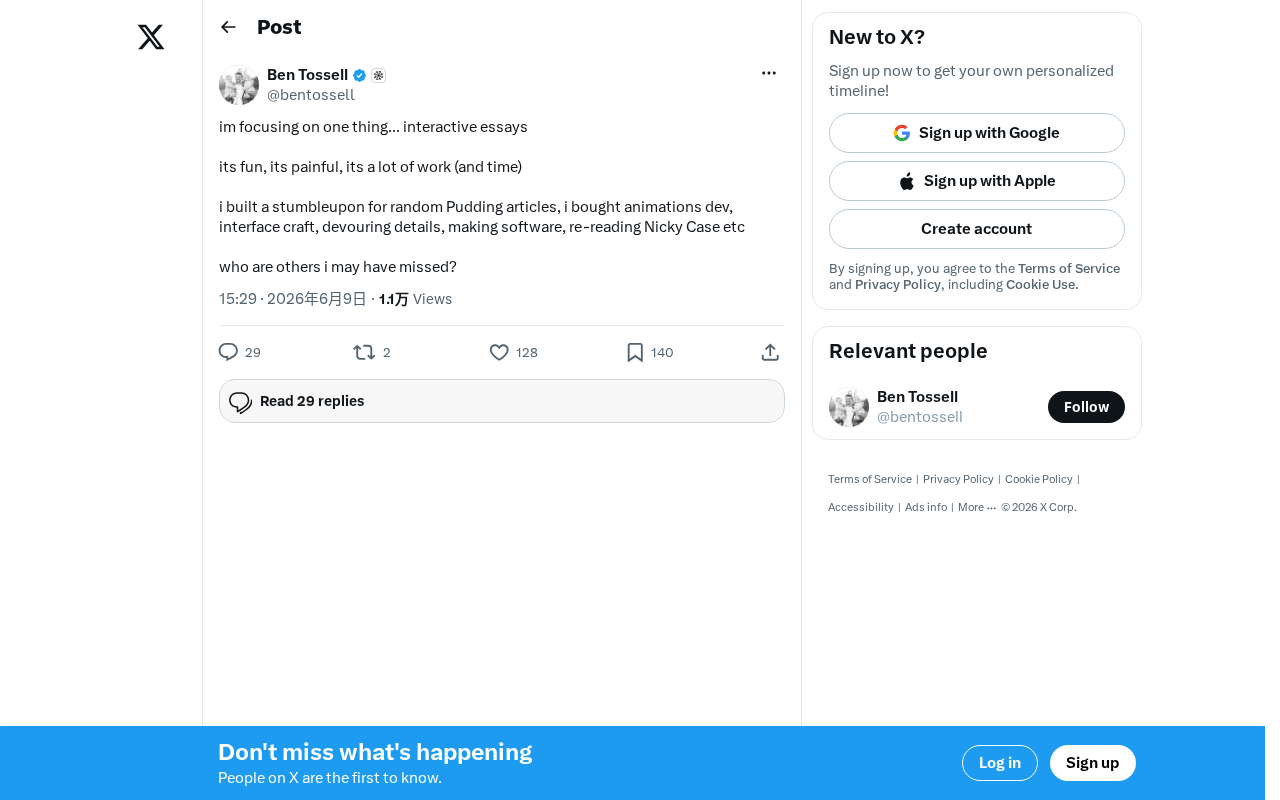
Recently, a developer shared on Twitter his journey of going all-in on creating "Interactive Essays." He candidly admitted that it's "fun, painful, and requires a massive amount of work and time" — but he chose to go all-in anyway.
Interactive essays are a content format that deeply integrates written narrative with interactive visualizations, animations, simulators, and other elements. Readers are no longer passive consumers — instead, they "experience" the concepts conveyed in the article by dragging sliders, clicking buttons, adjusting parameters, and more. This idea can be traced back to computer science pioneer Bret Victor's concept of "Explorable Explanations," proposed in 2011. He argued that numbers and models in articles should be manipulable, allowing readers to build intuition by adjusting parameters rather than passively accepting the author's conclusions. When explaining complex systems, mathematical principles, or social phenomena, interactive essays often deliver orders-of-magnitude improvements in cognitive efficiency compared to traditional text-and-image formats.
What Exactly Is This Creator Doing?
Several key takeaways can be extracted from his tweets:
Built a "StumbleUpon-Style" Discovery Tool
He built a random browsing tool for The Pudding — a media outlet renowned for data-driven visual essays — similar to the old StumbleUpon experience: click once and get randomly transported to a brilliant interactive piece. StumbleUpon was a web discovery platform founded by Garrett Camp in 2001. In the early Web 2.0 era, before algorithmic recommendations became ubiquitous, it was one of the core experiences for "serendipitously discovering great content" on the internet. At its peak, it had over 40 million users and was the second-largest source of social traffic after Facebook. Although StumbleUpon officially shut down in 2018, this "random discovery" interaction model continues to be honored and replicated by many independent projects. This shows that the creator isn't just producing content — he's systematically studying and absorbing the best work in the field.
Purchasing and Studying Extensive Reference Materials
He mentioned several important learning sources:
-
The Pudding: The gold standard for data journalism and visual storytelling — nearly every article is interactive. The Pudding was founded by Russell Goldenberg and others, positioning itself as "a digital publication that explains ideas debated in culture with visual essays." Team members typically wear multiple hats as journalists, data scientists, and front-end engineers. Notable works include Music Lyrics Have Gotten More Repetitive, which analyzes changes in pop music lyrics, and Film Dialogue, which explores gender differences in movie dialogue. Each article is built around carefully designed scrollytelling and data visualization, with production cycles typically ranging from weeks to months.
-
Nicky Case: A legendary figure in the interactive explanations space, known for works like The Evolution of Trust and Parable of the Polygons. Nicky Case is one of the core advocates of the Explorable Explanations movement. The Evolution of Trust lets players personally participate in Prisoner's Dilemma games, intuitively demonstrating the long-term evolutionary outcomes of cooperation and betrayal strategies — it has been translated into over 20 languages. Parable of the Polygons uses a draggable board to simulate Schelling's Model of Segregation, revealing how small individual preferences can lead to severe macro-level segregation. These works perfectly illustrate how interactivity can make abstract theories tangible and accessible.
-
animations.dev: A resource focused on web animation development
-
Interface Craft / Devouring Details / Making Software: In-depth content on interface design and software craftsmanship
This reading list itself serves as an excellent beginner's guide to interactive essays.
Why Are Interactive Essays Worth Paying Attention To?
Strong Support from Cognitive Science
The core advantage of interactive essays lies in "active learning." The cognitive science foundation behind this traces back to Jean Piaget's constructivist learning theory and Seymour Papert's Constructionism. Papert's research at the MIT Media Lab demonstrated that when learners can build and manipulate models with their own hands, their understanding of abstract concepts deepens significantly. A large-scale meta-analysis published in the Proceedings of the National Academy of Sciences (PNAS) in 2014 further confirmed this: active learning methods improved student exam scores by an average of 6% compared to traditional lectures, while the failure rate in passive learning groups was 1.5 times higher. Interactive essays essentially bring this active learning experience from the classroom into the browser.
Cognitive science research has repeatedly shown that when learners can manipulate variables and observe outcomes, the depth of understanding far exceeds passive reading. The reason Nicky Case's work has spread so widely is precisely because he enables readers to grasp concepts like game theory and group polarization — topics that would normally take hours to digest — in just 5 minutes of interaction.
New Creative Opportunities in the AI Era
With large language models and AI coding tools becoming increasingly mature, the barrier to creating interactive essays is dropping significantly. In the past, producing a high-quality interactive essay required writing ability, data visualization skills, and front-end development expertise simultaneously — this "trinity" of talent was extremely rare. Now, with AI coding assistants like Claude and Cursor, a person who excels at writing and thinking can much more quickly transform ideas into interactive prototypes.
A Powerful Tool for Content Differentiation
In an age of information overload, pure text content is increasingly difficult to stand out. Interactive essays, due to their scarcity and high engagement, naturally possess a distribution advantage. The lifespan of an excellent interactive essay often far exceeds that of a typical blog post — Nicky Case's The Evolution of Trust was published in 2017 and is still widely shared and cited today.
Getting Started with Interactive Essays: Where to Begin?
If you're also interested in creating interactive essays, here's a viable learning path:
-
Read extensively: Start with The Pudding, Nicky Case, and Distill.pub (machine learning visualization) to develop an intuition for what makes a great interactive essay. Distill.pub was an academic journal founded by Chris Olah and Shan Carter in 2017 with support from Google Brain. Its unique approach treated interactive visualization as a first-class citizen of academic expression, not merely a supplement to papers. Published articles like Attention and Augmented Recurrent Neural Networks and Feature Visualization became classic references for understanding the inner workings of deep learning. Notably, Distill announced a hiatus in 2021, with the team candidly acknowledging that the editorial cost of maintaining such high-quality interactive academic content was prohibitively high — which also underscores the difficulty of producing interactive essays.
-
Master the fundamental tools: Learn technology stacks commonly used for interactive content such as D3.js, Observable, and Svelte, or use AI-assisted coding to rapidly build prototypes. D3.js (Data-Driven Documents) was created by Mike Bostock in 2011 and is a foundational library in web data visualization. It provides fine-grained control over SVG, Canvas, and other graphics technologies by binding data to DOM elements. Observable is the interactive notebook platform Bostock later created — think of it as the Jupyter Notebook of data visualization — allowing creators to rapidly build interactive data narratives using reactive programming. Svelte has become a popular choice among interactive essay creators thanks to its minimal runtime overhead and intuitive reactive syntax — many of The Pudding's works are built with Svelte. Additionally, tools like Scrollama (a scroll-triggering library) and Three.js (3D rendering) are also common technical choices.
-
Start small: You don't need to build a complex simulator right away. A draggable slider paired with a real-time updating chart is already an effective interactive element.
-
Content first: Interactivity is a means, not an end. First figure out what you want to explain, then consider where interaction can genuinely help readers understand.
Conclusion
This creator's choice represents a content creation philosophy worthy of respect: he'd rather spend 10x the time on a single interactive essay that truly helps readers understand, than mass-produce 100 mediocre articles. In an era where AI can effortlessly generate vast amounts of text, this "craftsmanship" spirit has become even more precious.
Interactive essays may never become a mainstream content format — their production costs ensure that. But precisely because of this, they will continue to exist as a high-value, high-impact form of expression, serving as a unique competitive advantage for creators willing to invest the time and effort.
Related articles

Transformer²: Achieving Co-Design of Robot Morphology and Control with a Unified Architecture
Deep dive into how Transformer² uses a unified Transformer architecture to integrate robot morphology design and motion control into one model, enabling task-driven end-to-end co-design for embodied AI.

Tutorial: Installing Tailscale on a Jailbroken Kindle to Create a Private Network Node
Learn how to deploy Tailscale on a jailbroken Kindle, turning an idle e-reader into a private network node. Covers cross-compilation, power optimization, and risk considerations.
Tutorial: Installing Tailscale on a Jailbroken Kindle to Create a Private Network Node
Learn how to deploy Tailscale on a jailbroken Kindle to turn an idle e-reader into a private network node. Covers cross-compilation, power optimization, and risk considerations.