Interpretable Machine Learning Predicts Fiber-Reinforced Concrete Strength at High Temperatures

Study uses 1,204 records to compare eight ML models for post-high-temperature FRHPC strength; ensemble models perform best and SHAP reveals temperature dominance.
This study addresses the challenge of predicting the compressive strength of fiber-reinforced high-performance concrete (FRHPC) under high temperatures by building a data-driven framework with 1,204 experimental records and evaluating eight machine learning models. Ensemble methods, especially Gradient Boosting and XGBoost, performed best with R² of 0.903; Gradient Boosting had the lowest RMSE (6.67 MPa), while XGBoost led in MAE and MAPE. SHAP and PDP analyses identified temperature as the primary factor affecting strength, followed by fine aggregate, superplasticizer, and cement content. Strength decreases significantly with rising temperature, but deterioration depends on mix design. The best models are packaged into a Python GUI. The study notes applicability is limited by training data distribution and that SHAP reveals statistical associations, not causal mechanisms.
Title
Interpretable Machine Learning Predicts Fiber-Reinforced Concrete Strength at High Temperatures
Meta Description
A study uses 1,204 experimental records to compare eight machine learning models for predicting the compressive strength of fiber-reinforced high-performance concrete at high temperatures. Gradient Boosting and XGBoost achieve R² of 0.903, and SHAP analysis reveals temperature as the primary influencing factor. A companion Python GUI enables rapid prediction.
Article Content
Predicting the compressive strength of fiber-reinforced high-performance concrete (FRHPC) under high-temperature conditions has long been a challenge in engineering—mix proportions, fiber characteristics, curing conditions, and temperature are tightly coupled, making it difficult for traditional models to disentangle them. A recent study built a data-driven prediction framework using 1,204 experimental records, comparing eight machine learning models and, through interpretability analysis, revealing the dominant influence of temperature on strength.
Comparison of Eight Models: Ensemble Methods Win Across the Board
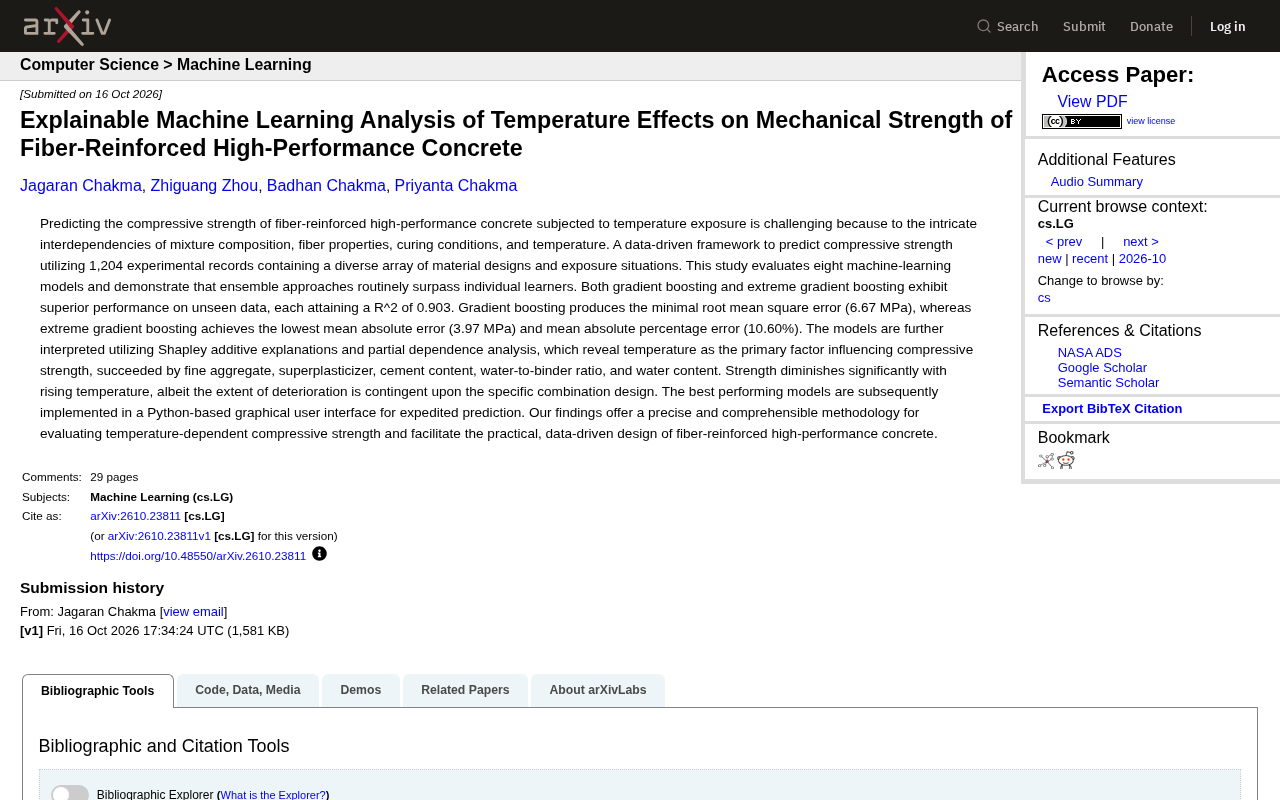
The research team collected 1,204 experimental records covering diverse material designs and exposure conditions, and evaluated eight machine learning models. Results show that ensemble approaches generally outperform single learners on the test set. Among them, Gradient Boosting and Extreme Gradient Boosting (XGBoost) performed best, both achieving an R² of 0.903 on unseen data.
In terms of specific error metrics, Gradient Boosting achieved the lowest root mean squared error (RMSE, 6.67 MPa), while XGBoost led in mean absolute error (MAE, 3.97 MPa) and mean absolute percentage error (MAPE, 10.60%). This result indicates that tree ensemble models possess strong generalization capability for the nonlinear prediction problem of post-high-temperature concrete strength.
Gradient Boosting and XGBoost: Gradient Boosting is an ensemble learning technique that iteratively trains a series of weak learners (typically decision trees), with each new tree fitting the residuals (i.e., prediction errors) of the previous tree, and finally summing the predictions of all trees in a weighted manner. XGBoost (Extreme Gradient Boosting) is an efficient implementation of gradient boosting that introduces regularization terms to control model complexity, supports parallel computation and sparsity awareness, and uses second-order gradient information to optimize the objective function, thus often exhibiting excellent accuracy and generalization on small-to-medium tabular datasets. Both are tree ensemble models that are insensitive to feature scaling and can automatically capture nonlinear interactions between features, which explains why they outperform single learners on multi-factor coupled problems such as concrete strength.
Interpretability Analysis: Temperature Is the Primary Influencing Factor
Beyond model accuracy, what is more noteworthy about this study is its dissection of the "black box." The authors employed Shapley Additive Explanations (SHAP) and partial dependence plots (PDP) to interpret the models, finding that temperature is the primary factor affecting compressive strength, followed by fine aggregate, superplasticizer, cement content, water-to-binder ratio, and water content.
This ranking has clear engineering implications: under high-temperature exposure scenarios, temperature's dominance over strength exceeds that of traditional mix proportion parameters. Partial dependence analysis further shows that strength decreases significantly with rising temperature, but the degree of deterioration depends on the specific mix design—meaning there is no universal temperature reduction factor, and material design requires targeted evaluation in conjunction with mix proportions.
SHAP and PDP: Shapley Additive Explanations (SHAP) originates from Shapley values in cooperative game theory. It decomposes a model's prediction for a given sample into the sum of contributions from each input feature, where the magnitude of contribution reflects how much that feature pushed the prediction above or below the baseline value. SHAP values are additive and consistent, providing both global feature importance rankings and local explanations. Partial dependence plots (PDP), on the other hand, show the marginal effect of a feature's value changes on model predictions while averaging out other features, and are commonly used to reveal nonlinear relationships between features and prediction targets. The combination of the two provides both "which features are important" and "how they influence" the outcome, transforming black-box models into insights understandable by engineering practitioners.
From Model to Tool: Python GUI Implementation
To facilitate use by engineering practitioners, the research team integrated the best-performing models into a Python-based graphical user interface (GUI) for rapid prediction. Users can obtain strength estimates by inputting mix proportions and temperature conditions, lowering the barrier to using machine learning models.
This work provides an accurate and interpretable method for evaluating temperature-related compressive strength, offering a practical pathway for data-driven design of fiber-reinforced high-performance concrete. Its value lies not only in prediction accuracy but also in transforming data conclusions into actionable engineering insights through interpretability analysis—for example, prioritizing temperature-sensitive mix parameters in high-temperature service environments rather than blindly optimizing conventional strength indicators.
Limitations and Outlook
It should be noted that the study's models were trained on 1,204 experimental records, and the data coverage determines their applicable boundaries. When mix proportions or temperature conditions fall outside the training data distribution, prediction reliability decreases. Additionally, SHAP reveals statistical associations rather than causal mechanisms; the microscopic mechanisms by which temperature affects strength still require validation through materials science experiments. Future work could combine the models with finite element thermo-mechanical coupling analysis, or introduce more fiber types and cooling regime variables to expand the framework's engineering applicability.
The difference between SHAP's statistical association and causal inference: SHAP values measure the degree of contribution of features to model predictions, based on statistical correlations between features and targets in the training data, rather than causal effects. If two features are highly correlated, SHAP may allocate predictive contribution to one while underestimating the other, causing importance rankings to be influenced by data distribution. Therefore, SHAP revealing temperature as the primary factor only indicates that temperature is strongly correlated with strength variation in the existing data, and does not prove that temperature is the sole or direct causal driver. Confirming microscopic mechanisms still requires materials science experiments (such as microstructure analysis and hydration product observation) for validation, or the use of causal inference methods to control for confounding factors.
One-line Summary
A study uses 1,204 records to compare eight machine learning models for predicting post-high-temperature FRHPC strength; ensemble models perform best and SHAP reveals temperature dominance.
Paragraph Summary
Addressing the challenge of predicting the compressive strength of fiber-reinforced high-performance concrete (FRHPC) under high-temperature conditions, this study constructed a data-driven framework containing 1,204 experimental records and systematically evaluated eight machine learning models. Results show that ensemble methods (particularly Gradient Boosting and XGBoost) performed best on the test set, both achieving R² of 0.903; Gradient Boosting had the lowest RMSE (6.67 MPa), while XGBoost led in MAE and MAPE. Through SHAP and PDP interpretability analysis, the study found temperature to be the primary factor affecting strength, followed by fine aggregate, superplasticizer, cement content, etc.; strength decreases significantly with rising temperature, but the degree of deterioration depends on the specific mix design. The best models were packaged into a Python graphical interface to lower the usage barrier. The study also notes that model applicability is limited by training data distribution, and that SHAP reveals statistical associations rather than causal mechanisms.
Related articles

Chain of Thought Isn't Just for AI: How Humans Can Use CoT to Improve Thinking Quality
Chain of Thought isn't just a prompt trick for large models. Starting from a Hacker News discussion, this article analyzes why CoT works for human thinking too, breaks down actionable ways to transfer it, and highlights the key differences between human CoT and machine CoT.
Cloudflare Teams Up with OpenAI: Closi…
Cloudflare Teams Up with OpenAI: Closing the Loop from Vulnerability Discovery to Defense with AI
Cloudflare uses OpenAI Daybreak to investigate security vulnerabilities and generate reviewable remediation plans, while developers use Codex to boost coding efficiency and quality.

Orca Multi-Agent Orchestration in Practice: A Guide to Parallel Collaboration with Claude and Codex
Orca is Stable AI's free open-source agent workbench supporting 34 agents like Claude Code and Codex in parallel. Learn its Git worktree isolation, multi-model orchestration, and mobile management.