Introduction to Prompt Engineering: Principles, Methods, and Practical Case Studies

A practical guide to prompt engineering principles, methods, and real-world case studies.
This article explains prompt engineering from first principles, covering In-Context Learning, role setting, and structured prompting techniques. Through practical cases like translation expert role-setting and DeepSeek image generation via external tools, it distills four core methods for effectively harnessing LLMs.
What Is Prompt Engineering
Prompt Engineering is a fundamental and important technique in the field of Natural Language Processing (NLP), specifically designed to guide language models in generating particular types of text. Its core idea is not complicated: by providing a language model with a piece of input text containing task information (i.e., the prompt), you leverage the linguistic knowledge and patterns the model learned during training to guide it toward producing the desired output.
The effectiveness of prompt engineering is rooted in the "In-Context Learning" capability of Large Language Models (LLMs). Through pretraining on vast amounts of text, these models learn to predict the probability distribution of the next word based on the input context, thereby acquiring cross-task generalization abilities.
It's worth understanding in depth that In-Context Learning is one of the most important emergent abilities of large language models. Unlike traditional machine learning, which requires retraining or fine-tuning the model for each task, this capability allows the model to instantly adapt to new tasks using only a few examples or instructions provided at inference time. It was first systematically described in the GPT-3 paper (2020)—researchers found that once the model's parameter scale crossed a certain threshold (typically in the billions), the model began to exhibit the ability to "learn" without gradient updates. This phenomenon of "Emergence" is not the result of linear growth, but a qualitative change that occurs once scale crosses a critical point, similar to how water suddenly boils at 100°C.
The underlying mechanism remains contested to this day: some research suggests that the model implicitly performs gradient descent during forward propagation, equivalent to completing a "virtual training" session in the activation space—Stanford researchers call this "Implicit Meta-Learning," arguing that the pretraining process essentially trains the model's ability to "learn how to learn"; another view holds that during pretraining the model has seen large amounts of text with "problem-answer" structures, and at inference time it is essentially doing pattern matching, retrieving the most similar solution framework from vast corpora—akin to a statistically-based "fuzzy memory retrieval." Research from MIT has further found that the Attention Mechanism in the Transformer architecture behaves in a manner strikingly similar to a gradient descent optimizer when processing few-shot examples—the attention heads at each layer implicitly perform weighted aggregation of example information, equivalent to completing multiple rounds of "soft optimization" along the depth dimension of the network. Regardless of the mechanism, this property makes prompt engineering possible.
Prompt engineering leverages precisely this property: through carefully designed input text, it activates the model's internal "implicit knowledge" corresponding to the task, without modifying any model weights. Task switching is achieved solely through text instructions—making it an AI application technique with an extremely low barrier to entry but enormous potential.
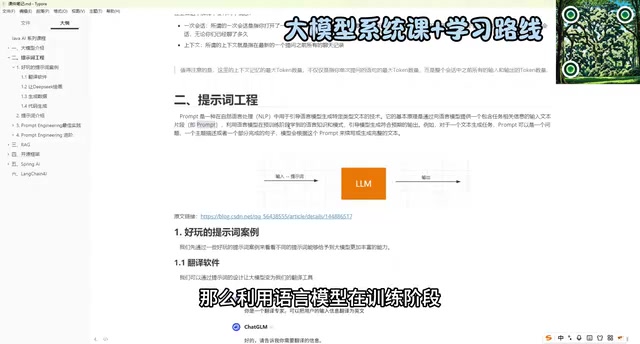
Here's an intuitive analogy: if you think of a Large Language Model (LLM) as a "brain," then the prompt is the input instruction you give it, and the model returns the corresponding output based on that input. This input can be a question, a topic description, or an unfinished sentence—the model will continue writing or complete the full text accordingly. Understanding this is the first step in mastering prompt engineering.
Basic Application Forms of Prompts
Prompts have a wide range of application scenarios. The simplest form is directly asking the model a question, while a more advanced approach uses a combination of "role setting + task description" to put the model into a specific working state, thereby producing more professional and precise content.
It's worth noting that prompt engineering has evolved into a relatively complete methodological system, following a clear path of technical progression. The most basic Zero-shot Prompting relies on the model's generalization ability, giving instructions directly without providing examples, suitable for tasks with clear boundaries where the model has thoroughly seen relevant corpora. Few-shot Prompting, formally established by the GPT-3 paper, embeds several "input-output" demonstration pairs within the prompt, significantly improving the model's performance on structured tasks—the examples serve to temporarily calibrate the model's output format and style, helping the model "understand" what you truly want. Chain-of-Thought (CoT) was an important breakthrough proposed by Google's research team in 2022—they found that when prompts require the model to "think step by step" or provide reasoning-process examples, the model's accuracy on tasks like mathematical reasoning and logical judgment improves dramatically. The reason is that step-by-step reasoning forces the model to decompose complex problems into multiple intermediate steps, reducing information loss across steps—essentially using the language generation process as an extension of "working memory."
Particularly noteworthy is that the effectiveness of CoT is highly correlated with model scale: experimental data shows that this technique provides almost no gains on small models with fewer than 10 billion parameters, and only reaches its full potential on models at the hundred-billion parameter level. This "scale dependency" reminds us that prompting techniques are not universally applicable, but are deeply bound to the capability boundaries of the underlying model. Additionally, the Google team also found that even a simple "magic phrase" like "Let's think step by step" can trigger CoT-like reasoning behavior in zero-shot scenarios—a discovery known as Zero-shot CoT, which further lowers the barrier to structured reasoning.
Tree of Thoughts further extends the linear reasoning chain into a tree-shaped search structure, allowing the model to explore, evaluate, and backtrack across multiple reasoning paths. Combined with heuristic search strategies (such as breadth-first or best-first), it is especially effective in scenarios like complex reasoning, code generation, and strategic planning. This evolutionary path from "direct instructions" to "structured reasoning" essentially uses prompt design to compensate for the inherent limitations of the model architecture itself.
Role Setting: Turning the Model into a Translation Expert
For example, after starting a new conversation, enter this prompt: "You are a language translation expert who can translate any information the user inputs into English." Once the role is defined, no matter what content the user sends, the model will automatically translate it into English output.
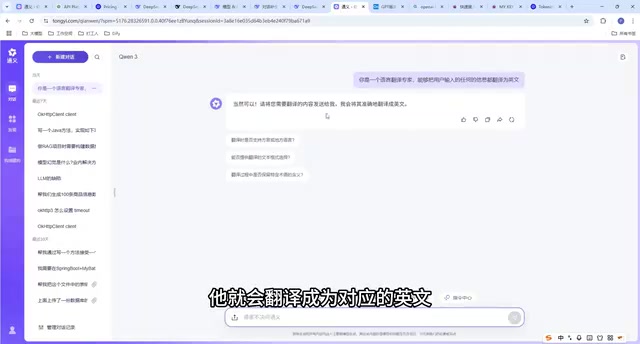
The effectiveness of this approach has deep underlying reasons: during training, large language models absorb vast amounts of professional text (such as medical papers, legal documents, and translation materials), and different role labels activate corresponding corpus distributions. When the model is told "you are a translation expert," its output probability distribution shifts toward professional expressions in the translation domain, statistically improving output quality significantly. This phenomenon is called the "Role Activation Effect" in research—the role description is equivalent to applying a directional bias in the high-dimensional probability space, guiding the model's "attention" toward specific language patterns and knowledge domains.
From an information theory perspective, role setting essentially compresses the "uncertainty space" (Entropy) of the output: a general-purpose model without a defined role, when faced with the same question, might respond in dozens of styles—academic, colloquial, humorous, serious, etc.; role setting is equivalent to applying a style constraint in advance, converging the possible output distribution from "broad and scattered" to "narrow and precise," thereby producing higher-quality generation within the target style. This is also why the more detailed the role description, the better the results tend to be—"You are a translation expert" versus "You are a senior simultaneous interpreter proficient in Chinese-English translation, skilled at preserving the original tone and cultural connotations" produce significantly different activated corpus distributions.
The essence of this approach is transforming a general-purpose language model into a specialized tool through clear role definitions and task constraints—in the example above, it becomes a translation software. This also reveals the core value of prompt engineering: without retraining the model, and relying solely on carefully designed text instructions, you can enable the same model to handle an ever-changing variety of tasks.
Practical Case: Extending Image Generation Capabilities with Prompts
The following case is quite instructive—how can prompts enable a model that originally lacks drawing capabilities to "indirectly" generate images?
DeepSeek's Image Generation Attempt
When directly asking DeepSeek to generate an image of "a small river, stones, butterflies, a lion, in a realistic style," it clearly responds that it cannot generate images directly and can only offer composition suggestions, recommending professional drawing tools such as Midjourney and DALL·E.
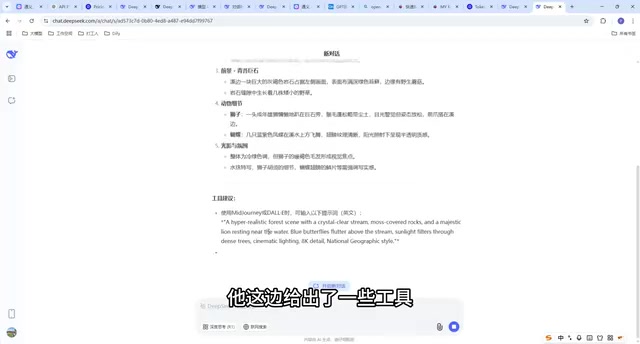
But with clever prompt design, this limitation can be completely bypassed. The core logic is: have the model play the role of an "AI image generation robot," first refining a detailed image description based on the user's input, then converting this description into URL encoding and inserting it into the address of an online image generation site, with the external service ultimately returning the image.
The underlying principles of this technique are worth understanding in depth. URL encoding (Percent Encoding) is a foundational specification of the HTTP protocol, defined in the RFC 3986 standard—since URLs only allow the transmission of a specific subset of the ASCII character set, characters like Chinese, spaces, and punctuation must first be converted into UTF-8 byte sequences and then encoded in the form of "%" followed by two hexadecimal digits (for example, a space becomes %20, and the Chinese word "森林" (forest) is encoded as %E6%A3%AE%E6%9E%97). This encoding scheme ensures the compatibility and transmissibility of URLs across different language environments worldwide, forming one of the cornerstones of modern Web communication. It's worth noting that UTF-8 itself is a variable-length encoding scheme: characters within the ASCII range (such as English letters and numbers) require only 1 byte, while Chinese characters typically require 3 bytes. This is why the character count of a Chinese description balloons dramatically after URL encoding—something to be mindful of when constructing URLs, given the limits browsers and servers place on URL length (typically ranging from 2,000 to 8,000 characters).
Pollinations.ai is an open AI image generation API service whose core architecture is based on open-source diffusion models (Diffusion Models) such as Stable Diffusion and FLUX—diffusion models work by first progressively adding random noise to an image (the forward diffusion process, typically involving hundreds to thousands of steps), then training a neural network to learn the reverse "denoising" process (the reverse diffusion process), so that it can start from pure noise and, guided by a text description as a condition, progressively generate clear image content. This idea derives from the diffusion equation in thermodynamics and was formally introduced into the image generation field by a Stanford team around 2020, rapidly replacing GANs (Generative Adversarial Networks) as the mainstream text-to-image paradigm over the following years. Pollinations.ai adopts a "URL-as-API" design—users simply append a text description to the URL, and the server sends it into the image generation pipeline and returns the corresponding image file, requiring no authentication or SDK. Any environment capable of rendering Markdown (such as a chat interface) can directly display the generated result, greatly lowering the barrier to invocation.
Therefore, the role the large language model plays throughout this process is that of a "parameter generator"—converting human natural language descriptions into high-quality English prompts and constructing correctly formatted URL strings, effectively acting as a "translation layer" between humans and the image generation service. This is precisely the prototype of modern AI Agent architecture: the language model is no longer merely a "conversation tool," but an "intelligent hub" capable of understanding intent, planning steps, invoking external tools, and integrating results.

Simply put, the essence of this technique is: have the large model generate a text description of the image, then use an external image generation site to convert the description into an image and display it. In actual testing, after inputting elements like "forest, stream, butterflies, lion," the image was successfully generated; further supplementing with descriptions like "blue sky and white clouds, small spring, fisherman, anime style" also yielded a style-matched anime-style work. This is a classic demonstration of how prompt engineering can "achieve much with little effort."
Capability Differences Across Models
It's worth noting that different large models vary in their level of support for similar tasks. Tongyi Qianwen can directly respond to image generation requests because Alibaba Cloud has integrated multimodal text-to-image capabilities for it; whereas DeepSeek, as a pure language model, does not include an image decoder in its architecture and needs to invoke external services through the prompt technique described above.
This capability difference reflects the deep architectural divergence between "multimodal large models" and "pure text large models." One of the core technical foundations of multimodal models is CLIP (Contrastive Language-Image Pretraining), proposed by OpenAI in 2021: through Contrastive Learning, it aligns image features with text descriptions in a shared embedding space—that is, making "an image of a cat" and the text "a cat" close to each other in vector space, while pushing mismatched image-text pairs apart. This alignment training method is extremely efficient: OpenAI used 400 million image-text pairs scraped from the internet for training, requiring no manual annotation, and completed the unified modeling of visual-semantic space relying solely on natural language supervision signals—regarded as a milestone in the field of multimodal learning.
Text-to-image models like Stable Diffusion use CLIP's text encoder to convert prompts into conditioning vectors, guiding the diffusion process to generate images matching the description. Multimodal models like Tongyi Qianwen, on top of the language model backbone, additionally introduce a visual encoder (such as ViT, Vision Transformer—a visual understanding model that cuts an image into fixed-size "patches," flattens each patch into a one-dimensional vector and attaches positional encoding, then feeds it into a standard Transformer architecture for processing; its core insight is that an image can be treated as a "sequence" like text, and the attention mechanism can naturally capture long-range spatial dependencies between patches) and a cross-modal fusion module, enabling bidirectional understanding and generation of text and images.
Meanwhile, the Transformer architecture of pure language models like DeepSeek does not include an image decoder, and its output space is limited to text tokens, so it cannot natively generate pixel-level image content. Models like GPT each have their own processing approaches—for example, GPT-4o achieves native multimodality through deeply integrating a visual encoder, while early ChatGPT plugins adopted an "external tool invocation" strategy similar to the case in this article. This reminds us: in actual use, it's important to thoroughly understand the capability boundaries and underlying architectural differences of different models, and flexibly adjust prompt strategies accordingly, rather than mechanically applying the same approach to all models.
Core Methodology of Prompt Engineering
Combining the above cases, we can summarize four practical points of prompt engineering:
First, clarify the role and task. Setting a role using phrasing like "You are a ... expert/robot" can significantly improve the relevance and professionalism of the output. The mechanism behind this is activating the probability distribution the model learned from corresponding domain corpora, converging the output style toward the professional direction. The effect of role setting is positively correlated with the granularity of the description: a vague "you are an expert" is not as effective as a specific "you are a tech writing expert with 10 years of experience, skilled at concise expression" in activating the model's professional corpus distribution. In practice, you can also assign the role "behavioral guidelines" (such as "you always confirm the user's needs before giving advice") and "output constraints" (such as "each answer should not exceed 200 words, using bullet-point lists") to further narrow the output space and improve the predictability of results.
Second, structure the requirement description. Whether translating or drawing, the clearer and more specific the description, the closer the results will be to expectations. Take image generation as an example: only by clearly listing the scene elements (such as forest, stream, lion) and style requirements (realistic, anime) can you guide the model to produce ideal content. In practice, you can draw on the "5W1H" framework (What, Why, Who, Where, When, How) to break down vague requirements into structured prompt components, greatly reducing the model's "guessing space." Additionally, Negative Prompting is also an important dimension of structured design—clearly telling the model "what not to do" (such as "do not use technical jargon" or "do not exceed three paragraphs") can effectively avoid common output biases, complementing positive descriptions to jointly tighten the output boundaries.
Third, make good use of tool combinations to extend capabilities. When a single model's capabilities are limited, you can use prompts to link the model with external services (such as image generation sites) to form capability supplements. This is an advanced approach of "prompts + tool chains," and it is also the foundational logic of the currently popular AI Agent development paradigm. The core architecture of an AI Agent includes four modules: the perception layer (receiving user instructions and environmental feedback, equivalent to the Agent's "senses," including multimodal input channels such as text, images, voice, and sensor data), the planning layer (with the LLM responsible for task decomposition and reasoning, serving as the entire Agent's "brain," deciding "what to do" and "how to do it," typically combined with reasoning frameworks such as ReAct and Reflexion to achieve self-reflection and dynamic adjustment), the tool layer (invocable external APIs, databases, code executors, search engines, etc., equivalent to the Agent's "hands and feet," responsible for interacting with the external world and converting the language model's "thinking" into real side effects), and the memory layer (short-term conversation context and long-term external storage, such as semantic retrieval systems based on vector databases, enabling the Agent to accumulate knowledge across sessions and achieve continuous learning that gets "smarter with use"). More mature Agent frameworks (such as LangChain and OpenAI Function Calling) further implement dynamic tool selection and feedback loops for execution results—the model can not only invoke tools but also autonomously decide the next action based on the results returned by tools, forming a closed loop of "perception-planning-execution-feedback," representing the direction of prompt engineering evolving from "instruction design" to "systems engineering."
Fourth, understand the capability boundaries of each model. The same prompt may perform completely differently across different models. Familiarity with the characteristics and architectural differences of mainstream models is a prerequisite for using prompt engineering efficiently. It is recommended to establish a "model capability matrix" in practice—recording the measured performance of different models across dimensions such as reasoning, code, multilingual, and multimodal capabilities, forming a basis for model selection rather than blindly relying on a single model. At the same time, pay attention to each model's Context Window size—this parameter determines how much content the model can "remember" within a single conversation, directly affecting the feasibility of long document processing, multi-turn conversations, and complex task decomposition; currently the context windows of mainstream models range from tens of thousands to millions of tokens, an important reference dimension in model selection.
Conclusion
Prompt engineering may seem simple, but it is actually a key lever for unlocking the potential of large language models. It does not require the user to have a deep background in programming or algorithms, but instead emphasizes understanding and applying language expression, task decomposition, and tool combination. For beginners with no foundation, starting by imitating cases and gradually mastering the closed-loop process of "role setting—task description—result feedback" is an effective path to getting started quickly. As the capabilities of models like DeepSeek, Tongyi Qianwen, and GPT continue to evolve, and as new paradigms such as multimodality and AI Agents continue to mature, prompt engineering will become an essential skill for every user in the AI era.
Related articles

Hubbele: An Open-Source Note-Taking App Built for Both Humans and AI Agents
Hubbele is an open-source note-taking app designed for both humans and AI Agents, supporting self-hosted deployment. This article analyzes its Agent-native design philosophy and implications for the future of knowledge management.

AI Treasure Hunting on the Ocean Floor: How AE Studio Uses Algorithms to Locate Shipwreck Treasures
AE Studio uses AI to fuse historical shipping archives, marine geographic data, and satellite remote sensing to locate shipwreck treasures via machine learning models.

AI Treasure Hunting Underwater: How AE Studio Uses Algorithms to Locate Shipwreck Treasures
AE Studio uses AI to fuse historical shipping archives, ocean geographic data, and satellite remote sensing to locate underwater shipwreck treasures via machine learning models.