Invited: AI Reminder Scanner Turns Bill Invitations into Smart Reminders

Invited is an AI reminder scanner that turns bills, invitations, and documents into calendar reminders.
Invited is an AI reminder scanning tool that debuted on Product Hunt, converting bills, invitations, checks, screenshots, and PDFs into smart calendar reminders. It extracts multiple reminders from a single document across date, time, location, and amount fields, supporting 80+ languages and 9 calendar systems. It targets the 'last mile' of reminder tools — moving scattered time information into the calendar. Currently Android-focused, with 76 votes and a 13th-place ranking on Product Hunt.
Invited: AI Reminder Scanner Turns Bill Invitations into Smart Reminders
Have you ever had this experience: your phone's photo album is packed with pictures of payment slips, wedding invitations, checks, and meeting screenshots, yet you only remember them after the deadline has passed? Invited tries to solve this problem with AI — it's a scanning tool that automatically converts paper and digital documents into calendar reminders.
What Is Invited
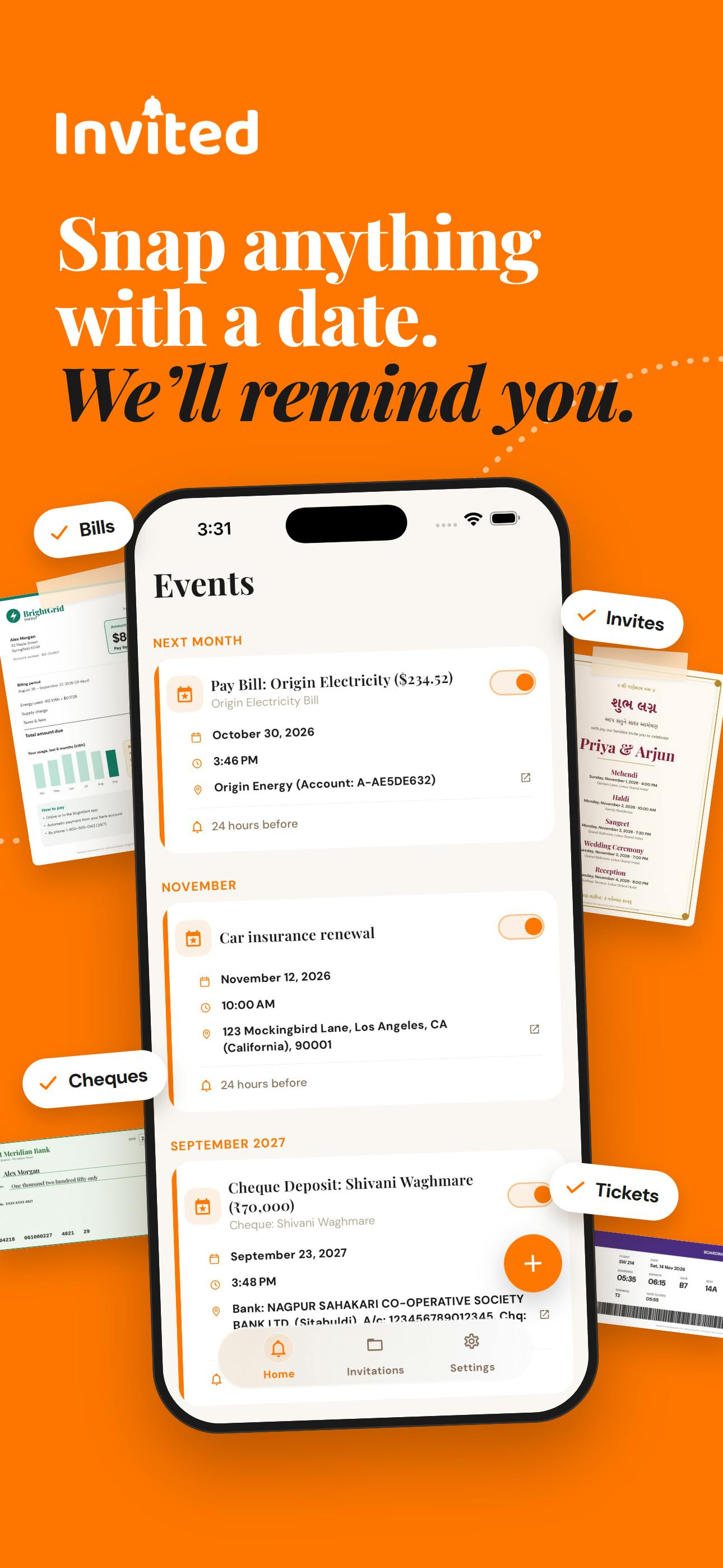
Invited debuted on Product Hunt with the tagline "AI reminder scanner for bills, invites & documents," positioning itself as an AI-powered reminder scanner. Its core logic is simple: users photograph or upload bills, invitations, checks, screenshots, and PDFs, and Invited automatically extracts the dates, times, locations, and amounts within them to generate corresponding smart reminders.
The product earned 76 upvotes and 6 comments on Product Hunt, ranking 13th for the day, with categories spanning Android, Productivity, Calendar, and Artificial Intelligence. From its positioning, it targets the everyday pain point of "scattered information sources and easily overlooked reminders."
Core Features Breakdown
Extracting Structured Information from Documents
Invited's capability goes beyond simple OCR text recognition. According to the official description, it can identify multiple reminders from a single document — meaning that if a bill contains both a payment deadline and a service renewal date, Invited can extract them separately and create two independent reminders rather than generating one vague record.
The extracted fields include date, time, location, and amount, essentially covering the most critical information dimensions in everyday receipts and invitations. For users, this eliminates the tedium of manual entry and reduces the likelihood of "taking a photo and then forgetting about it."
OCR (Optical Character Recognition) is the technology that converts text in images into editable text. It's a foundational capability for this type of scanning tool, but it's far from sufficient. Plain OCR only produces a stream of unstructured characters, and whether "2024-06-30" on a receipt is a payment deadline, an issue date, or a service start date requires layout analysis and semantic understanding to determine. Invited's claim that it can identify multiple reminders from a single document means it layers an information extraction step on top of OCR: first locating key field regions in the document, then normalizing entities like dates and amounts into standard formats (for example, parsing "by June 30" into a specific date), and finally determining which fields constitute an independent reminder event. This is why two dates on the same bill can be split into two reminders — the system needs to understand the semantic relationships between fields rather than simply splitting by line.
Multi-Language and Multi-Calendar Support
Invited claims support for over 80 languages and 9 calendar systems. Multi-language capability determines whether it can handle non-English receipts and documents, making it more user-friendly in multilingual environments; support for 9 calendars means it's not limited to Google Calendar and may cover system-native calendars, Outlook, and other mainstream options.
These two figures are relatively standout specifications among similar tools. Most reminder apps only support a handful of languages and one or two calendar platforms, so Invited's coverage in this regard constitutes a degree of differentiation.
Interoperability between calendar systems isn't as simple as it appears on the surface. Google Calendar, Apple Calendar, Outlook, and other platforms each use different data models and synchronization protocols. CalDAV is a relatively universal open standard, while each vendor also has its own proprietary interfaces. So-called "support for 9 calendar systems" typically means the app needs to implement independent authorization, reading, and writing logic for each platform, and handle mapping differences in time zones, recurring event rules (RRULE), reminder lead times, and other fields. On the multi-language front, support for over 80 languages involves not just interface localization but, more critically, the document recognition step — date formats vary enormously across languages (such as the ambiguity between "30/06/2024" and "06/30/2024"), requiring judgment based on language context, otherwise dates can easily be parsed incorrectly.
What Problem Does It Solve
The "Last Mile" of Reminder Tools
Calendar apps themselves don't lack reminder functionality — what's missing is the step of "getting the reminder in there." Users receive paper bills, wedding invitation screenshots from friends, or PDF meeting notices, and this information stays in chat logs or photo albums without ever entering any reminder system. Invited targets exactly this "last mile" — uniformly moving time information scattered across various mediums into calendars and reminders.
This idea isn't new, but the execution challenge lies in recognition accuracy and scenario coverage. Bill layouts vary enormously, invitations are even more free-form, and checks have high information density with special fonts. Whether it can reliably extract the correct time and amount is the key to success or failure for this type of tool.
The real technical barrier for such tools is robustness. Recognizing a neatly formatted PDF bill in a lab environment isn't difficult, but real-world inputs are extremely messy: paper receipts photographed at an angle have shadows and creases, screenshots compressed by messaging apps have very low resolution, handwritten invitation fonts are wildly varied, and check amounts appear in both numerals and uppercase Chinese characters or English words. Even a few percentage points' difference in recognition accuracy translates to losses for users — experiences like "the reminder was set for the wrong date" that directly cause harm. Therefore, the success of such products often doesn't depend on how long the feature list is, but on its fault-tolerance design for edge cases — for example, whether it prompts users to confirm when recognition confidence is low, rather than silently generating a potentially incorrect reminder.
Target User Profile
Judging from the feature design, Invited's core users are likely: freelancers and small business owners who need to handle large volumes of receipts, multinational workers who frequently receive multilingual documents, and ordinary users who habitually record to-dos by taking photos. For these people, the time cost of manually entering reminders accumulates considerably.
Notable Design Trade-offs
One Scan, Multiple Reminders
The ability to "find multiple reminders in a single document" deserves special mention. Many scanning tools assume one document corresponds to one event, but in reality a bill may contain multiple payment milestones, and an invitation may contain both a registration deadline and the event date. Invited's support for multi-reminder extraction shows it considered the complexity of real documents in its product design.
Platform Strategy
Currently Invited appears under the Android category, and its Product Hunt page uses Android as the primary platform tag. Considering that iOS users have equally strong demand for productivity tools, whether an iOS version will be released or whether it will take a cross-platform route will affect its user coverage.
Similar Products and Market Position
AI document scanning and reminder management are two already quite crowded tracks. The scanning category has mature products like CamScanner and Adobe Scan, while the reminder category has established tools like Todoist and Any.do. But products that bridge the two and focus specifically on the "document → reminder" niche scenario are relatively rare.
Invited's opportunity lies in the verticality of its scenario: it doesn't need to be the best scanner, nor the best to-do app — it just needs to be reliable enough at "snap a receipt, automatically generate a reminder." The risk is that if major players integrate similar capabilities into system-level calendars or scanning apps, the survival space for independent tools will be squeezed.
Summary
Invited's approach is clear: use AI to transform unstructured receipts and documents into structured calendar reminders, reducing the everyday losses of "forgetting deadlines." Support for 80 languages and 9 calendars gives it a certain advantage in coverage, while multi-reminder extraction reflects an understanding of real-world scenarios.
Whether it can establish itself depends on recognition accuracy on real documents and whether users are willing to install a dedicated app for a niche scenario. For those constantly chased by bills and invitations, this is at least a direction worth trying.
One-line Summary
Invited is an AI reminder scanner that automatically converts bills, invitations, and other documents into calendar reminders.
Paragraph Summary
Invited is an AI reminder scanning tool that debuted on Product Hunt, focused on converting bills, invitations, checks, screenshots, and PDFs into smart calendar reminders. Its core capability is extracting multiple reminders from a single document, covering date, time, location, and amount fields, with support for over 80 languages and 9 calendar systems. The article argues that it targets the "last mile" missing from reminder tools — calendars don't lack reminder functionality; what's missing is the step of moving time information scattered across photo albums and chat logs into the calendar. The product currently primarily targets the Android platform, earning 76 votes and ranking 13th on Product Hunt. Its opportunity lies in being sufficiently vertical, while its risks lie in whether recognition accuracy can withstand the test of real documents and the potential squeeze from major players' system-level integrations.
Related articles

JobRunner MCP Server: AI Agents Can Now Fix Failed Java Jobs
JobRunner launches an open-source MCP server enabling AI agents to view cluster status, diagnose failures, and recover Java jobs—incident response from any cloud coding environment or existing agent.

MLAI Digital Launches 9 Security Agents: MCP Server Safeguards the Full Lifecycle of Agentic AI
MLAI Digital launches Security MCP Server with nine built-in specialized security agents covering vulnerability discovery, attack simulation, prompt injection detection, API and infrastructure assessment, and accelerated remediation—embedding security validation across the full Agentic AI lifecycle from development to production.

Running Isaac Lab on H100 GPUs: Exploring Better Approaches
Exploring optimization methods for running Isaac Lab on NVIDIA H100 GPUs, including MIG configuration, mixed precision, TensorRT acceleration, and community experience to improve robotics simulation and reinforcement learning efficiency.