Invofox Self Serve: Document Extraction API with 99% Accuracy Backed by SLA

Invofox Self Serve uses a single API and SLA-backed accuracy guarantees to redefine document extraction trust.
Invofox Self Serve is a document data extraction service for developers and enterprises, converting invoices, contracts, and reports into clean JSON through a single API that bundles parsing, extraction, validation, edge case handling, and monitoring in one endpoint. Its standout differentiator is a commercial commitment: 99%+ extraction accuracy backed by an SLA, with errors meaning no charge — shifting risk from customer to provider. The system also learns continuously from user feedback to improve accuracy on specific document types over time. It earned 171 upvotes and a #3 ranking on Product Hunt, though key details like accuracy benchmarks, supported document scope, and SLA terms still require hands-on evaluation.
Document data extraction has long been one of the most frustrating bottlenecks in enterprise automation. Invoices, contracts, reports, forms — these unstructured or semi-structured documents need to be converted into machine-readable, structured data, and traditional OCR solutions often fall apart on edge cases like complex layouts, handwriting, or mixed-language content. Invofox Self Serve aims to solve this age-old problem with a single API and a Service Level Agreement (SLA), earning 171 upvotes and a #3 ranking on Product Hunt the day it launched.
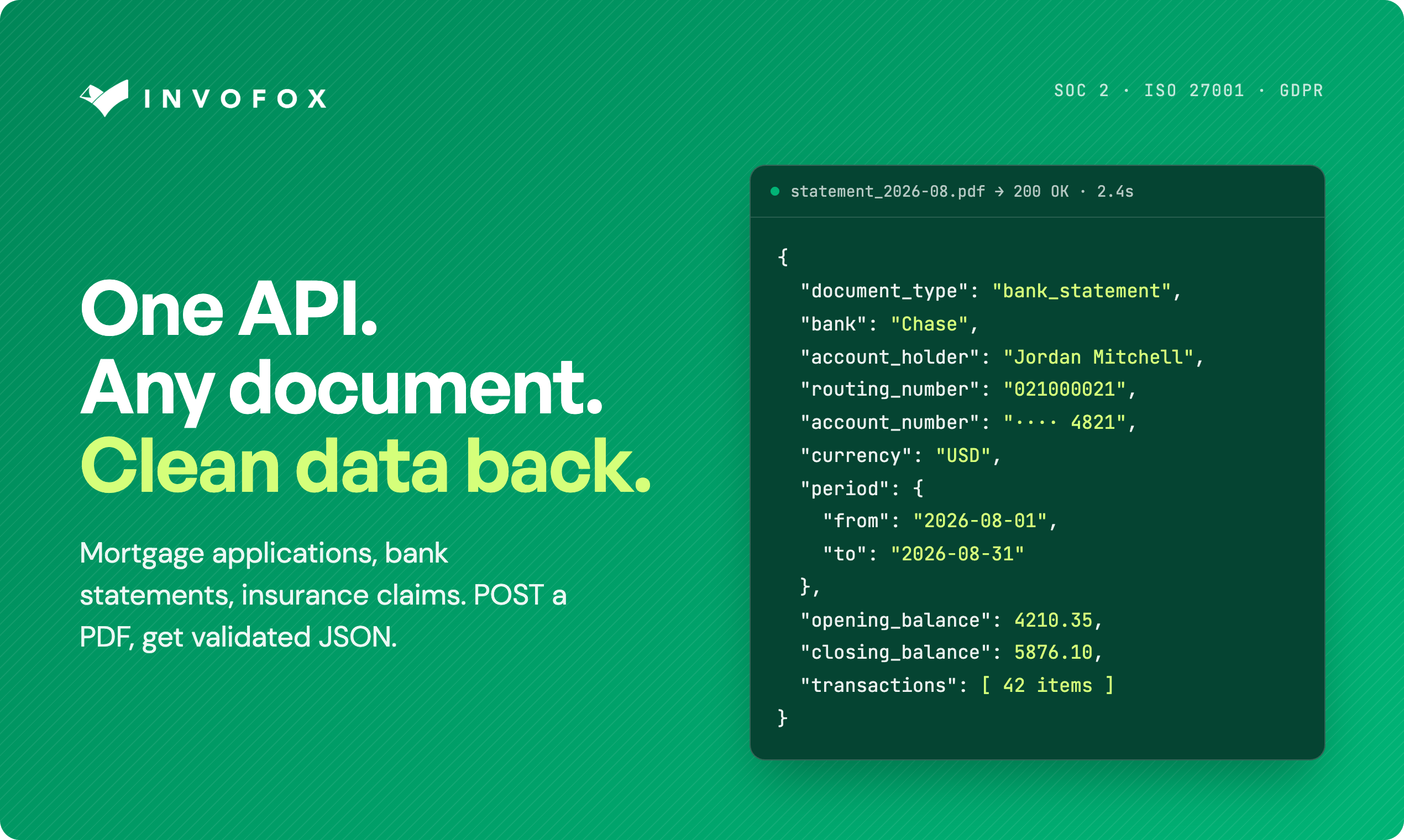
One API to Turn Documents into Clean JSON
Invofox's core value proposition is straightforward: convert any document into well-structured JSON through a single API. Developers don't need to stitch together multiple tools or handle the tedious work of parsing, extraction, and validation themselves — all of it is encapsulated behind one endpoint.
According to the official description, Invofox handles five stages within a single interface: parsing, extraction, validation, edge case handling, and monitoring. This "black box" approach is especially appealing to small and mid-sized teams, because building a document processing pipeline in-house requires significant engineering investment, and covering edge cases typically demands years of accumulated data and rule refinement.
For developers, this translates to dramatically lower integration costs. One API call in, structured data out — the messy work in between is the service provider's problem.
A traditional document processing pipeline is typically composed of multiple independent components chained together: an OCR engine (such as Tesseract or AWS Textract) converts images or PDFs to text, then a rules engine or regex layer handles field extraction, a validation layer checks format compliance, and only then is structured output produced. Each stage has its own failure points, and converting data formats between components adds further engineering overhead. For enterprises handling documents from multiple sources and layouts, the maintenance burden grows exponentially with document variety. Invofox's "single endpoint" approach is essentially outsourcing this entire pipeline to a SaaS provider — developers only need to care about the contract between input document and output JSON, not the engineering details in between.
Backing Accuracy with SLA: No Charge for Errors
What truly sets Invofox apart from the many document extraction services on the market is that it writes accuracy into its commercial commitment. The product claims 99%+ extraction accuracy, backed by an SLA — if an extraction fails, that document isn't charged.
This is a bold pricing and trust mechanism. The document extraction space is full of vague marketing claims like "our accuracy is very high," while Invofox directly shifts the risk onto itself: errors mean no charge. For enterprises that rely on document processing in mission-critical workflows, this kind of commitment significantly lowers the barrier to adoption.
That said, how "99% accuracy" is defined, under what document types and complexity levels it holds, and the specific terms of the SLA's compensation clauses are not fully elaborated in the product brief — these details still require careful evaluation before actual adoption.
An SLA (Service Level Agreement) is a contract term in B2B software services that sets the floor for service quality, typically covering availability (e.g., 99.9% uptime), response times, and failure compensation. Including "accuracy" in an SLA is uncommon in the document processing space — most OCR or document AI vendors only commit to infrastructure-level availability, not result quality. Invofox's promise of "no charge for extraction errors" essentially trades revenue risk for customer trust, in sharp contrast to the traditional model of per-call billing where accuracy risk falls on the customer. When evaluating such an SLA, pay close attention to how "errors" are defined (field-level vs. document-level), the dispute resolution mechanism, and the limits of this commitment on high-complexity documents.
Continuous Learning from Feedback
Another design philosophy behind Invofox is that it gets more accurate the more you use it. The system automatically learns from user feedback, continuously optimizing extraction performance for the specific document types a business actually processes.
This speaks to a fundamental truth in document extraction: general-purpose models often underperform compared to models fine-tuned for specific business contexts. Every company's invoice formats, contract templates, and report structures are different. A system that iterates based on real usage data will, in theory, become increasingly reliable on a customer's particular documents over time.
This feedback loop essentially spreads the cost of solving "long-tail edge cases" across ongoing operations, rather than expecting an out-of-the-box model to handle everything from day one.
In document extraction, "feedback-based learning" typically follows one of two technical paths: Active Learning, where the system flags low-confidence extraction results and prioritizes them for human review, with confirmed samples used for model fine-tuning; or implicit feedback from user corrections, where a user editing an extracted field in the UI is recorded as a training signal. Either way, the ceiling of effectiveness depends on the quality and volume of feedback data. Enterprise customers with a narrow set of document types and high processing volumes tend to benefit the most from this mechanism; for scenarios with highly varied document formats and small batch sizes, accuracy fluctuations during the cold-start phase are still a challenge to anticipate.
Target Audience and Use Cases
Based on its Product Hunt category tags — API, Developer Tools, and Artificial Intelligence — Invofox has a clear positioning: it's built for developers and enterprises that need to embed document processing capabilities into their applications.
Typical use cases include financial automation (invoice and receipt processing), document-heavy back-office operations, and SaaS products that need to batch-extract fields from PDFs or scanned files. For these teams, plugging into a mature API with SLA guarantees is often a better bet than spending months building something in-house.
The name "Self Serve" also signals a low-friction onboarding experience — developers can sign up, trial, and integrate on their own without going through a lengthy sales process, further lowering the barrier to getting started.
Takeaway
Invofox Self Serve's appeal isn't that it does something entirely new — it's that it redefines the trust model for document extraction services through commercial commitment. A single API simplifies integration, an SLA-backed accuracy guarantee reduces risk, and continuous feedback learning drives ongoing optimization. Together, these three elements form a developer-friendly package.
That said, the product description stays largely at the marketing level. Key details — accuracy benchmarks, supported document types, pricing structure, and the specifics of the SLA — still need to be confirmed through hands-on evaluation. For teams actively exploring document data extraction solutions, it's worth adding to the shortlist for comparison.
Related articles

Chain of Thought Isn't Just for AI: How Humans Can Use CoT to Improve Thinking Quality
Chain of Thought isn't just a prompt trick for large models. Starting from a Hacker News discussion, this article analyzes why CoT works for human thinking too, breaks down actionable ways to transfer it, and highlights the key differences between human CoT and machine CoT.
Cloudflare Teams Up with OpenAI: Closi…
Cloudflare Teams Up with OpenAI: Closing the Loop from Vulnerability Discovery to Defense with AI
Cloudflare uses OpenAI Daybreak to investigate security vulnerabilities and generate reviewable remediation plans, while developers use Codex to boost coding efficiency and quality.

Orca Multi-Agent Orchestration in Practice: A Guide to Parallel Collaboration with Claude and Codex
Orca is Stable AI's free open-source agent workbench supporting 34 agents like Claude Code and Codex in parallel. Learn its Git worktree isolation, multi-model orchestration, and mobile management.