Ion Thrusters: The Slow Rocket Winning the Space Race

Ion thrusters whisper for years in space — and that slow whisper is how we build a spacefaring civilization.
Ion thrusters work by electrically accelerating ionized propellant to extremely high exhaust velocities, achieving specific impulses ten times better than chemical rockets — at the cost of very low thrust. They can never lift off from a planet, but in space their efficiency compounds over time into enormous delta-v. Gridded ion thrusters and Hall-effect thrusters are the two dominant designs, with Hall thrusters now standard on commercial satellites. Power supply is the core bottleneck: solar panels work in the inner solar system, nuclear reactors for the outer planets. Already proven on missions like Dawn, ion thrusters excel at orbital maneuvering, space logistics, and building the infrastructure that could one day enable interstellar exploration.
In space, patience isn't just a virtue — sometimes it's the propulsion system itself. We tend to imagine rockets as thunderous things: pillars of flame, clouds of steam, engines that rattle buildings. That's what rockets have to look like when launching from Earth's surface, where gravity is strong, the atmosphere is thick, and everything conspires against anything trying to leave.
But once you're in space, the rules change. There's no runway, no sea, no slope to climb, no air drag constantly bleeding away your speed. An incredibly faint push, sustained long enough, can eventually produce an enormous change in velocity. That's the secret of ion thrusters.
The "Patience Loophole" in the Rocket Equation
The fundamental problem with rockets is both simple and brutal: a rocket moves in one direction by throwing mass in the opposite direction. Whether it's hot gas, plasma, nuclear-heated hydrogen, or a stream of charged particles, a rocket never pushes against the air — it pushes against its own exhaust.
The problem is that a spacecraft must carry its propellant with it. To go faster, you either throw more mass backward or throw it faster. But carrying more propellant makes the spacecraft heavier, which requires even more propellant to move that propellant — the rocket equation watches you like a tax collector.
Chemical rockets are great at generating thrust. They can lift payloads off planets, execute rapid burns, and land in places where gravity is actively trying to kill you. But their exhaust velocity is limited by chemistry — chemical bond energy is finite, and that sets a ceiling on how fast the exhaust can go.
Ion thrusters attack the problem from the other end: rather than throwing a large amount of propellant at moderate speed, they throw a tiny amount of propellant extremely fast. Instead of burning fuel, they use electricity to strip electrons from propellant atoms — usually xenon — forming ions, then accelerate those ions with electric or magnetic fields and eject them at extremely high velocities.

This brings us to specific impulse (ISP) — the metric for how efficiently a rocket uses propellant, closely related to exhaust velocity. Chemical rockets typically achieve specific impulses in the hundreds of seconds, while ion engines can reach thousands of seconds. But that efficiency is spread over extremely low thrust and very long burn times, which is why they can never lift off from Earth, the Moon, Mars, or any world with significant gravity.
High efficiency means they can eventually produce enormous delta-v; low thrust means they can't produce it quickly. Chemical rockets are sprinters. Ion thrusters are marathon runners.
Specific Impulse (ISP) is measured in seconds — a deliberate choice: it represents how many seconds an engine can produce one unit of thrust per unit of propellant weight. The higher the number, the more delta-v you get per kilogram of propellant. Intuitively, think of it as "propellant mileage" — like fuel economy for a car. The best chemical rocket combination, liquid hydrogen and liquid oxygen, achieves around 450 seconds of ISP. Ion thrusters typically fall between 1,500 and 10,000 seconds — more than an order of magnitude better. The physical root of this gap is exhaust velocity: ISP is proportional to exhaust velocity, and ion engines accelerate ions to tens or even hundreds of kilometers per second using electric fields, far beyond what any chemical reaction can release. This explains why, carrying the same 100 kilograms of propellant, an ion thruster can produce far greater total delta-v than a chemical rocket — at the cost of extremely low thrust and very slow acceleration.
How Ion Thrusters Work
The classic ion engine is the gridded ion thruster. Neutral propellant atoms are fed into a chamber where electrons collide with them and knock out additional electrons, producing positively charged ions. A set of charged grids then accelerates those ions and ejects them. A critical component is the neutralizer, which releases electrons into the exhaust plume to prevent the spacecraft from accumulating dangerous charge — otherwise, the spacecraft would build up negative charge from continuously ejecting positive ions and eventually pull them back in.
The other major family is the Hall-effect thruster, which uses electric and magnetic fields to ionize and accelerate propellant within an annular channel. While its ISP is generally lower than the best gridded ion engines, it produces more thrust for the same size and power level, and has become the workhorse of modern electric propulsion.
Ion engines don't starve for propellant — they starve for power. Chemical rockets store energy inside the propellant itself, while ion thrusters decouple the energy source from the reaction mass. The propellant is mostly just something to be thrown; the energy comes from solar panels, batteries, a nuclear reactor, or some future power system.
This is both a blessing and a constraint. The blessing is that you're no longer limited by the energy in chemical bonds. The constraint is that electrical power isn't actually massless — solar panels, reactors, power converters, and radiators all have mass. More thrust requires more power. Ion thrusters aren't magic; they trade power and time for propellant savings.
Why Xenon
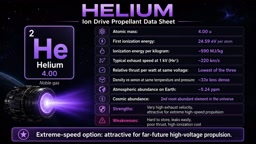
Xenon is essentially the gold standard for this job. It's an inert noble gas — chemically stable, won't corrode the engine. Its atomic mass is around 131, making it heavy; since thrust depends on momentum (mass times velocity), heavier ions carry more momentum per particle, meaning more thrust per watt of power. Xenon is also relatively easy to ionize, requiring about 9 megajoules per kilogram, compared to roughly 38 MJ/kg for argon and around 590 MJ/kg for helium.
But xenon is rare and expensive — around $1,000 per kilogram. That's negligible for a billion-dollar science probe, but it becomes a serious issue for satellite constellations needing ion propulsion for station-keeping. Argon, by contrast, costs less than $1 per kilogram and is more than 100,000 times more abundant in the atmosphere than xenon, making it a cheaper industrial candidate. Helium, while it would produce very high exhaust velocities, is difficult to store and produces terrible thrust — it only makes sense for hypothetical far-future spacecraft equipped with megavolt accelerators.
Hall-effect thrusters deserve a closer look, because their differences from gridded ion thrusters are often misunderstood. In a Hall thruster, electrons are trapped by a magnetic field and spiral in a ring-shaped channel, forming an "electron cloud." This cloud both ionizes the incoming propellant gas and, in concert with the electric field, accelerates the ions out of the thruster. Because there are no physical grids, the magnetic field acts as a "virtual grid" — and this avoids the erosion problem that high-energy ions cause on physical grids, giving Hall thrusters generally better longevity and durability than traditional gridded designs. Hall thrusters have become the preferred electric propulsion solution for commercial satellites; SpaceX's Starlink satellites, for example, use them extensively for orbital maintenance and adjustment.
From Curiosity to Workhorse
Ion propulsion has flown successfully on multiple missions. Deep Space 1 was an early proof-of-concept; Dawn was a famous demonstration, using ion propulsion to visit and orbit both Vesta and Ceres — a mission profile that involved orbiting one body, departing, and traveling to another, made possible specifically because of ion propulsion.
Many satellites use electric thrusters for station-keeping, maintaining their orbital slot, or slowly raising their orbits. Solar electric propulsion has become the standard approach for destinations like asteroids and Mercury, where patience and efficiency matter more than raw thrust.
Where ion thrusters truly shine is when a spacecraft is already in space and needs to spiral outward, spiral inward, rendezvous with a small body, or gradually reshape its orbit. In those scenarios, they're exceptional.
The "Freight Industry" of Space
Ion thrusters aren't just engines for science probes — they're engines for logistics. Imagine reusable electrically-propelled tugs ferrying cargo between low Earth orbit, high Earth orbit, lunar orbit, and resupply depots. They don't need to be glamorous. They just need to be reliable.

The history of civilization was written not only by explorers, but by wagons, ships, canals, railroads, trucks, and shipping containers. A lunar base or asteroid colony might use chemical or nuclear thermal propulsion to move crew quickly, while ion tugs haul cargo ahead slowly. The crew arrives faster; the supplies arrive cheaper. Exploration wins the headlines; logistics builds the civilization.
The "Tyranny" of Power and the Limits of Ion Propulsion
The power source determines everything. Solar electric propulsion is the obvious choice for the inner solar system, but solar power falls off with the square of distance — at Jupiter, you get roughly 1/25th of the power available near Earth; at Saturn, about 1%. For the outer solar system, nuclear electric propulsion becomes more attractive: a reactor generates electricity, and the electric thrusters accelerate the propellant. But this isn't some magic torch drive — the reactor, shielding, power conversion systems, and radiators all have mass, and thermodynamics always sends a bill.

Patience doesn't eliminate engineering challenges. Ion thrusters must operate for thousands to tens of thousands of hours. Grids erode, channels wear, cathodes fail, solar panels degrade. Long operational life isn't a nice-to-have for ion thrusters — it's a fundamental requirement. A chemical rocket engine might need to fire for a few minutes; an ion thruster might need to run for years.
Ion thrusters also struggle to exploit the Oberth effect — the boost in orbital energy gained by firing intensely at high speed deep inside a gravity well — because their thrust is smeared across hours, days, or even months, which washes out that advantage. Their trajectories are also more complex: an ion-powered spacecraft might spiral outward from Earth rather than departing in a single dramatic burn, taking months to slowly reshape its orbit. Not cinematic, but highly practical.
A few misconceptions are worth clearing up: ion thrusters are not reactionless drives — they still throw mass backward. They're not warp engines and can't eliminate inertia. They can't lift themselves off Earth under their own thrust. And they don't make propellant irrelevant. They're real engines with real advantages and real limitations.
The Oberth Effect is a counterintuitive but critically important phenomenon in orbital mechanics: firing at the deepest point of a gravitational potential well — where velocity is highest — produces far greater gains in orbital energy than firing elsewhere. This is because kinetic energy scales with the square of velocity: adding the same delta-v at high speed increases kinetic energy far more than adding it at low speed. Chemical rockets excel at firing hard at this "sweet spot" in a very short time, executing highly efficient orbital maneuvers. The problem with ion thrusters is that their thrust is too low to concentrate at this critical moment: their equivalent "burn" is stretched across days or weeks, by which point the spacecraft has long since departed the deepest part of the gravity well, and most of the Oberth benefit has been diluted. This makes ion thrusters less efficient than their theoretical ISP would suggest for missions requiring rapid escape from deep gravity wells, such as direct departure from low Earth orbit.
The Engine for Building a Starship
Can existing ion thrusters take us to the stars on any human timescale? No. Even highly efficient engines need power, propellant, and time — and reaching a meaningful fraction of the speed of light is an entirely different problem from reaching an asteroid or Mars.
In the distant future, electric propulsion rockets equipped with megavolt or gigavolt accelerators, enormous power supplies, and propellant flows measured in tons rather than grams might enter the realm of interstellar precursor spacecraft — but that's no longer the ion thruster of today.
Even if ordinary ion thrusters never become starship engines, they may help build the interstellar future. Before you can launch a starship, you need industry: power collectors, mining operations, fuel depots, telescope arrays, habitats, dry docks. Ion thrusters can help build the infrastructure that makes faster propulsion possible later.
Real propulsion technology isn't a neat ladder of upgrades like weapons in a video game — it's a toolbox. A hammer doesn't become obsolete because screwdrivers exist, and slow vehicles might be exactly what carries most of civilization's mass. Ion thrusters don't roar or shake the ground. They whisper. But in space, a whisper can last for years — and a long enough whisper becomes velocity, and enough velocity becomes access, and enough access becomes industry.
Related articles

JobRunner MCP Server: AI Agents Can Now Fix Failed Java Jobs
JobRunner launches an open-source MCP server enabling AI agents to view cluster status, diagnose failures, and recover Java jobs—incident response from any cloud coding environment or existing agent.

MLAI Digital Launches 9 Security Agents: MCP Server Safeguards the Full Lifecycle of Agentic AI
MLAI Digital launches Security MCP Server with nine built-in specialized security agents covering vulnerability discovery, attack simulation, prompt injection detection, API and infrastructure assessment, and accelerated remediation—embedding security validation across the full Agentic AI lifecycle from development to production.

Running Isaac Lab on H100 GPUs: Exploring Better Approaches
Exploring optimization methods for running Isaac Lab on NVIDIA H100 GPUs, including MIG configuration, mixed precision, TensorRT acceleration, and community experience to improve robotics simulation and reinforcement learning efficiency.