IPFS Maintainers Winding Down: The Sustainability Crisis Facing Decentralized Storage

IPFS maintainers winding down exposes the sustainability crisis of decentralized infrastructure projects.
The IPFS core maintenance team's announced contraction has sparked widespread concern in the Web3 community. Driven by crypto market downturns, Protocol Labs resource reallocation, and the immense complexity of maintaining IPFS's technical stack, this event highlights a fundamental paradox: decentralized protocols often depend on centralized entities for development. The situation serves as a wake-up call for projects relying on IPFS storage to prepare redundancy plans and evaluate alternatives like Arweave.
An Announcement That Shook the Decentralized Community
Recently, a post titled "IPFS Maintainers Winding Down" quickly rose to the front page of Hacker News, garnering 320 upvotes and over 160 comments. The news sparked widespread discussion across the decentralized storage and Web3 communities — as one of the most prominent open-source projects in the distributed file system space, the contraction of IPFS (InterPlanetary File System) core maintenance forces undoubtedly struck a nerve with many developers and practitioners.
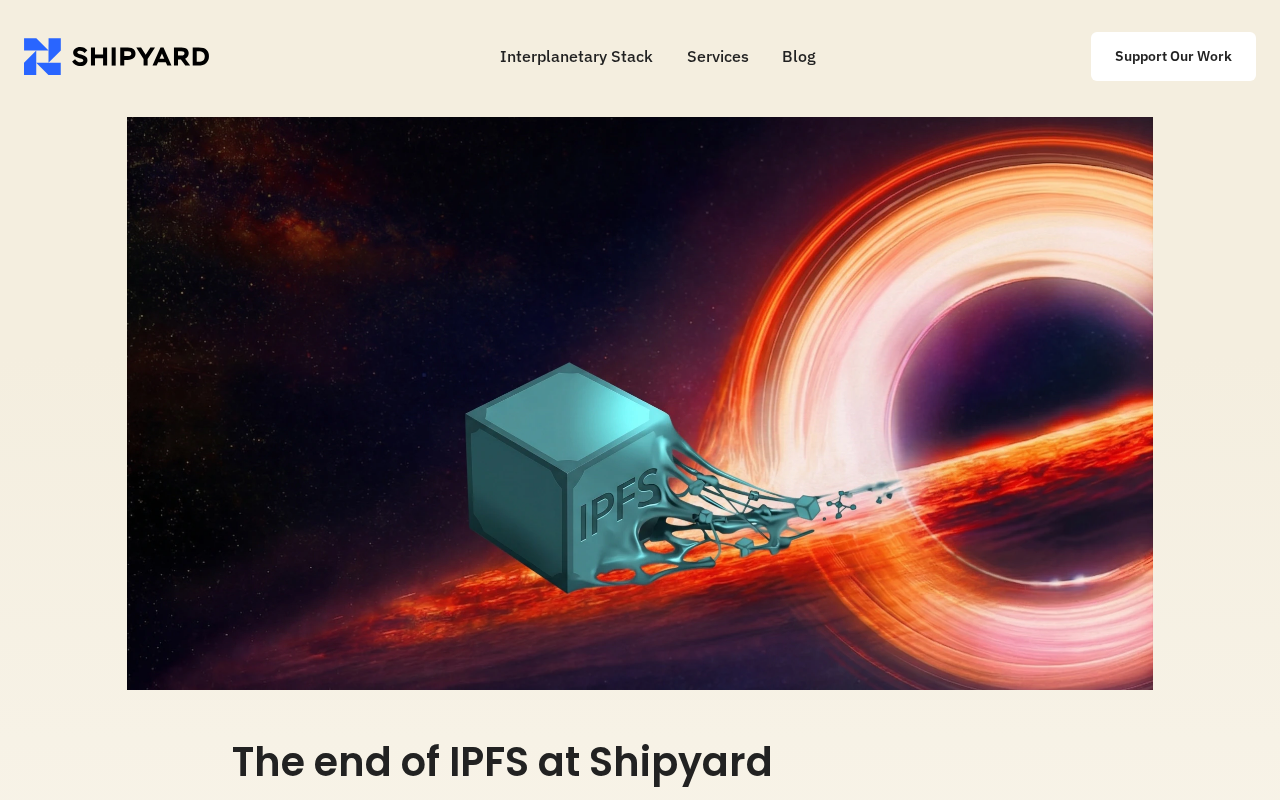
IPFS was launched by Protocol Labs in 2015 with the vision of replacing traditional location addressing with content addressing, building a more persistent, censorship-resistant, and decentralized internet foundation. The traditional internet uses location addressing — pointing to a specific file path on a specific server via URLs. If the server goes down, the domain expires, or the file is moved, the link breaks. This is the well-known "link rot" problem; statistics show that over 20% of internet links become invalid within two years. IPFS's content addressing works entirely differently: each file is identified by the cryptographic hash of its content (CID, Content Identifier), independent of which server stores it. As long as any node in the network holds the file, users can retrieve it via CID — inherently providing deduplication, tamper-resistance, and distributed redundancy.
Over the years, IPFS has become critical infrastructure for NFT metadata storage, decentralized website hosting, large file distribution, and more. So when signals of "maintainers stepping back" appeared, the community's attention was predictable.
The Deeper Reasons Behind IPFS Core Maintenance Contraction
From community discussions, the contraction of IPFS maintenance forces is the result of multiple overlapping factors rather than a single event.
Commercialization Pressure and Resource Reallocation
Open-source infrastructure projects universally face an awkward predicament: the tension between technical idealism and sustainable business models. Protocol Labs, as the primary driving force behind IPFS, simultaneously operates multiple projects including Filecoin. Founded by Juan Benet in 2014, Protocol Labs raised approximately $257 million through Filecoin's ICO in 2017, setting a fundraising record at the time. Filecoin is essentially IPFS's incentive layer — IPFS itself provides no storage incentive mechanism, and any node can delete data it no longer needs at any time. Filecoin, through its token economic model, gives storage providers economic motivation to preserve data long-term. However, this token-funding-driven model also means the project's financial health is highly correlated with crypto market cycles.
As crypto markets fluctuated and capital environments tightened — during the 2022-2023 crypto winter, FIL token price dropped over 95% from its all-time high — the company needed to reallocate resources, directing limited engineering talent toward directions that could generate cash flow or strategic value. Protocol Labs conducted multiple rounds of layoffs during this period, directly impacting maintenance resources for multiple projects including IPFS. When core maintenance is no longer a resource priority, "gradual wind-down" becomes almost inevitable.
Technical Stack Complexity and Maintenance Burden
IPFS itself is a vast and complex system involving multiple subsystems including DHT (Distributed Hash Table), the libp2p networking layer, and the Bitswap data exchange protocol.
DHT is the core mechanism IPFS uses for content routing — when a user requests a file corresponding to a CID, DHT helps locate which nodes hold that content. IPFS uses a variant of Kademlia DHT with theoretical lookup complexity of O(log n), but in real networks, due to NAT traversal issues and frequent node churn, lookup latency often reaches tens of seconds. libp2p is a modular network protocol stack extracted from IPFS, handling node discovery, connection management, stream multiplexing, and NAT traversal — it's now also adopted by other blockchain projects including Ethereum 2.0 and Polkadot. Bitswap is IPFS's data exchange protocol, similar to BitTorrent's block exchange mechanism, where nodes transfer data blocks through "what I have, what I need" information exchanges.
These three subsystems are each complex and tightly coupled — performance bottlenecks in any one affect the overall user experience. The community has long criticized IPFS's performance issues, especially slow content retrieval and inefficient node discovery. Maintaining such a complex tech stack requires sustained human investment, and once the core team downsizes, the maintenance burden may exceed the remaining workforce's capacity.
The Community's Complex Reaction to IPFS's Prospects
The comment section displayed a typical "love-hate" attitude, reflecting IPFS's real-world situation.
The Gap Between Ideals and Reality
Many developers expressed regret, acknowledging that IPFS's content-addressing concept is genuinely elegant and represents a valuable direction for internet architecture evolution. But more people admitted that IPFS's experience in production environments has been less than ideal: file retrieval can be maddeningly slow, running a stable node requires significant operational overhead, and "pinning" data to ensure its persistent availability often still relies on centralized pinning services (such as Pinata, web3.storage, etc.).
In the IPFS network, nodes by default only cache data they've recently accessed and clean up infrequently used content through garbage collection. To ensure a file remains persistently available on the network, users need to "pin" it — explicitly telling the node not to delete that data. However, ordinary users rarely run an IPFS node 24/7, which spawned commercial "remote pinning services" like Pinata, web3.storage, and Infura. These services are essentially centralized companies operating large numbers of IPFS nodes, where users pay them to store and serve data on their behalf. Ironically, this model is virtually indistinguishable from traditional cloud storage in terms of user experience — the only advantage being that data is identified by CID and can theoretically be retrieved from multiple sources. Notably, web3.storage is funded and operated by Protocol Labs, and its long-term sustainability is equally affected by this maintenance contraction.
This "nominally decentralized, practically semi-centralized" reality has led some to question the project's long-term value.
The Governance Paradox of Decentralized Projects
A recurring discussion point: why would the fate of a "decentralized" project depend so heavily on a single company's resource investment? This exposes a deep contradiction in many current decentralized projects — the protocol is decentralized, but its development, maintenance, and evolution are highly centralized around a particular foundation or company. When that center exits, whether the open-source promise that "anyone can take over" can truly be fulfilled will be a real test of the IPFS community's resilience.
Implications for Web3 Infrastructure
The significance of this event extends beyond IPFS itself — it sounds an alarm for the entire decentralized infrastructure space.
Open-Source Project Sustainability Is a Critical Challenge
The sustainability problem of open-source infrastructure is long-standing. From the maintenance crisis exposed by OpenSSL's Heartbleed vulnerability, to the core-js maintainer's public plea for help, to now IPFS, the industry has repeatedly proven: critical infrastructure cannot rely solely on the passion of a few individuals or the generosity of a single institution.
The Heartbleed vulnerability was disclosed in 2014, affecting approximately two-thirds of HTTPS websites globally, yet at the time only one person was maintaining the critical OpenSSL cryptographic library full-time, with annual donations totaling less than $2,000. This incident directly led to the Linux Foundation's Core Infrastructure Initiative (which later evolved into OpenSSF). Similarly, core-js is one of the most downloaded polyfill libraries in the JavaScript ecosystem (over 30 million weekly downloads), but its sole maintainer Denis Pushkarev has publicly expressed financial difficulties multiple times. These cases reveal a systemic problem: digital infrastructure heavily depends on open-source projects that are "commons" in nature, yet lacks effective mechanisms to convert usage value into maintenance resources.
For decentralized projects, token economics was supposed to solve this problem, but practice has shown that token price volatility actually intensifies funding uncertainty. Decentralized projects especially need to establish more diversified governance structures and funding sources to avoid "single point of failure" maintenance risks.
What Users Depending on IPFS Should Prepare For
For users and projects that depend on IPFS for storing critical data (especially NFT projects), this news is a clear reminder: don't place all your hopes for data persistence on any single protocol or service. Maintaining data redundancy, preparing migration plans, and evaluating alternatives is rational risk management.
Among alternatives, Arweave is currently one of the most watched options, with its core philosophy of "pay once, store forever." Unlike IPFS+Filecoin's subscription-style storage, Arweave operates through a "Storage Endowment" economic model: users prepay a fee, leveraging the historical trend of continuously declining storage costs, with interest covering future storage expenses. Its blockchain structure uses "Blockweave," where miners must prove they store historical data to participate in block production, incentivizing long-term data preservation. Other alternatives include Storj (which encrypts and shards files across global nodes), Sia (an early project with a similar philosophy), and Ceramic Network (a decentralized data network focused on mutable data streams). Each solution makes different trade-offs between persistence, cost, performance, and degree of decentralization — users need to choose carefully based on their own needs.
Conclusion: The End of a Phase, Not the End of the Road
It's important to clarify that "maintainers winding down" does not equal "project death." As an open-source project, IPFS's code and protocols still exist, and the community can continue driving its development. The real question is: after losing the core team's intensive investment, can IPFS evolve into a healthier, more distributed maintenance model?
Regardless of the outcome, this event marks an important milestone in the history of decentralized storage development. It compels us to rethink: true decentralization isn't just about technical architecture — it's about decentralizing governance, funding, and maintenance responsibilities. That road, clearly, is still a long one.
Related articles

Chain of Thought Isn't Just for AI: How Humans Can Use CoT to Improve Thinking Quality
Chain of Thought isn't just a prompt trick for large models. Starting from a Hacker News discussion, this article analyzes why CoT works for human thinking too, breaks down actionable ways to transfer it, and highlights the key differences between human CoT and machine CoT.
Cloudflare Teams Up with OpenAI: Closi…
Cloudflare Teams Up with OpenAI: Closing the Loop from Vulnerability Discovery to Defense with AI
Cloudflare uses OpenAI Daybreak to investigate security vulnerabilities and generate reviewable remediation plans, while developers use Codex to boost coding efficiency and quality.

Orca Multi-Agent Orchestration in Practice: A Guide to Parallel Collaboration with Claude and Codex
Orca is Stable AI's free open-source agent workbench supporting 34 agents like Claude Code and Codex in parallel. Learn its Git worktree isolation, multi-model orchestration, and mobile management.