iPhone 18 Pro Unboxing: Physical Variable Aperture and the Details Everyone Missed

iPhone 18 Pro launches with physical variable aperture and staggered release, but Siri AI still needs a waitlist.
Apple's iPhone 18 Pro series breaks tradition with a staggered Pro and Pro Max launch, interpreted as a response to component shortages and rising costs. The headline hardware feature is a true mechanical variable aperture (F1.4–F8), bringing professional photography control to mainstream consumers, alongside improved battery life and thermal design. The silver model drops its dual-tone look, in-box accessories are minimal, and eSIM replaces physical SIM slots in all major markets. AI photo editing — including object removal and generative reframing — is genuinely impressive, but the new Siri AI requires joining a waitlist, and backend model attribution (ChatGPT vs. Gemini) remains unclear. One subtle design note: the Apple logo on the back has been repositioned higher in an asymmetric layout.
Apple has broken with tradition for the iPhone 18 Pro and Pro Max launch — the two Pro models are no longer releasing simultaneously, but instead follow a staggered rollout strategy. According to an unboxing analysis by a well-known tech YouTuber, this reflects the reality of constrained component supply and rising costs, with Apple choosing to push its highest-margin products to market first.
The Business Logic Behind the Staggered Launch
This is, by memory, the first time Apple has ever offset the Pro and Pro Max release dates. The full lineup launches in this order: Pro first, then Pro Max, followed by the foldable Duo, and finally the standard models.
This approach is interpreted as a way to manage cost increases and limited component availability. It's easier to "bake in" pricing pressure on Pro models first — consumers are more willing to accept a premium on high-end products. By the time the non-Pro models arrive, prices are expected to settle at a more competitive level, bringing increases back within a range people are accustomed to. And among all the new models, the foldable Duo is the one people are really talking about on the street.
An Even More Minimal Unboxing Experience
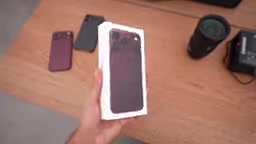
Apple's unboxing experience has always been known for simplicity, but this generation ships with fewer accessories than ever before.

The most immediately noticeable change on the silver version is the elimination of the dual-tone design — the body is entirely silver, with the glass back matching the frame in a unified monochromatic look. The reviewer described the aesthetic as having a hint of the DeLorean from Back to the Future, with some people even drawing comparisons to the Cybertruck. The previous orange colorway is also gone.
Inside the box, you'll find only a braided USB-C cable and a sheet of documentation. One telling detail: there's no longer a physical SIM card needed, so the SIM ejector tool has disappeared too. Even in markets like Canada that had long retained dual SIM card slots, the switch to eSIM is now complete. The reviewer joked that the next generation might drop the cable entirely, leaving just the phone in the box.
The black version (Midnight) also uses a matching monochromatic treatment — fingerprint smudging is expected to be similar to the black MacBook, but it will likely remain a popular choice regardless. The true "flagship statement color" is the burgundy option, which immediately signals to anyone nearby that you're holding the latest 18 Pro or Pro Max.
Physical Variable Aperture: A Real Camera Feature Goes Mainstream
The most talked-about upgrade this generation is the addition of a true mechanical variable aperture — a physically adjustable iris structure. While this isn't the first phone to feature it, Apple's adoption signals that this professional camera capability is officially entering the mainstream consumer market.
The aperture adjusts between F1.4 and F8. The reviewer demonstrated the full range: at F1.4, background blur is clearly visible on the ceiling, and point light sources like string lights produce star-burst or bokeh effects; at F8, significantly more detail is retained throughout the frame. That said, the reviewer was candid that due to the phone's sensor size, the depth-of-field complexity goes far beyond what an f-number alone conveys — don't expect full-frame camera-style extreme shallow depth of field.
The real value, in the reviewer's view, is educational. Bringing concepts like aperture and shutter speed into the consumer world through iPhone allows people to experiment hands-on without investing in dedicated professional gear, helping them understand how a photograph is actually made.

Beyond variable aperture, the camera also features subject tracking autofocus, which performed excellently in testing despite briefly losing its target on occasion. Video specs support 4K at 30fps, with a shutter speed of 160 and F4 aperture delivering ideal motion blur. Under complex lighting conditions, however, auto white balance showed a slight tendency toward pink tones.
What is aperture (f-stop)? Aperture is the core parameter in photography for controlling light intake and depth of field. A smaller f-number (like F1.4) means a wider opening, more light, and stronger background blur; a larger f-number (like F8) narrows the aperture, producing greater depth of field and overall sharpness throughout the frame. Traditional smartphone photography has long relied on fixed apertures combined with software algorithms to simulate depth of field, with no real control over physical light intake. A mechanical variable aperture uses multiple metal blades — similar to those inside a DSLR lens — to physically open and close, giving a phone the ability, for the first time, to actively trade off between "background blur" and "detail retention" depending on lighting conditions. This feature was previously seen only in Samsung's Galaxy S flagship series; Apple's adoption makes it an official benchmark for premium smartphones going forward.
Thermals, Battery Life, and a Detail Nobody Noticed
During shooting, the body warmed up quickly. This is because the internals use a large-area vapor chamber — the entire device essentially acts as one big heat spreader, actively conducting heat away from the processor to maintain stable performance.
On the battery front, this generation sees a significant increase in capacity, with charging speeds finally climbing to a competitive 50W+, and improved chip efficiency further extending real-world battery life. The larger battery does push total weight to an all-time high for the lineup — which makes thinner cases more meaningful, while MagSafe is seamlessly integrated into the chassis for a more elegant interaction experience.
The "detail nobody noticed" mentioned in the title refers to a shift in the position of the Apple logo on the back. After repeated comparisons, the reviewer confirmed the logo has been moved upward. He had always felt the logo sat too low on previous models; Apple has now repositioned it to be centered within a specific zone, creating an asymmetric layout where the lower portion of the back is larger than the upper. This seemingly minor adjustment likely involved considerable internal deliberation.
AI Ambitions vs. Real-World Gaps
Apple is heavily betting on AI this generation, with the word "AI" mentioned repeatedly throughout its marketing. System-level AI can access personal information on the device, enabling deeper user understanding — and Apple is leaning into this as a privacy differentiator.

Photo editing features are genuinely impressive. The reviewer demonstrated object removal and reframing: AI can not only cleanly erase objects but also generatively fill in missing areas. In one particularly surprising demo, an original image showed barely a sliver of a shopping cart wheel, and the AI convincingly "imagined" the entire cart into existence — an effect the reviewer called magical. This capability is thought to stem from Apple's work related to ProVision.
Siri's experience, however, was disappointing. The reviewer had hoped the all-new Siri would be ready to "go toe-to-toe with the big players." The interface has indeed been refreshed with a new glassy aesthetic, but when he tried to use it, the system showed a message saying "Siri AI is not currently available" — and asked him to join a wait list. He put it bluntly: "I bought a new phone, you advertised an all-new Siri AI — why am I still waiting in a queue?"
There's also confusion about the AI model powering Siri behind the scenes. Sending an image to ask about nutritional information redirected to ChatGPT, yet previous reports suggested Siri uses Gemini — and in practice it may be using both. This fractured experience exposes a significant gap between Apple's AI rollout and its marketing promises.
What is eSIM? An eSIM (embedded SIM) is a programmable SIM chip integrated directly into the device's motherboard, requiring no physical card slot. Users can remotely download a carrier profile via a carrier app or QR code, and a single device can store multiple carrier profiles and switch between them freely. For Apple, the widespread adoption of eSIM offers dual benefits: hardware simplification (eliminating the slot and its waterproofing challenges) and supply chain unification (no longer needing to produce different hardware variants for different regions). Markets like Canada had previously retained physical SIM slots due to local carrier infrastructure and regulatory requirements; this generation's full transition to eSIM marks the completion of that shift across Apple's major global markets.
Background Notes
Vapor Chamber is a passive thermal component that uses liquid-phase-change heat transfer: a small amount of working fluid (such as purified water) is sealed inside; the fluid evaporates at the heat source, absorbing thermal energy, and the vapor rapidly spreads to the cooler end where it condenses and releases heat in a continuous cycle. Compared to traditional copper heat pipes, a vapor chamber covers a larger surface area, transfers heat more efficiently, and is better suited to the highly compact internal space of a smartphone. As A-series chips and imaging sensors continue to push performance boundaries, thermal management has become one of the core design challenges for flagship phones — and expanding the vapor chamber area has been the most notable direction in iPhone's thermal architecture over recent generations.
Related articles

JobRunner MCP Server: AI Agents Can Now Fix Failed Java Jobs
JobRunner launches an open-source MCP server enabling AI agents to view cluster status, diagnose failures, and recover Java jobs—incident response from any cloud coding environment or existing agent.

MLAI Digital Launches 9 Security Agents: MCP Server Safeguards the Full Lifecycle of Agentic AI
MLAI Digital launches Security MCP Server with nine built-in specialized security agents covering vulnerability discovery, attack simulation, prompt injection detection, API and infrastructure assessment, and accelerated remediation—embedding security validation across the full Agentic AI lifecycle from development to production.

Running Isaac Lab on H100 GPUs: Exploring Better Approaches
Exploring optimization methods for running Isaac Lab on NVIDIA H100 GPUs, including MIG configuration, mixed precision, TensorRT acceleration, and community experience to improve robotics simulation and reinforcement learning efficiency.