iPhone Duo: Apple's Foldable Phone Development in Full Swing
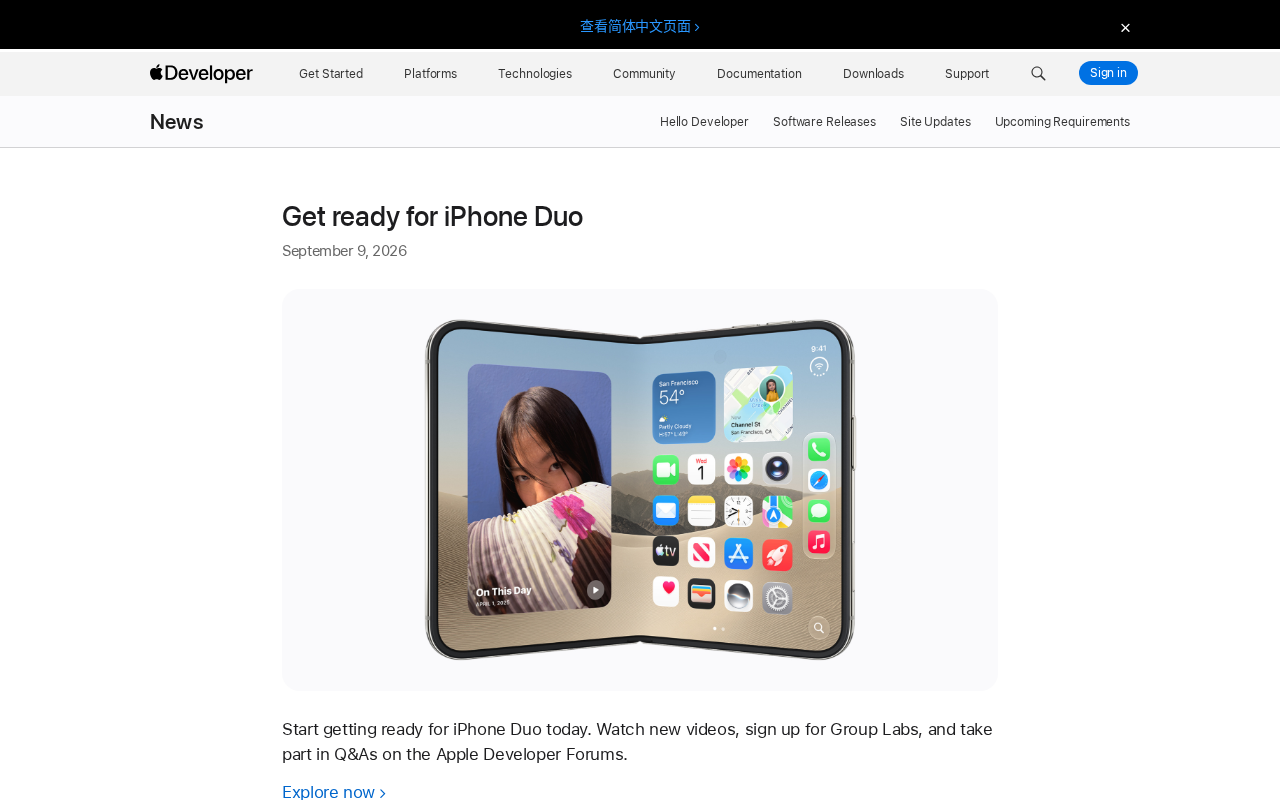
Apple kicks off developer preparations for iPhone Duo, its dual-screen foldable iPhone.
Apple has officially begun developer outreach for the iPhone Duo, a dual-display foldable iPhone. The device features two independent screens with cross-screen interface capabilities. Apple is offering technical videos, Group Labs, and Developer Forum Q&A sessions to help developers prepare for new challenges like coordinate mapping, hinge avoidance, and multi-mode adaptive layouts ahead of launch.
Apple's Foldable Era Officially Begins
Apple has officially released preview information about the iPhone Duo through its developer channels, marking a pivotal step for the tech giant into the foldable mobile device space. According to content published by Apple Developer, developers can start preparing for iPhone Duo now — including watching brand-new technical videos, signing up for Group Labs, and participating in Q&A sessions on the Apple Developer Forums.
From the official product images, the iPhone Duo features a dual-display foldable design. In its partially folded state, the device can simultaneously show the Home Screen and widgets across both displays. While this shares some similarities with existing foldable form factors on the market, it also hints at Apple's unique approach to software-level interface adaptation.
Notably, based on current product images, the iPhone Duo appears to use a dual independent display approach rather than a single flexible OLED panel that folds in half. The core technology behind foldable devices typically relies on flexible OLED panels or Ultra-Thin Glass (UTG) cover lenses — achieving physical folding by depositing organic light-emitting materials on a bendable polyimide substrate. The iPhone Duo's dual-screen approach is more aligned with the Microsoft Surface Duo design philosophy. Its advantage is that each screen can use more durable rigid or semi-rigid panels, fundamentally avoiding the crease issues and screen longevity concerns common in single-screen foldable designs. However, it also introduces engineering challenges around precision hinge design and managing the gap between the two screens.
Technical Breakdown of the iPhone Duo's Dual-Screen Foldable Form Factor
Cross-Screen Interface Adaptation Challenges
The most striking feature of the iPhone Duo is its cross-screen interactive experience. From the official images, it's clear that the Home Screen icon layout and widgets can span continuously across both screens. This means iOS needs to fundamentally rework interface rendering, coordinate mapping, and content avoidance around the hinge area at the system level.
In cross-screen display implementation, Coordinate Mapping is one of the core challenges. The operating system needs to abstract two physically independent displays into a single continuous logical display plane, precisely converting touch input and UI element positions between physical and logical coordinate systems. For example, when a user taps a button on the right screen, the system must correctly calculate that touch point's position in the unified coordinate system. Hinge Avoidance is even more critical — since a physical hinge or gap exists between the two screens, if key UI elements (such as buttons or lines of text) happen to fall in this area, readability and usability are severely impacted. In the Android ecosystem, Google has already provided the FoldingFeature API in the Jetpack WindowManager library to help developers detect fold areas and automatically adjust layouts. Apple is expected to introduce similar fold-aware mechanisms in UIKit or SwiftUI.
For developers, this introduces entirely new adaptation requirements. Apps need to detect the device's folding state (fully open, partially folded, closed) and dynamically adjust their layouts. Modern foldable devices typically include a Hinge Angle Sensor that detects the device's opening angle in real time — from fully closed (0°) to fully open (180°) and every angle in between. These states are generally categorized into several typical modes: Closed, Tent, Laptop (partially folded at roughly 90°–120°), and Flat. The user's posture and expected experience differ dramatically in each mode — for instance, in Laptop mode, the upper screen is suited for displaying content while the lower screen is ideal for controls or a virtual keyboard.
This is conceptually similar to iPad multitasking and Split View, but the physical form factor of a foldable device adds significantly more complexity — the app interface must remain usable and visually appealing at various opening angles. Apple's existing Size Classes and adaptive layout system in SwiftUI provide a foundation for this kind of multi-form-factor adaptation, but the continuous angle changes of a foldable device demand a more granular layout response mechanism rather than simple discrete breakpoint switching.
Group Labs and Developer Support
Apple has placed particular emphasis on the role of Group Labs. This is a direct technical support channel Apple provides to developers, where they can interact face-to-face with Apple engineers and receive firsthand guidance on iPhone Duo adaptation. Group Labs is a one-to-many technical consultation service, typically led by Apple's internal engineers, where developers can ask questions on specific technical topics and receive real-time feedback. Complementing this are One-on-One Labs, which are more targeted toward specific app adaptation issues.
Combined with Q&A sessions on the Developer Forums, Apple clearly aims to build a sufficiently mature app ecosystem before the hardware officially ships. This system is a core component of Apple's Developer Relations strategy.
This approach is consistent with Apple's strategy when launching major new device form factors in the past — such as Apple Watch and Apple Vision Pro — providing development tools and documentation in advance so developers have ample time for adaptation, ensuring a rich selection of native apps at product launch. Looking back, Apple provided WatchKit Labs before the Apple Watch launched in 2015, and opened extensive visionOS Labs before the Vision Pro launch in 2023 — some of which even required developers to travel to Cupertino headquarters to debug on prototype devices. The scale of Group Labs deployment for iPhone Duo suggests Apple treats the foldable app ecosystem with the same level of importance as these revolutionary products.
The Strategic Significance of iPhone Duo for Apple's Ecosystem
Filling the Foldable Product Line Gap
In the foldable space, manufacturers like Samsung, Huawei, and Google have been building for years. Since launching the Galaxy Fold in 2019, Samsung has iterated to its sixth generation, covering two product lines: inward-folding large-screen devices (Fold series) and clamshell foldables (Flip series), with cumulative shipments exceeding tens of millions of units. Huawei's Mate X series focuses on outward-folding designs and differentiated features like satellite communication, holding a leading position in the Chinese market. Google's Pixel Fold (later renamed Pixel 9 Pro Fold), launched in 2023, has limited market share but carries significant implications for the Android foldable software ecosystem — it accelerated Google's native Android support for large screens and foldables, including taskbars, split-screen gestures, and app continuity features. Additionally, OPPO's Find N series, Xiaomi's MIX Fold series, and vivo X Fold are all actively competing.
Despite the many players, foldable devices still account for less than 2% of global smartphone shipments, meaning the category has yet to reach true mass adoption. While Apple's entry is relatively late, the iPhone Duo — backed by Apple's strengths in hardware-software integration — has the potential to redefine the foldable device experience and could very well serve as the catalyst that ignites the broader market. True competitiveness often lies not in hardware specs but in system-level seamless integration and deep app ecosystem support.
Developers Should Act Early
For iOS developers, Apple's preview sends a clear signal: foldable adaptation is about to become a major direction for app optimization. Getting ahead on understanding cross-screen layouts, state transitions, multi-window coordination, and other technical essentials will help developers gain an edge when the iPhone Duo officially launches.
Apple encourages developers to explore related resources immediately through official channels (developer.apple.com/iphone-duo/). As more technical details are disclosed, we can expect the development toolchain, Human Interface Guidelines, and SDK support for iPhone Duo to roll out progressively.
The Human Interface Guidelines (HIG) are Apple's design specification documents published for all its platforms, covering everything from visual design and interaction patterns to accessibility. HIG is not only an expression of Apple's design philosophy but also an important reference for App Store review. Every time Apple introduces a new hardware form factor, HIG undergoes significant updates: the iPhone X notch gave rise to the Safe Area concept; Apple Watch introduced design guidelines for the Digital Crown and Complications; Vision Pro brought an entirely new interaction paradigm for spatial computing. For the iPhone Duo, HIG is expected to add detailed guidance on cross-screen layouts, content hierarchy in folded states, hinge area safe margins, and fold/unfold transition animations — all of which will profoundly influence the design direction of millions of iOS apps.
Conclusion
The iPhone Duo developer preview is not just an important expansion of Apple's hardware product line — it's a forward-looking mobilization of the entire iOS app ecosystem. The foldable form factor brings more than just increased screen real estate; it introduces an entirely new human-computer interaction paradigm — from coordinate mapping to fold state awareness, from hinge area avoidance to multi-mode adaptive layouts, every technical aspect requires careful system-level design. For developers and users following cutting-edge technology, this is a significant development worth tracking closely. Apple has not yet announced specific launch dates or hardware specifications for the iPhone Duo, but judging from its proactive developer mobilization, an official release may not be far off.
Related articles

Flown App Review: Flight Log Visualization Maps & Automatic Delay Compensation Alerts
Flown is an iOS flight logging app that plots your journeys on a private map, supports 197-country check-ins, annual flight reviews, and auto-calculates flight delay compensation. Local data storage, no account needed.

Hermes Agent Hands-On: Full Workflow for Building Apps Locally with an Autonomous AI Agent
Hands-on review of Hermes Agent: from installation to building a local calorie tracker in three steps. Covers local memory, Anthropic API setup, and progressive prompt workflows.

Fable 5.1 vs GPT-6 Astra: A Hands-On Comparison of 3D Modeling Capabilities
A detailed comparison of Fable 5.1 and GPT-6 Astra for 3D model generation, analyzing geometry, topology, UV quality, and materials in Blender asset creation.