iPhone Duo Dual-Screen Foldable Phone Explained: Apple Enters the Foldable Market
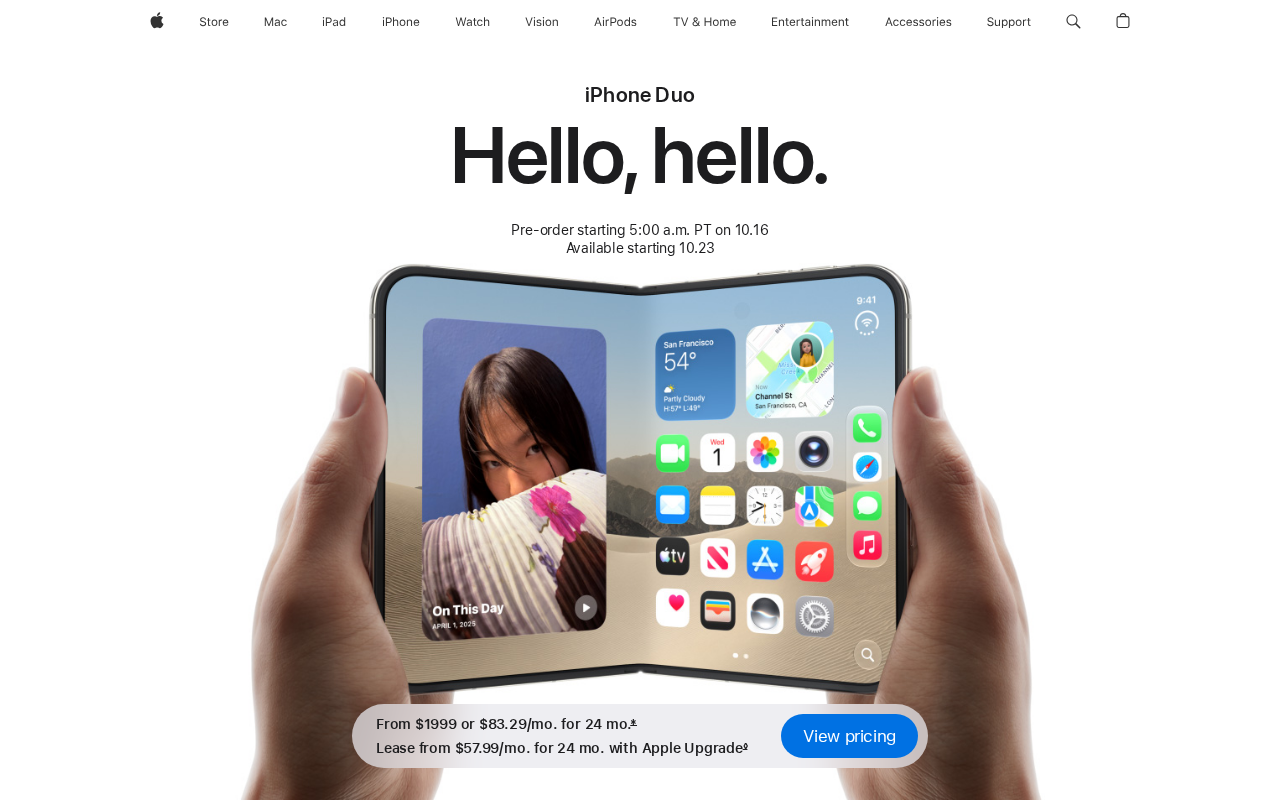
Apple's iPhone Duo page hints at its entry into the foldable phone market with a dual-screen device.
Apple quietly published an iPhone Duo page on its website, sparking intense discussion across the tech community. This article analyzes the potential product form factors — foldable, dual-screen, or paired devices — alongside the technical challenges of flexible OLEDs and hinges. It examines Apple's late-mover strategy, its software ecosystem advantages over Android foldables, and the community's mix of excitement and skepticism about durability, pricing, and real-world utility.
Another Form Factor Experiment from Apple
Apple quietly published an "iPhone Duo" page on its official website, and it quickly sparked heated discussion on Hacker News — racking up 452 upvotes and over 1,000 comments in short order. The buzz alone tells the story: any news about a change in iPhone form factor sends ripples through the entire tech world.
As a bellwether of the smartphone industry, every hardware form factor Apple explores has the potential to redefine an entire product category. Looking back at Apple's history of hardware evolution, each transformation has been epoch-defining: the original iPhone in 2007 eliminated the physical keyboard, pioneering capacitive multi-touch full-screen interaction and effectively ending the era of physical keyboard phones dominated by BlackBerry and Nokia; the iPhone X in 2017 introduced Face ID and the notch design, boldly removing the Home button and Touch ID to accommodate the TrueDepth camera system (including an infrared emitter, flood illuminator, and dot projector); and in 2022, the iPhone 14 Pro transformed the front camera cutout into an interactive element with Dynamic Island, showcasing Apple's unique ability to turn hardware constraints into experience innovations. Now, against the backdrop of industry-wide interest in foldable trends, the appearance of "iPhone Duo" naturally raises the question: is Apple finally making its move in the foldable and dual-screen arena?
Decoding the iPhone Duo Form Factor
Judging by the name "Duo" — meaning "a pair" or "twofold" — this product most likely points to some kind of dual-screen or foldable device. The word "Duo" is no stranger to the tech industry — Microsoft's dual-screen device was called the Surface Duo, featuring two screens connected by a hinge.
The Microsoft Surface Duo series stands as the tech industry's most notable exploration of the dual-screen form factor. The original Surface Duo, released in 2020, used two 5.6-inch AMOLED screens connected by a 360-degree hinge, unfolding into an 8.1-inch workspace. Unlike Samsung's Galaxy Z Fold series, which uses a single flexible folding display, the Surface Duo opted for two separate rigid screens — meaning no crease issues, but a physical gap between the displays. The product performed poorly in the market, mainly due to the severe lack of dual-screen app optimization in the Android ecosystem, frequent software bugs, and camera performance that lagged behind competitors. Microsoft ultimately discontinued the product line after 2023, offering Apple an important cautionary tale: the success or failure of a dual-screen device hinges not on the hardware form factor itself, but on whether the software ecosystem can truly leverage the dual-screen advantage.
If Apple adopts a similar naming convention, it suggests the company may be exploring:
- Foldable form factor: A single flexible screen that folds in half, unfolding to deliver a tablet-like large-screen experience
- Dual-screen hinge design: Two independent screens connected by a hinge, foldable for portability
- Paired device concept: An ecosystem-oriented approach where two devices work in tandem
You may not have noticed, but multiple industry sources had long been reporting that Apple was developing a foldable iPhone, with supply chain analysts repeatedly mentioning related panel orders. The appearance of the "iPhone Duo" page — whether it represents a final product or a concept showcase — adds a new footnote to these rumors.
Apple's Timing for Entering the Foldable Market
After years of cultivation by Samsung, Huawei, and other manufacturers, the foldable phone market has gradually matured from a "novelty toy" into a viable product category. According to data from IDC and Counterpoint Research, global foldable phone shipments in 2024 were approximately 22–25 million units. While this still accounts for less than 2% of the overall smartphone market (roughly 1.2 billion units shipped annually), it has maintained a robust annual growth rate of 25–30%. Samsung holds an absolute dominant position with over 60% market share, with its Galaxy Z Flip series (vertical clamshell fold) and Galaxy Z Fold series (horizontal book-fold) forming two major product lines. Huawei holds second place in the Chinese market with its Mate X series, while OPPO's Find N series, vivo's X Fold series, and Xiaomi's MIX Fold series are also actively competing. Notably, the clamshell form factor is gaining greater market acceptance than the book-fold form factor, as the former is more affordable and closer to the traditional phone usage experience.
Early pain points such as hinge reliability, screen creases, and software compatibility have seen significant improvement over recent product generations. For Apple — a company that has always pursued a "wait for maturity, then enter" strategy — this is a fitting time to enter the foldable arena, consistent with its longstanding product philosophy: don't be the first to try something new, but be the one who does it best.
This "late-mover advantage" strategy has been validated multiple times in Apple's product history. MP3 players appeared as early as 1998, but Apple didn't launch the iPod until 2001, going on to dominate the digital music market with the iTunes ecosystem and minimalist click wheel interface. Smartphones already existed on Windows Mobile, Symbian, and BlackBerry platforms in the early 2000s, but the iPhone overtook them all in 2007 with its disruptive touchscreen experience. In the tablet space, Microsoft introduced the Tablet PC concept as early as 2002, but it was the iPad in 2010 that truly defined the category. In smartwatches, products like Pebble led the way for years, but the Apple Watch, launched in 2015, ultimately became the industry standard. The core logic of this strategy: wait for the underlying technology to mature to the tipping point where it can support an excellent user experience, then define the experience standard in one fell swoop through deep hardware-software integration.
Tech Community Response: Excitement and Skepticism Coexist
The more than one thousand comments on Hacker News reflect the tech community's complex attitude toward this product.
On one hand, developers and tech enthusiasts are generally intrigued by new form factor devices — a larger screen means more use cases. Whether it's multitasking, content creation, or mobile productivity, dual-screen and foldable form factors open up new possibilities.
On the other hand, skepticism is equally vocal. Several core issues common to foldable devices remain focal points of discussion:
- Durability: Whether hinges and flexible screens can withstand the rigors of daily use over the long term. The hinge is the most mechanically complex component in a foldable device, needing to simultaneously deliver durability through tens of thousands of open-close cycles, precise damping feel, dust and debris protection, and the smallest possible form factor. Samsung's Flex Hinge, now in its fifth generation, supports over 200,000 folds; Huawei's multi-axis linkage hinge comprises over 100 precision components, using a cam mechanism to enable the screen to hold at any angle. Apple holds multiple patents related to folding hinges, some of which describe a self-healing coating mechanism that reduces wear marks in the hinge area — hinting that Apple may have a unique technical approach to hinge durability.
- Weight and thickness: Folding mechanisms inevitably add weight and bulk. Hinge design directly impacts device thickness — the double-layer stacking effect in the folded state makes foldable phones typically 3–5mm thicker than traditional slab phones.
- Price: These devices are typically priced at a premium — is it worth paying extra just for a "bigger screen"?
- Software ecosystem: How iPadOS and iOS will adapt, and how apps will take advantage of dual screens, are problems that need to be solved.
The Current State and Challenges of Flexible Display Technology
The core technical challenge for foldable phones lies in flexible OLED panels. Flexible OLEDs use polyimide (PI) film substrates instead of traditional glass substrates, giving the screen its bendable properties. Early products (such as the 2019 Samsung Galaxy Fold) used a plastic protective layer that was prone to scratching and had a noticeable crease. Samsung subsequently developed an Ultra-Thin Glass (UTG) cover solution, just 30 micrometers thick, balancing a degree of hardness with flexibility. On the crease front, the latest generation of products uses waterdrop-shaped hinge designs that increase the bending radius, reducing crease visibility to relatively low levels — though creases remain perceptible under strong light. On the supply chain side, Samsung Display, BOE, and Visionox are the major flexible OLED panel suppliers, and multiple sources indicate Apple has placed orders with Samsung Display and LG Display for foldable panel test samples.
The Deeper Logic Behind Apple's Foldable Strategy
Hardware and Ecosystem: A Dual Consideration
Apple never evaluates products based on hardware alone — it always thinks in terms of the complete ecosystem loop. If the iPhone Duo truly adopts a foldable or dual-screen form factor, Apple will need to do extensive adaptation work at the iOS level: how to enable apps to seamlessly transition between unfolded and folded states, how to design dual-screen interaction logic — these are tough challenges on the software front.
Software adaptation for foldable devices is a systemic engineering challenge. In the Android camp, Google introduced large-screen and foldable-specific APIs starting with Android 12L, including Activity Embedding (allowing two app activities to display side by side in split screen) and Window Size Classes (helping developers adjust layouts based on available display area). But results have been mixed — a large number of third-party apps have not been specifically optimized for the folded state, simply stretching the phone interface on the larger unfolded screen and wasting the additional screen real estate.
Apple has a natural advantage here: its integrated hardware-software control allows deep system-level optimization of the folding experience, avoiding the "apps don't fit" awkwardness common in early Android foldables. Through SwiftUI's adaptive layout system and strict App Store review process, Apple has the ability to require (or at least strongly encourage) mainstream apps to adapt to the new form factor. Furthermore, the existing Split View and Slide Over multitasking features on iPadOS provide a ready-made foundation of experience for designing foldable iPhone interactions — an ecosystem advantage the Android camp lacks.
Positioning in the Premium Market
Foldable devices currently remain a premium market segment. If Apple launches such a product, it will almost certainly take the flagship route, further raising the price ceiling of the iPhone product line. This is both a response to high-end user demand and a strategic choice for Apple to maintain its high profit margins.
A Realistic View of the Product's Prospects
It's worth noting that the appearance of a page on Apple's website does not confirm the final product form. Apple has a history of showcasing concepts and exploring directions. With limited public information available, key details about the iPhone Duo — including specific specs, release date, and pricing — await further official disclosure.
For consumers, rather than being led by names and rumors, it's more useful to focus on a few substantive questions: What real pain point does this device solve? Does the user experience justify the premium? Is the foldable or dual-screen form factor a genuine need or a solution in search of a problem?
Conclusion
The debut of the iPhone Duo marks a noteworthy step for Apple in smartphone form factor innovation. Regardless of whether it ultimately takes the form of a foldable, a dual-screen, or something else entirely, Apple's entry into this arena carries industry benchmark significance — it typically signals a technology direction graduating from "niche exploration" to "mainstream validation."
The tech community's spirited discussion reflects both excitement for the new form factor and rational skepticism about practicality, durability, and pricing. This coexistence of anticipation and doubt is exactly the kind of public discourse a potentially transformative product should generate. Now, it's up to Apple to answer these voices with an actual product.
Related articles

Flown App Review: Flight Log Visualization Maps & Automatic Delay Compensation Alerts
Flown is an iOS flight logging app that plots your journeys on a private map, supports 197-country check-ins, annual flight reviews, and auto-calculates flight delay compensation. Local data storage, no account needed.

Hermes Agent Hands-On: Full Workflow for Building Apps Locally with an Autonomous AI Agent
Hands-on review of Hermes Agent: from installation to building a local calorie tracker in three steps. Covers local memory, Anthropic API setup, and progressive prompt workflows.

Fable 5.1 vs GPT-6 Astra: A Hands-On Comparison of 3D Modeling Capabilities
A detailed comparison of Fable 5.1 and GPT-6 Astra for 3D model generation, analyzing geometry, topology, UV quality, and materials in Blender asset creation.