iPhone Duo Hands-On Review: The Real Experience of a Foldable iPhone

The Verge editor spent a week with the iPhone Duo, revealing Apple's trade-offs and positioning dilemma for its foldable screen.
The Verge's senior phone reviewer used the iPhone Duo for a week and co-reviewed it with editor-in-chief Nilay Patel in AMA format. The article covers key dimensions: Apple's conservative book-style inward-folding approach with possible multi-angle hovering, success hinging on iOS large-screen adaptation; persistent reader concerns about weight, crease, and app adaptation; and the AMA format as a content strategy. It argues the biggest challenge is product-line positioning—why pay more for a heavier, more fragile foldable when the Pro Max is already big enough—and that Apple must win through experience integration, not specs.
The Verge's senior phone reviewer completed this review together with editor-in-chief Nilay Patel after using the iPhone Duo extensively for a week. This device represents Apple's first formal response to the foldable form factor. Although the original piece was presented in AMA (Ask Me Anything) format with limited information, by combining public intelligence and industry context, we can outline the most noteworthy dimensions of this product.
Foldable Form Factor: Apple's Restraint and Trade-offs
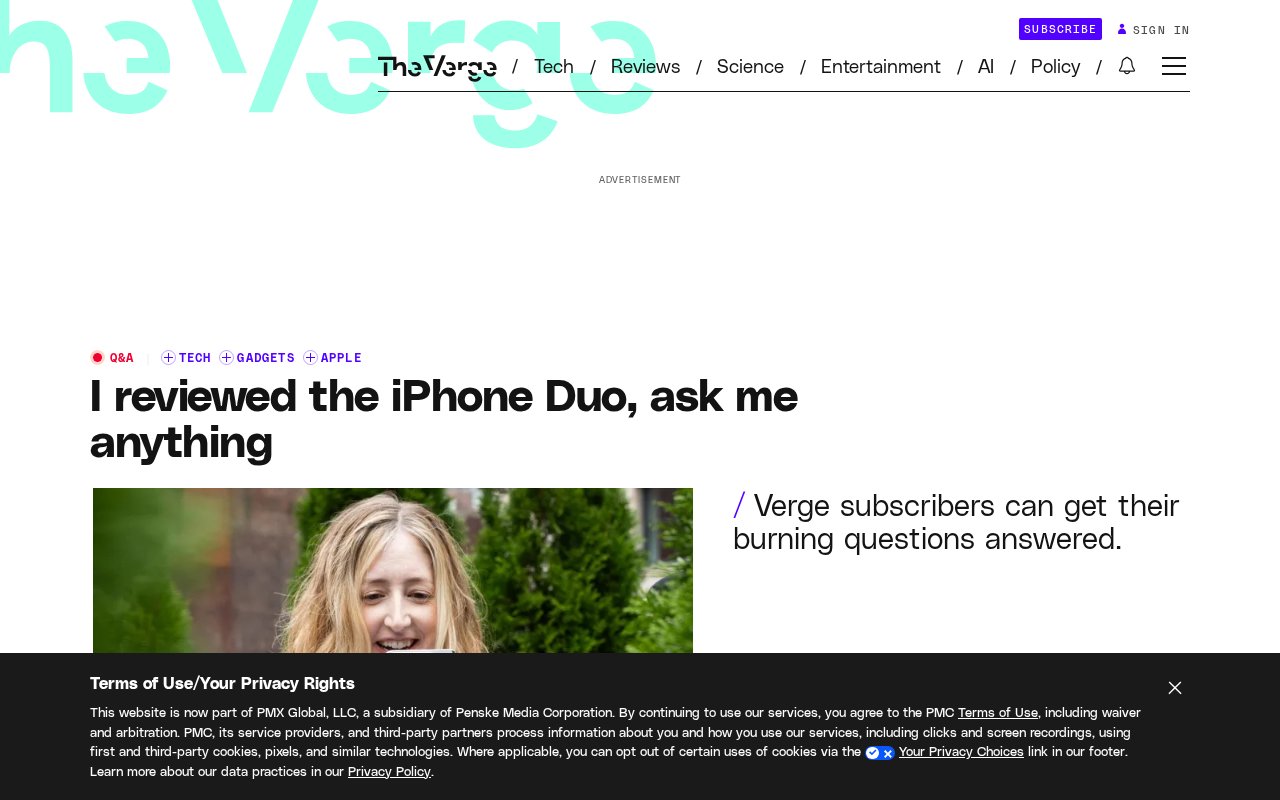
According to The Verge editor, he "unfolded, flipped, and folded" the device countless times over the course of a week. This high-frequency interaction precisely illustrates that the core value of a foldable screen lies in the freedom of form-factor switching, not in raw hardware specs.
Judging by industry conventions, Apple's strategy on foldables has always been rather conservative. If the iPhone Duo follows a book-style inward-folding design similar to the Galaxy Z Fold, it means Apple needs to strike a delicate balance among hinge durability, screen crease control, and body thickness. The editor's use of the verb "flipped it" suggests the device may support multi-angle hovering, which has practical significance for video calls, selfies, and desktop mode.
What's worth noting is that Apple has never pursued being first with new form factors; instead, it waits until the supply chain matures and wins through experience integration. The success of the iPhone Duo will likely depend on how deeply iOS is adapted to the large foldable screen, rather than on the hardware itself.
Book-style inward folding is currently the most mainstream form factor for large foldable phones: the device opens and closes left and right like a book, with the outer screen at a conventional phone size and an inner screen close to tablet size when unfolded. Samsung's Galaxy Z Fold series is the representative of this approach. Its technical difficulty lies in the inner screen needing to withstand repeated bending, so it generally uses ultra-thin flexible glass (UTG) as cover and leaves a bending radius in the hinge area to control the crease. By contrast, multi-angle hovering relies on the damping structure inside the hinge, allowing the screen to be fixed at different opening angles, which gives rise to usage scenarios such as tent mode and desktop mode. Together, these two designs determine the upper limits of a foldable's thickness, weight, and durability.
A Week of Real Use: What the Reviewer Focused On
The Verge's review process typically covers camera, battery life, performance, and everyday feel. The editor emphasized "writing the review while using it," meaning the conclusions come from a continuous week of real-world scenarios rather than lab benchmarks.
The three things foldable users complain about most are weight, crease, and app adaptation. The original article gave no specific data, but from the direction of the AMA questions we can infer that readers are still most concerned with whether these long-standing issues have been solved in Apple's hands. The joint review by the editor and Nilay Patel also indicates that this product is treated as a key product within The Verge.
The Signal Behind the AMA Format
The Verge's choice to use "ask me anything" to preview the review is itself a content strategy. It foregrounds readers' most genuine concerns and uses a Q&A format to fill in details that traditional review articles struggle to cover.
For potential buyers, the most valuable information in an AMA is often not the spec sheet but "after seven days of use, would you still want to keep using it." The pain points of foldables have never been the wow factor at unboxing, but whether the hinge loosens and whether new creases appear on the screen after the third week.
AMA (Ask Me Anything) originates from Reddit's community Q&A culture, where participants solicit questions in advance and answer them in a concentrated session, emphasizing no scripts and no limits. Tech media have introduced it into product review previews to collect readers' most genuine concerns before the official review is published and to use the Q&A format to fill in details that traditional reviews struggle to cover. For the reviewer, AMA can generate buzz in advance and extend the content lifecycle; for readers, it provides information closer to everyday use than a spec sheet. This format is particularly suited to products like foldables, where the experience dimensions are complex and the points of controversy are concentrated.
Editor's View: The Positioning Dilemma of a Foldable iPhone
The biggest challenge facing the iPhone Duo is not technology but product-line positioning. It must answer a fundamental question: given that the iPhone Pro Max is already big enough, why should users pay more for a heavier, more fragile foldable device?
Apple's answer will most likely lie in multitasking and content consumption. An inner screen close to iPad mini size, combined with iOS's split-screen capabilities, can cover light productivity and media scenarios. But this requires Apple to deliver enough exclusive features at the software level; otherwise, the foldable is just a form-factor show-off.
Looking at the competitive landscape, Samsung, Huawei, and Honor have been iterating in the foldable space for years, and Apple, as a latecomer, needs to prove itself through experience rather than specs. The review conclusion of the iPhone Duo will likely become the bellwether for the entire foldable iPhone product line.
Product-line positioning refers to the price band and usage scenarios a product occupies within a brand's existing product matrix, and its core is answering "whom does it replace and whom does it complement." If the iPhone Duo is priced above the Pro Max, it must provide value the Pro Max cannot cover, such as the multitasking and media experience brought by a larger inner screen. Historically, Apple has repeatedly used new form factors to open up market segments: the iPad mini filled the gap between phones and laptops, while the Apple Watch exists independently of the iPhone. Whether a foldable iPhone can succeed depends on whether Apple can clearly define the boundaries between it, the Pro Max, and the iPad mini, avoiding internal cannibalization.
FAQ
Is the iPhone Duo worth buying? It depends on how strongly you need large-screen multitasking. If your daily use is mainly one-handed operation, a traditional slab iPhone remains the safer choice.
Is the crease obvious? The original article did not disclose specific details; we recommend checking the hands-on photos in The Verge's full review.
How does it compare with Android foldables? Apple's advantage is expected to be in system integration and ecosystem synergy; it may not lead on hardware specs.
One-line Summary
The Verge editor used the iPhone Duo extensively for a week, revealing Apple's trade-offs and positioning dilemma for its foldable screen.
Paragraph Summary
The Verge's senior phone reviewer used the iPhone Duo continuously for a week and completed the review jointly with editor-in-chief Nilay Patel in AMA format. The article outlines several key dimensions of Apple's first foldable device: in terms of form factor, Apple continues its conservative strategy, likely adopting a book-style inward-folding design with multi-angle hovering, with success depending on how deeply iOS is adapted to the large screen; in a week of real use, readers are still most concerned with long-standing issues such as weight, crease, and app adaptation; the AMA format itself is a content strategy that foregrounds readers' concerns. The article points out that the iPhone Duo's biggest challenge is not technology but product-line positioning—given that the Pro Max is already big enough, why should users pay more for a heavier, more fragile foldable device? As a latecomer, Apple needs to win through experience integration rather than hardware specs.
Related articles

Workbuddy for Absolute Beginners: How a Desktop AI Agent Fits Into Real Workflows
A beginner's guide to the Workbuddy desktop AI agent: installation, claiming credits, file management, and building automated workflows—compared with CodeX for fit and cost, helping professionals shift from AI question-askers to AI managers.

OpenAI's New Agent Stack: Computer Use, Decisions API, and Ultra-Fast Workflows
OpenAI Dev Day unveiled a new agent stack: Computer Use outperforms humans, Decisions API delivers ultra-low-latency classification via Luna, Agents API opens the same Computer Use capabilities, and GPT-6.1 Sol costs only one-seventh of Astra. Core updates, benchmark data, and developer insights.

Liang Wenfeng Open-Sources DeepInfo Inference Framework, Takes On U.S. Ban
DeepSeek open-sources its DeepInfo inference framework after its models, featuring GPU/CPU cross-pipelining, small-model prediction with large-model verification, and full Huawei Ascend and NVIDIA chip support—facing the U.S. federal ban head-on. This article analyzes its significance for AI deployment and open-source strategy.