IQ: A Team AI Usage Monitoring Dashboard That Makes Costs and Permissions Clear at a Glance

IQ is a team AI usage dashboard that centrally monitors usage and spending with key isolation and budget alerts.
IQ is positioned as a "team AI usage dashboard" to solve opaque usage and spending when multiple members share API keys. It aggregates request volume, token consumption, and costs into a unified interface, supports separate keys and quotas per app or teammate, and balances cost control with security. The Team plan adds budgets, threshold alerts, and audit logs. Built-in routing aims to optimize model selection to cut costs, and the IQ Code plugin extends tracking to Claude Code. It suits small-to-medium engineering teams and studios using multiple AI apps, but is still early-stage with integration and routing effectiveness yet to be validated.
Why Do Teams Need an AI Usage Dashboard?
When AI tools evolve from personal toys into team productivity tools, an awkward question surfaces: Who's using them, how much, and how much is it costing? Especially when multiple members share the same API key, the bill often runs wild like an unbridled horse. IQ (ranked #13 on Product Hunt's daily list) targets exactly this pain point—positioning itself as a "dashboard for team AI usage" that makes usage, spending, and every request centrally visible.
Core Features: From Monitoring to Control
A Panoramic View of Usage and Spending
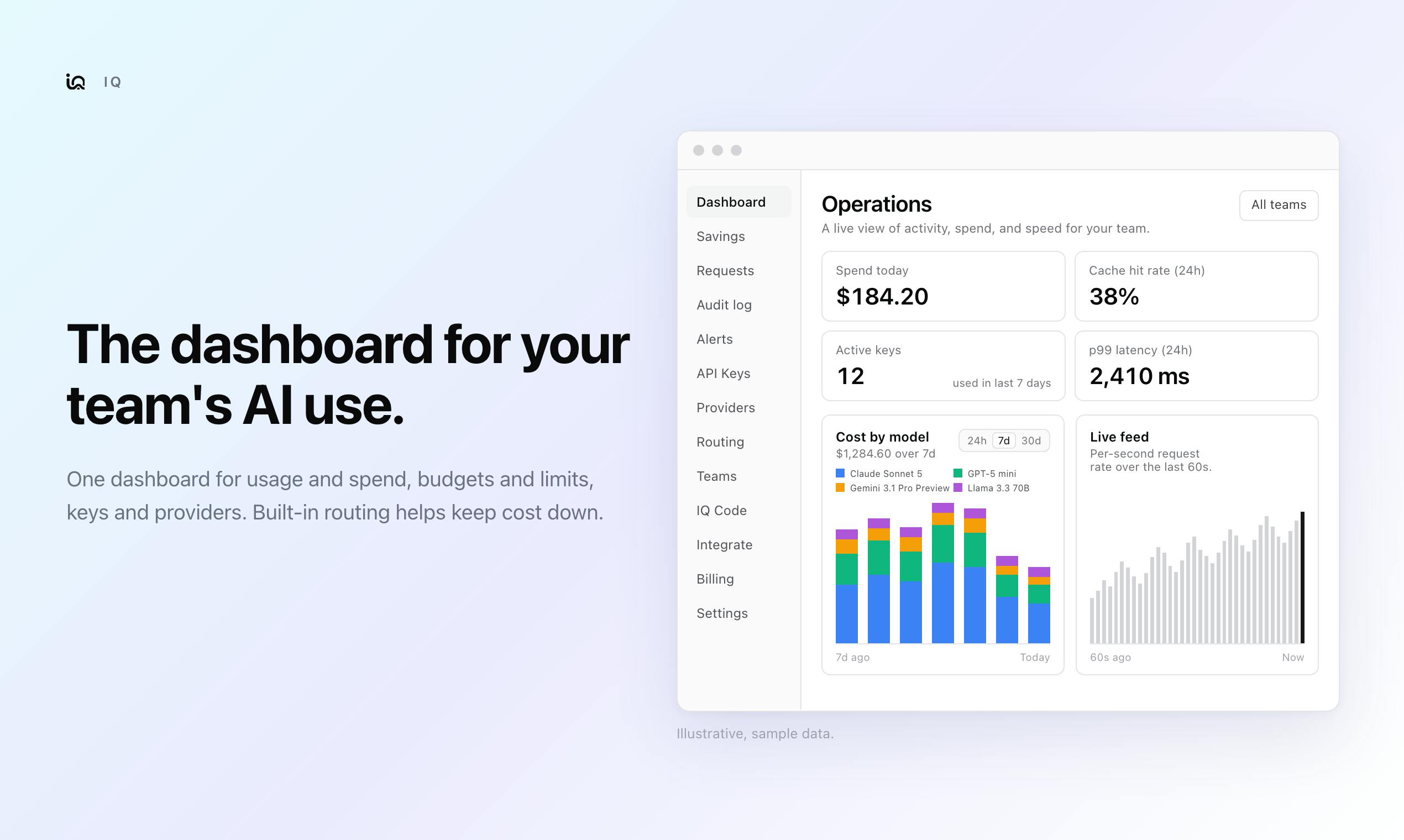
IQ aggregates AI call data that was previously scattered across various places into a single interface. You can see request volume, token consumption, and corresponding costs for each app or each teammate. For teams that need to explain to their boss "why AI spending doubled this month," this transparency itself is valuable.
Key Isolation and Quotas
Rather than letting everyone share a single universal key, IQ allows you to assign separate keys to each app or teammate and set individual quotas. This is both a cost-control measure and a security practice—when one member's project spirals out of control, it won't drag down the entire team's budget.
API keys are credentials for calling large model services, typically bound to a billing account. When team members share the same key, all calls are billed to the same account—making it impossible to attribute costs or quickly identify who is responsible when abuse or leakage occurs. Assigning separate keys to each app or member (key isolation) is a common practice in cloud service cost governance: it makes usage attributable, permissions revocable, and allows rate limits or spending caps to be set for individual keys, thereby containing risk locally.
Budgets, Alerts, and Auditing for Teams
In the Team plan, IQ adds budget setting, threshold alerts, and audit logs. Budgets give financial planning a solid basis; alerts proactively notify when spending approaches the limit; audit logs record who called what and when, meeting compliance and internal accountability requirements.
Built-in Routing to Optimize Costs
IQ has built-in routing functionality to help teams make more economical choices among different models or services. Although the product description doesn't elaborate on the specific routing strategy, this design suggests that IQ is not just passively recording but also attempting to actively reduce AI usage costs.
Model routing refers to the technique of dynamically distributing requests across multiple large models or API services. Different models vary significantly in price, latency, and output quality—for example, lightweight tasks can be handled by low-cost models, while complex reasoning calls for high-cost models. The routing layer typically selects backends based on task type, prompt length, or real-time pricing strategies, thereby reducing overall overhead without noticeably sacrificing quality. IQ including routing as a built-in capability means it is not only an observability tool but also attempts to intervene in the call chain to actively optimize costs.
IQ Code: A Plugin for Claude Code
IQ also offers IQ Code—a plugin for Claude Code. For developers using Anthropic's coding assistant, this means they can integrate IQ's usage tracking capabilities into their familiar coding environment without switching to a separate backend.
Claude Code is a command-line coding assistant launched by Anthropic. Developers can directly invoke Claude in the terminal to complete tasks such as code generation, refactoring, and debugging, with usage also billed by token. The plugin mechanism allows third-party tools to inject hooks or extend commands into Claude Code's workflow, thereby collecting call data without changing developers' habits. IQ Code leverages this mechanism to embed usage tracking into the coding process, avoiding the need for developers to frequently switch to a separate dashboard to check consumption.
Who Is IQ Best Suited For?
Judging from the feature combination, IQ best fits two scenarios: small to medium-sized engineering teams and studios using multiple AI applications simultaneously. The former need to account for AI ROI to management, while the latter need to allocate AI budgets across different projects. The free-to-start strategy also lowers the barrier to entry—get it running first, then decide whether to upgrade to the Team version with budgets and auditing.
However, IQ is still in its early stages (only 72 votes and 1 comment on Product Hunt). The depth of ecosystem integration, coverage of various model APIs, and the actual effectiveness of routing all still need validation from more users. If you're looking for a lightweight entry point for AI usage monitoring, IQ is worth adding to your watchlist.
Key Takeaways
- IQ centralizes team AI usage, spending, and request records in a single dashboard, solving the cost black box problem when multiple members share keys.
- It supports assigning separate keys and quotas to each app or teammate, balancing cost control with access security.
- The Team version offers budgets, alerts, and audit logs, suitable for teams with compliance and financial planning needs.
- Built-in routing attempts to actively reduce AI call costs, while the IQ Code plugin extends tracking capabilities into the Claude Code development workflow.
One-line Summary
IQ is a team AI usage dashboard that centrally monitors usage and spending with key isolation and budget alerts.
Paragraph Summary
IQ is a product positioned as a "team AI usage dashboard," designed to solve the pain point of opaque usage and spending when multiple members share API keys. It aggregates request volume, token consumption, and costs from various apps and members into a unified interface, supports assigning separate keys and quotas to each app or teammate, and balances cost control with security. The Team plan further provides budget setting, threshold alerts, and audit logs to meet financial planning and compliance needs. Built-in routing attempts to actively optimize model selection to reduce costs, while the IQ Code plugin extends tracking capabilities to the Claude Code development workflow. The product suits small to medium-sized engineering teams and studios using multiple AI applications, but it is still early-stage, with ecosystem integration and routing effectiveness yet to be validated.
Related articles
 Tech Frontiers
Coldframe: A Honeypot Disguised as a Supermarket Freezer Controller
Coldframe is a honeypot disguised as Danfoss AK-SM 800A and Dixell XWEB freezer controllers, built as a single Python file that detects CVE-2025-41450 attempts and is identified as real devices on Shodan.
 Tech Frontiers
GRFNet: A Lightweight PyTorch Model Designed for Multichannel Time-Series Classification
GRFNet is a lightweight PyTorch model for multichannel time-series classification, originating from EEG decoding research. With only 3,847 parameters, it is based on the ROCKET architecture, combining random convolution kernels with learnable spatial filters, supports arbitrary input lengths, and will soon be evaluated on the PhysioNet dataset.
 Tech Frontiers
CUDA-Accelerated Rocket League Simulator: A Player-Made Hardcore Experiment
A Reddit post shows a "100% Accurate" Rocket League simulator accelerated with CUDA. We analyze its technical context, CUDA's value in game physics simulation, and the significance and limitations of such community projects.