Iran Threatens to Strike US Data Centers and AI Facilities as Gulf Tensions Escalate

Iran threatens to strike US data centers, AI facilities, and undersea cables in the Gulf, extending geopolitical conflict into digital infrastructure.
Iran recently warned that if hostilities with the US resume, it will target US data centers, AI facilities, and undersea cables in the Gulf, marking digital infrastructure as a formal target of geopolitical competition. The article analyzes the strategic logic of this threat: AI and data centers are deeply embedded in military command and economic operations, and attacking them can simultaneously paralyze military actions and economic activities; the vulnerability of undersea cables means the threat's impact could extend to communications across Europe, Asia, and Africa. Gulf states face a dilemma between relying on US protection and avoiding involvement in conflict, with the UAE calling for regional unity. The boundary between cyber attacks and physical strikes is increasingly blurred, and attribution difficulties and low thresholds make the deterrence landscape more complex. The article concludes that tech companies deploying data centers in emerging markets must elevate geopolitical risk from a peripheral consideration to a core decision-making variable.
Iran recently issued a stark warning that if hostilities with the United States resume, it will target US data centers, artificial intelligence facilities, and undersea cables in the Gulf region. This statement marks a new phase in tensions between the two countries—digital infrastructure is moving from behind the scenes to the forefront of geopolitical competition.
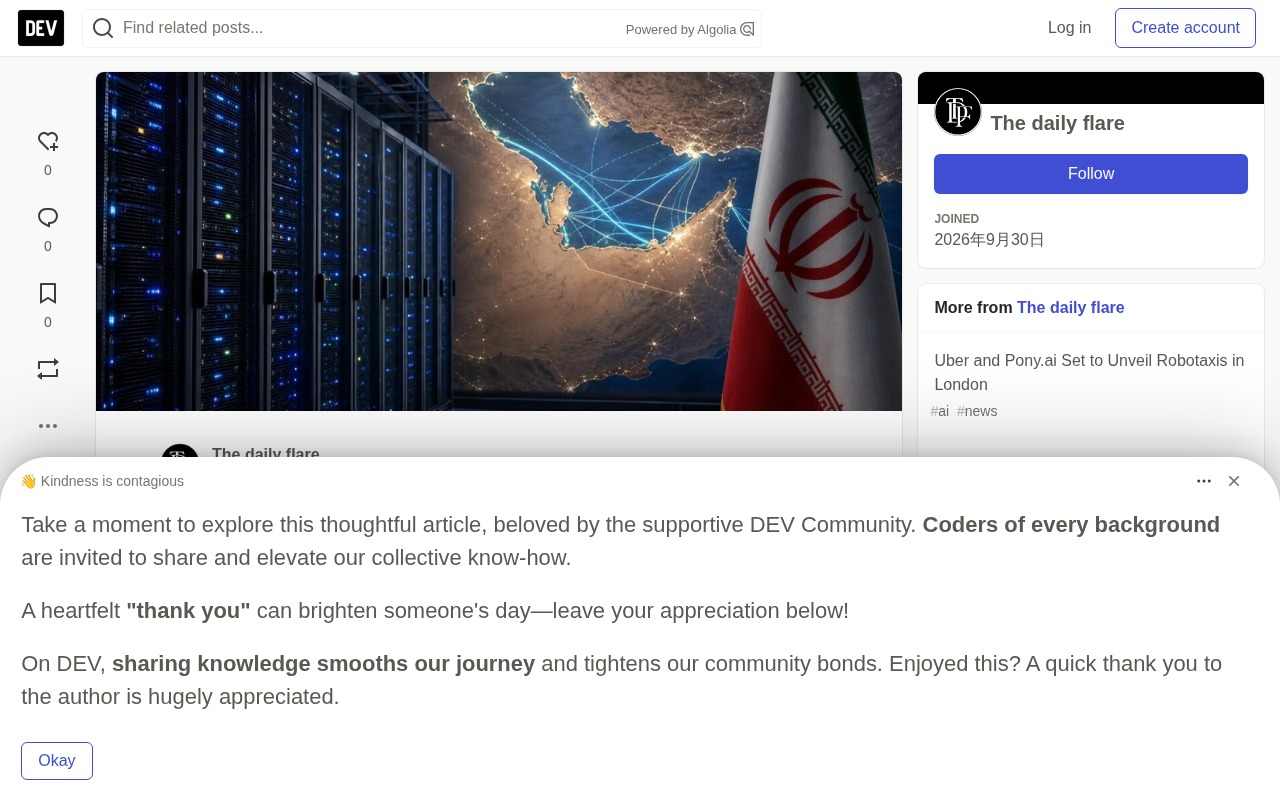
The Specifics of the Threat and Its Context
According to The Daily Flare, the Iranian government has conveyed its intentions through multiple channels: any renewed US military action could trigger retaliatory strikes on critical infrastructure. Then again, the US continues to strengthen its military deployment in the Gulf, which Tehran views as a direct threat.
Iran particularly emphasized its cyber warfare capabilities, hinting at possible digital attacks on US assets. While Iran's specific capabilities remain unclear, US officials are wary of its advances in cyber capabilities—in several previous incidents, Iran has demonstrated cyber attack methods targeting regional adversaries and US interests.
The timing of this warning is particularly sensitive. The Gulf region has recently seen a series of confrontations, with the US Navy monitoring Iranian activities. The Strait of Hormuz, a critical channel for global oil transportation, remains a focal point of tension.
Why Target Data Centers and AI Facilities
Including data centers and AI sites on the threat list reflects a shift in strategic thinking. Traditionally, military confrontation focused on warships, bases, and weapons; today, the digital infrastructure supporting military command, economic operations, and intelligence analysis has become an equally important strategic asset.
AI technology is deeply embedded in every industry. Attacking AI facilities would not only disrupt military operations but could also sever economic activities that depend on these technologies. Once data centers are damaged, the impact would ripple through finance, communications, logistics, and beyond—far exceeding the direct scope of traditional military strikes.
For the Gulf region, this issue is especially thorny. The region has invested heavily in digital transformation and the AI industry in recent years, with data center construction booming. Iran's threat directly targets the security and reliability of these investments, forcing relevant countries to reassess the protective capabilities of their infrastructure.
Infrastructure Dependencies of AI Training Clusters
AI training clusters are fundamentally different from ordinary data centers. Training a large language model typically requires thousands to tens of thousands of GPUs or specialized accelerator chips, working in concert for weeks or even months via high-speed interconnect networks (such as InfiniBand). Such clusters demand far more in power supply, cooling capacity, and network bandwidth than traditional data centers, and are highly concentrated physically—once a critical node is damaged, the entire training task may be interrupted and difficult to quickly restore.
From a military perspective, the value of AI facilities lies in serving both the civilian economy and military applications. US military command and control systems, intelligence analysis platforms, and logistics optimization systems are already deeply dependent on AI capabilities, and many AI model trainings rely precisely on data centers deployed in the Gulf region or connected through its networks.
This means attacking AI facilities can produce a dual effect: weakening the adversary's military technological advantage while striking its economic competitiveness. This dual-use ambiguity makes AI infrastructure an extremely attractive target in geopolitical conflicts, while also making it difficult for defenders to formulate protection strategies using purely military or commercial logic.
Reactions of Gulf States and Regional Security Dilemmas
Iran's threat has drawn attention from all regional parties. Gulf states allied with the US are closely monitoring developments. A UAE official recently called on Gulf states to remain united in the face of escalating threats, emphasizing the need for coordinated response to maintain regional security.
Behind this call for unity is the dilemma facing Gulf states: on one hand, they rely on the US military umbrella; on the other, their geographic proximity and economic ties to Iran make them unwilling to be drawn into a full-scale conflict. The security of data centers and AI facilities precisely embodies this contradiction—these facilities are both symbols of national modernization and the most vulnerable links in potential conflicts.
The Blurring Boundary Between Cyber Warfare and Physical Strikes
In Iran's warning, cyber attacks and physical strikes are presented side by side, which itself is noteworthy. In the digital age, cyber attacks can cause damage equal to or even greater than physical strikes, but attribution is difficult, the threshold is lower, and escalation paths are more ambiguous.
US concerns about Iran's cyber capabilities are not unfounded. Over the past few years, Iran has been accused of launching multiple cyber operations against regional adversaries and US interests. If these capabilities were used to attack data centers or AI training clusters, the consequences could include data breaches, service disruptions, and even damage to the integrity of AI models.
Undersea cables have also been listed as targets. The vast majority of global internet traffic is transmitted through undersea cables, and cables in the Gulf region carry critical communications connecting Europe, Asia, and Africa. Any physical damage to cables could cause widespread communication disruptions, with impacts extending far beyond the region.
The Strategic Vulnerability of Undersea Cables
Undersea cables are the physical backbone of the global internet, carrying approximately 99% of intercontinental data transmission. There are currently about 500 undersea cable systems in operation worldwide, with a total length exceeding 1.3 million kilometers. The Gulf region is a key communications hub connecting Europe, Asia, and Africa, where multiple backbone cables (such as the SEA-ME-WE series connecting Europe and India, and Africa-1) converge.
The vulnerability of undersea cables comes from two aspects. Physically, cables in shallow waters (typically less than 200 meters deep) are easily damaged by anchor chains, trawlers, or even submersibles, and there have been multiple major network outages caused by accidental anchor chains in history. Repairing a deep-sea cable typically requires specialized repair ships and takes weeks or even months. Politically, cable landing stations involve multiple national jurisdictions, making attribution of attacks extremely difficult.
It is precisely for this reason that listing undersea cables as strike targets has an asymmetric deterrence effect—the cost of attack is low, but the communication disruption caused could simultaneously impact military command, financial transactions, and civilian internet, with a scope far exceeding the direct combat zone.
Diplomatic Space and Conflict Risk
The international community is closely watching the situation. Diplomatic de-escalation efforts have been ongoing, but the shadow of military confrontation persists. The US has reaffirmed its commitment to protecting its own and its allies' interests in the Gulf, while Iran's leadership has shown a firm stance against perceived aggressions.
The coming weeks are crucial. Whether diplomatic channels can effectively mitigate the threat or the situation slides toward open confrontation depends on whether both sides are willing to seek compromise beyond tough rhetoric. For the tech industry, this incident also serves as a wake-up call: the geopolitical risks of data centers and AI infrastructure are no longer a distant hypothesis but an unfolding reality.
When AI facilities become targets of military threats, global tech companies laying out data centers in emerging markets need to incorporate geopolitical risk into their core considerations. The Gulf region's digital ambitions are facing an unexpected stress test.
Geopolitical Risk and Tech Infrastructure Deployment
In recent years, global tech companies' investments in the Middle East have grown significantly. Countries like the UAE and Saudi Arabia have launched large-scale digital transformation plans, attracting Microsoft, Google, Amazon, and others to build data centers and cloud regions locally. These investments are usually based on commercial logic—proximity to users, low latency, emerging market demand—but often underestimate the weight of geopolitical risk.
Incorporating geopolitical risk into infrastructure assessment typically involves several dimensions: the conflict exposure of the location (whether it is in a potential war zone), single points of failure in the supply chain (whether critical equipment depends on a single source), legal risks of data sovereignty (whether the host country can seize assets in a crisis), and the dual protection costs of physical and cyber security.
This Iranian threat incident shows that tech companies need to elevate geopolitical analysis from a peripheral consideration to a core decision-making variable. For enterprises planning to deploy AI computing power and data infrastructure in the Gulf or other high-risk areas, distributed layout, redundant design, and crisis contingency plans are shifting from optional to mandatory.
One-line Summary
Iran threatens to strike US data centers, AI facilities, and undersea cables in the Gulf, extending geopolitical conflict into digital infrastructure.
Paragraph Summary
Iran recently warned that if hostilities with the US resume, it will target US data centers, AI facilities, and undersea cables in the Gulf, marking digital infrastructure as a formal target of geopolitical competition. The article analyzes the strategic logic of this threat: AI and data centers are deeply embedded in military command and economic operations, and attacking them can simultaneously paralyze military actions and economic activities; the vulnerability of undersea cables means the threat's impact could extend to communications across Europe, Asia, and Africa. Gulf states face a dilemma between relying on US protection and avoiding involvement in conflict, with the UAE calling for regional unity. The boundary between cyber attacks and physical strikes is increasingly blurred, and attribution difficulties and low thresholds make the deterrence landscape more complex. The article concludes that tech companies deploying data centers in emerging markets must elevate geopolitical risk from a peripheral consideration to a core decision-making variable.
Related articles

Workbuddy for Absolute Beginners: How a Desktop AI Agent Fits Into Real Workflows
A beginner's guide to the Workbuddy desktop AI agent: installation, claiming credits, file management, and building automated workflows—compared with CodeX for fit and cost, helping professionals shift from AI question-askers to AI managers.

OpenAI's New Agent Stack: Computer Use, Decisions API, and Ultra-Fast Workflows
OpenAI Dev Day unveiled a new agent stack: Computer Use outperforms humans, Decisions API delivers ultra-low-latency classification via Luna, Agents API opens the same Computer Use capabilities, and GPT-6.1 Sol costs only one-seventh of Astra. Core updates, benchmark data, and developer insights.

Liang Wenfeng Open-Sources DeepInfo Inference Framework, Takes On U.S. Ban
DeepSeek open-sources its DeepInfo inference framework after its models, featuring GPU/CPU cross-pipelining, small-model prediction with large-model verification, and full Huawei Ascend and NVIDIA chip support—facing the U.S. federal ban head-on. This article analyzes its significance for AI deployment and open-source strategy.