IronFuel Lands on Android: Dynamically Linking Workout Logs with Nutrition Goals

IronFuel unifies workout logging and nutrition goals into one dynamic loop, built for Android fitness users.
IronFuel is a newly launched Android fitness app whose core value proposition is bridging workout tracking and nutrition goals into a single dynamic loop — every completed training session automatically adjusts that day's calorie and protein targets to match actual expenditure, eliminating manual cross-app math. Logging is designed to be frictionless: workouts via three taps or voice input, meals via photo recognition. Developed by Quantdesk, the app debuted on Product Hunt with 7 upvotes and ranked 17th on launch day. Its main uncertainty lies in the accuracy of its AI food recognition and exercise expenditure estimation, both of which require real-world validation. For strength trainers who take both training and diet seriously, it tackles a genuine and long-standing pain point.
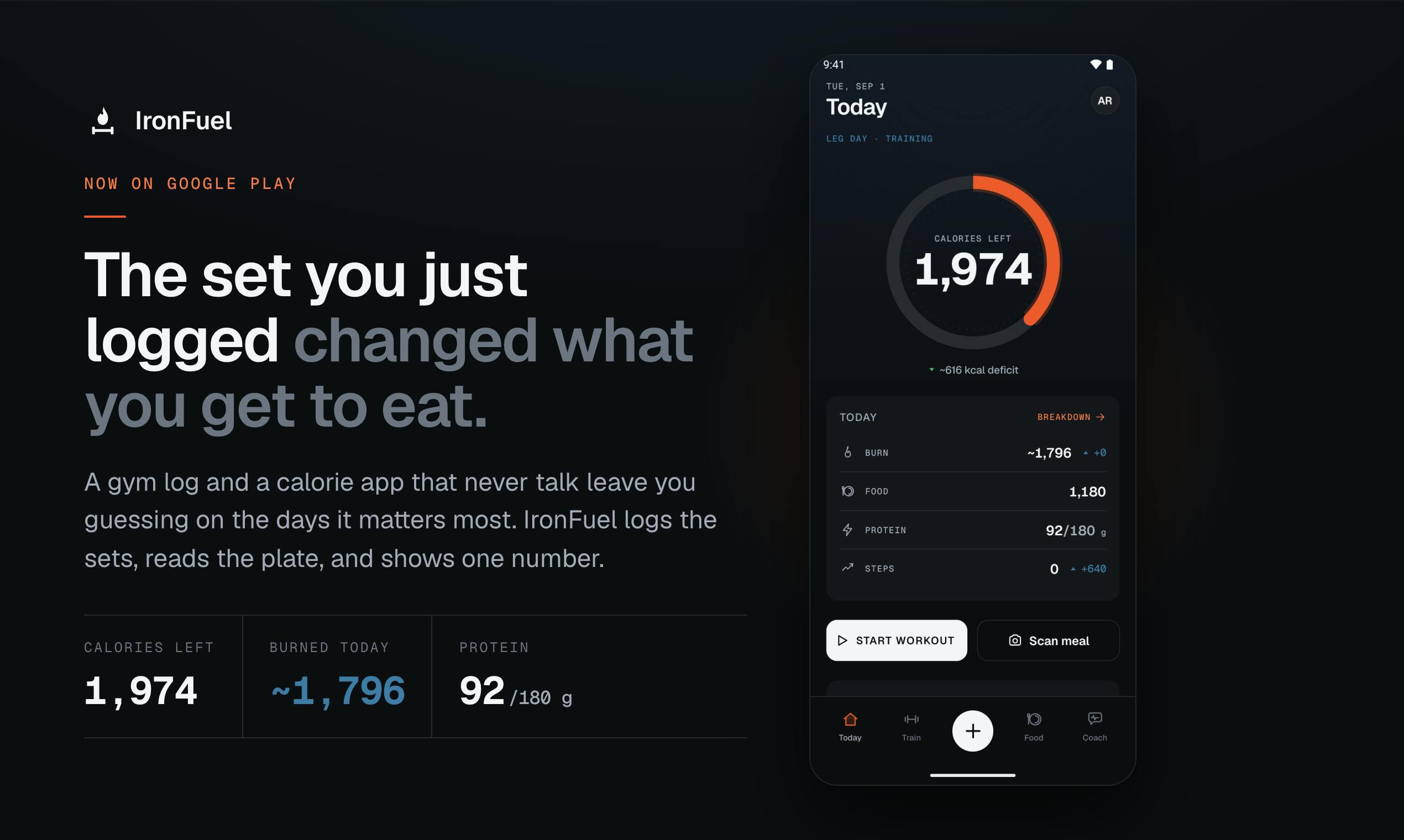
Fitness enthusiasts often keep two completely separate apps on their phones: one for logging workout sets, another for tracking calorie intake. With no data flowing between them, users are left doing the mental math themselves — trained hard today, should I eat more? Am I getting enough protein? IronFuel aims to merge these two tasks into a single closed loop. The app recently launched on Android, debuting on Product Hunt with the tagline "Log a set, watch your daily nutrition goals adjust in real time."
Core Concept: Real-Time Sync Between Training and Nutrition
The most noteworthy aspect of IronFuel is how it places "calories burned" and "calories consumed" within the same dynamic balance. In traditional setups, a workout journal and a calorie app operate in complete silos: finish a few sets of squats at the gym, and your calorie app has no idea — it still reminds you to hit the same fixed daily target.
IronFuel's approach is different: once a workout is complete, that day's calorie and protein targets automatically adjust to reflect actual energy expenditure. In other words, the harder you train, the more nutrition you're allowed — and indeed need — to consume. This real-time feedback directly links training intensity to dietary decisions, reducing the burden of manual estimation on the user.
Estimating exercise-related energy expenditure is inherently complex. Common methods include formula-based calculations using MET (Metabolic Equivalent of Task) values, as well as regression models that factor in heart rate, body weight, and exercise type. Strength training is particularly difficult to estimate — unlike cardio, compound movements like squats and deadlifts have relatively modest immediate calorie burns, but the post-exercise "afterburn effect" (EPOC, Excess Post-exercise Oxygen Consumption) can persist for hours, causing algorithms that rely solely on workout duration to significantly underestimate total expenditure. For IronFuel to deliver accurate dynamic goal adjustments, its model must account for variables like training intensity, rest intervals between sets, and exercise type — a core test of the algorithm's maturity.
Interaction Design: Three Taps or Voice Input
For fitness apps, logging efficiency often determines whether users stick with them. IronFuel emphasizes that logging a single set takes just three taps, and also supports voice input — during rest periods, with sweaty hands, speaking is clearly more practical than filling out fields manually.
On the nutrition side, the app uses photo logging: snap a picture of a meal and the app identifies it and adds it to your daily nutritional tally. Given its "Artificial Intelligence" category tag on Product Hunt, the app likely relies on image recognition and automated estimation to lower the barrier to entry. AI-powered food recognition has become a standard direction for health apps in recent years — how accurate it is will be the deciding factor in the overall experience.
AI-driven food recognition technology typically uses convolutional neural networks (CNNs) to classify food images, then estimates calories and macronutrients against a nutritional database. Notable approaches in the industry include Google's Meal Snap concept and third-party vision APIs used by apps like Calorie Mama and Lose It!. The core challenges with this technology include: portion size variation for the same dish, differences in cooking method (fried vs. steamed can nearly double calorie counts), and decomposing the ingredients of mixed dishes — all of which introduce significant estimation error. Academic research suggests that leading food recognition models achieve over 80% accuracy under laboratory conditions, but error rates often climb to 20–30% in real-world dining scenarios. There is thus an inherent tension between the convenience of photo logging and the precision of nutritional data — users relying on this feature for rigorous dietary management should maintain realistic expectations.
Product Positioning and Market Reception
IronFuel is built by the Quantdesk team. Its Product Hunt launch was listed under three categories: Android, Health & Fitness, and Artificial Intelligence. By the numbers, the product received 7 upvotes and 3 comments on launch day, ranking 17th — a small-to-mid-sized debut in its early stages, without yet generating significant traction.
Worth noting is that the Android platform has historically seen fewer "training + nutrition all-in-one" apps, with many comparable products launching on iOS first. IronFuel's explicit "Now on Android" positioning signals that the team has identified an underserved need among Android fitness users.
Who It's For
The most direct audience for this app is strength trainers who take both their workouts and their diet seriously — and are tired of toggling between two separate apps. For casual users who just want a rough log, the dynamic target mechanism may not add much value. But for goal-oriented individuals focused on muscle gain or fat loss, the real-time link between training expenditure and nutritional targets genuinely addresses a persistent pain point.
That said, it's worth keeping expectations grounded: any calorie expenditure estimate and AI food recognition system carries inherent error, and the accuracy of dynamic targets ultimately depends on the maturity of the underlying algorithms. As a newly launched Android app, IronFuel's real-world recognition accuracy, voice logging reliability, and data sync experience all remain to be tested through broader user feedback.
Summary
IronFuel addresses a long-overlooked disconnect in fitness tracking — bridging "how much you trained" and "how much you should eat" into a single dynamic loop. Low-friction logging (three taps, voice input, photo capture) combined with real-time nutritional goal adjustments forms its core competitive edge over traditional workout journals. For Android fitness users, it's a new option worth watching — though the reliability of its AI recognition and expenditure estimation still needs time and real-world data to prove out.
Related articles

Workbuddy for Absolute Beginners: How a Desktop AI Agent Fits Into Real Workflows
A beginner's guide to the Workbuddy desktop AI agent: installation, claiming credits, file management, and building automated workflows—compared with CodeX for fit and cost, helping professionals shift from AI question-askers to AI managers.

OpenAI's New Agent Stack: Computer Use, Decisions API, and Ultra-Fast Workflows
OpenAI Dev Day unveiled a new agent stack: Computer Use outperforms humans, Decisions API delivers ultra-low-latency classification via Luna, Agents API opens the same Computer Use capabilities, and GPT-6.1 Sol costs only one-seventh of Astra. Core updates, benchmark data, and developer insights.

Liang Wenfeng Open-Sources DeepInfo Inference Framework, Takes On U.S. Ban
DeepSeek open-sources its DeepInfo inference framework after its models, featuring GPU/CPU cross-pipelining, small-model prediction with large-model verification, and full Huawei Ascend and NVIDIA chip support—facing the U.S. federal ban head-on. This article analyzes its significance for AI deployment and open-source strategy.