Is a $400/Month Codex Plan Worse Than a $200 Claude Plan? A Developer's Real-World Test Ignites the Subscription Value Debate

Developer switched from two $200 Codex subscriptions to one $200 Claude plan—and doubled effective output.
A developer who used OpenAI Codex for nearly two years documented switching from $400/month (two $200 Pro plans) to a $200 Claude subscription. He found both OpenAI quotas exhausted within one to two days, with much usage spent fixing Codex's own errors—paying to generate, then paying to fix. After switching to Claude, especially post-Opus 5.5, one subscription delivered about twice the effective output of two, with cleaner code and quota left by the weekend. The article cites OpenAI documentation noting existing Pro users keep quotas until October 29, 2026, after which quotas drop while price stays at $200. The author argues subscription decisions should weigh effective output, rework cost, and quota predictability—not just model rankings.
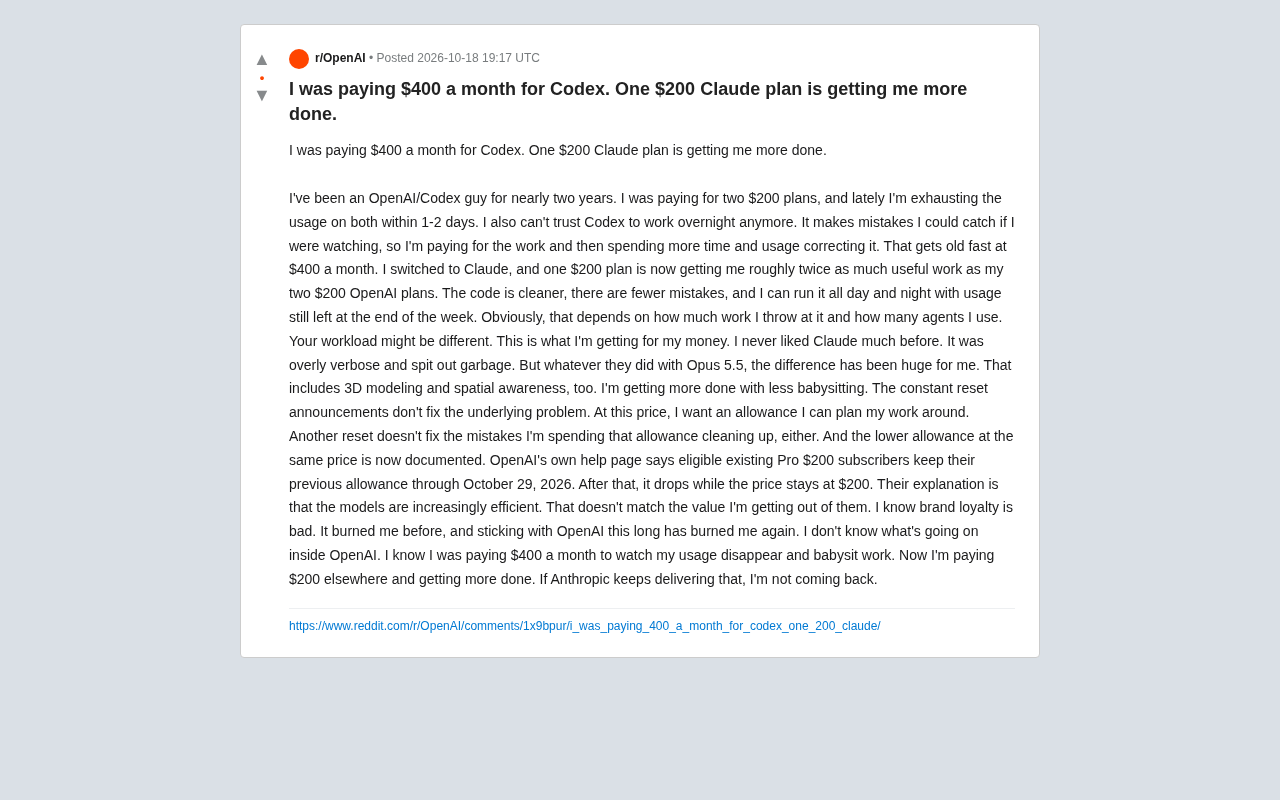
A developer who used OpenAI Codex for nearly two years documented on Reddit his experience switching from $400 per month (two $200 Pro subscriptions) to a $200 Claude subscription. The core conclusion is straightforward: one Claude subscription delivers roughly twice the effective output of his previous two OpenAI subscriptions. What makes this comparison worth discussing isn't a fanboy war over which tool is stronger, but a more practical question—when AI coding tools keep their subscription prices the same while tightening their quotas, how should developers vote with their actual money?
From "Enough" to "Not Enough": The Tipping Point of Quota Consumption
According to the developer, the problem didn't appear overnight. He used to rotate between two $200 Pro subscriptions to barely cover his workload. But recently, the usage on both subscriptions gets exhausted within one to two days. This means quotas originally planned for a whole month now last only weeks—or even less.
Accelerating quota consumption isn't unusual in itself; improved model capabilities often come with higher token throughput. But what really drove his decision to migrate was where the quota was going—a large portion of usage wasn't spent writing new code, but fixing mistakes Codex itself made. He mentioned a specific scenario: letting Codex run unattended overnight, only to find errors in the output that could only be caught by watching in real time. So the workflow became: pay to generate, then pay to fix—part of the $400 monthly fee was effectively paying for rework.
This observation resonates with many heavy users: the cost of AI coding tools isn't just the subscription price, but also the "rework rate." When the rework rate is high, the subscription fee is only the explicit cost—debugging time and repeatedly consumed quota are the hidden expenses.
"Quota" in AI coding tool subscriptions typically refers to usage allowances that reset on a fixed cycle (e.g., monthly or every few hours), measured in message counts, tokens, or agent runtime. Reset mechanisms vary widely across products: some use rolling time windows, others calendar months. This design determines whether users can spread usage evenly across the month. When usage hits the cap within one or two days, the quota's effective usable period is compressed—users must either wait for reset, pay extra, or rotate between multiple subscriptions. As a result, "quota predictability"—whether users can plan ahead how many tasks they can complete this month—becomes an independent cost dimension, not merely a byproduct of price or model capability.
The Claude Shift: Output Comparison After Opus 5.5
The developer's assessment of Claude shows a clear before-and-after contrast. He admits he previously disliked Claude, citing overly verbose output that often produced useless content. But after Opus 5.5, his judgment changed, and he specifically mentioned improvements in 3D modeling and spatial reasoning tasks.
His actual post-migration experience: one $200 Claude subscription produced roughly twice the effective work of two $200 OpenAI subscriptions. Cleaner code, fewer errors, can run around the clock, and still has quota left by the weekend. He also added caveats—this depends on workload size and the number of concurrently running agents, and different people's usage patterns may be completely different.
Two metrics need to be distinguished here: total output and effective output. The former is easy to measure; the latter determines actual efficiency. His core argument is that effective output per dollar of subscription doubled—not just that it runs more.
"Agent" here refers to an AI coding agent capable of autonomously executing multi-step tasks: it doesn't just answer single-turn questions, but can read and write files, run commands, and iteratively modify code, often running unattended in overnight batches. An agent's usage pattern is completely different from interactive chat—it calls the model dozens or hundreds of times in a single task, each call consuming quota, and failed tasks require retries. Therefore, running multiple agents simultaneously or letting agents run autonomously for extended periods multiplies quota consumption. This is why the original article emphasizes "depends on the number of concurrently running agents": agent-type workloads put far more pressure on quotas than manual one-by-one questioning.
Quota Changes in OpenAI's Official Documentation
The article cites a verifiable data point: OpenAI's help page states that eligible existing Pro $200 subscription users can retain their previous quotas until October 29, 2026, after which quotas will be reduced while the price remains at $200. OpenAI's explanation is that model efficiency continues to improve.
This reasoning holds logically, but there's a gap at the user experience level. Improved model efficiency lowers the provider's per-unit inference cost, but what users perceive is how many tasks they can complete each month. When quota reductions outpace the real benefits of efficiency gains, users feel they're getting less for the same money. The developer's own words illustrate the point: "At this price, I want a quota I can use to plan my work." Reset announcements solve short-term supply interruptions, but not the uncertainty of quota planning.
"Improved model efficiency" in the provider context usually means lower inference cost per token—for example, through better inference optimization, caching, model distillation, or hardware utilization improvements, enabling the same compute to serve more requests. For providers, this means improved gross margins; but for subscribers, it's only perceptible when efficiency gains translate into higher quotas or lower prices. If providers choose to retain the benefits of cost reductions while cutting quotas, users will feel they're "getting less for the same money." Understanding this distinction helps determine whether quota adjustment announcements represent a sharing of technological progress or a pricing strategy adjustment.
Subscription Decisions Are Becoming a Calculated Game
The developer also offered a moment of self-reflection: brand loyalty is harmful—he'd been burned once before, and this time staying loyal to OpenAI burned him again. Such statements are increasingly common in developer communities, reflecting a shift in the AI coding tool market from "choose the strongest" to "choose the most cost-effective per unit."
From a practical standpoint, the decision framework from this migration is worth adopting: break subscription costs into effective output, rework cost, and quota predictability for comparison, rather than just looking at model leaderboards or single-generation quality. For developers who need to run agents for extended periods or rely on overnight batch tasks, quota plannability may even be more important than single-output quality.
Of course, a single user's experience can't be directly generalized into a universal conclusion. Workload type, language stack, and task complexity all affect results. But this user's experience at least provides a reproducible observation angle: when rework starts eating into quotas, switching to a tool that makes fewer mistakes at the same unit price may be more cost-effective than upgrading to a higher-tier subscription.
One-line Summary
Developer switched from two $200 Codex subscriptions to a single $200 Claude subscription and doubled effective output.
Paragraph Summary
A developer who used OpenAI Codex for nearly two years documented his switch from $400/month (two $200 Pro subscriptions) to a $200 Claude subscription. He found that two OpenAI subscriptions' quotas were exhausted within one to two days, with much usage spent fixing Codex's own errors—creating a cycle of paying to generate, then paying to fix. After switching to Claude, especially post-Opus 5.5, a single subscription delivered roughly twice the effective output of the previous two, with cleaner code, around-the-clock operation, and quota remaining by the weekend. The article also cites OpenAI documentation stating existing Pro users retain quotas until October 29, 2026, after which quotas decrease while price stays the same. The author proposes that subscription decisions should compare effective output, rework cost, and quota predictability—not just model leaderboards.
Related articles

Workbuddy for Absolute Beginners: How a Desktop AI Agent Fits Into Real Workflows
A beginner's guide to the Workbuddy desktop AI agent: installation, claiming credits, file management, and building automated workflows—compared with CodeX for fit and cost, helping professionals shift from AI question-askers to AI managers.

OpenAI's New Agent Stack: Computer Use, Decisions API, and Ultra-Fast Workflows
OpenAI Dev Day unveiled a new agent stack: Computer Use outperforms humans, Decisions API delivers ultra-low-latency classification via Luna, Agents API opens the same Computer Use capabilities, and GPT-6.1 Sol costs only one-seventh of Astra. Core updates, benchmark data, and developer insights.

Liang Wenfeng Open-Sources DeepInfo Inference Framework, Takes On U.S. Ban
DeepSeek open-sources its DeepInfo inference framework after its models, featuring GPU/CPU cross-pipelining, small-model prediction with large-model verification, and full Huawei Ascend and NVIDIA chip support—facing the U.S. federal ban head-on. This article analyzes its significance for AI deployment and open-source strategy.