Is a ¥16,800 Stock-Picking 'Insider Report' Worth It? A Doubao Work AI Agent Exposes the Information Asymmetry Scam

A creator uses AI to expose a ¥16,800 stock-picking report as mostly recycled public information sold as anxiety.
Bilibili creator Liu Hangzhang dissects a ¥16,800 stock-picking "insider report," showing its exclusive reviews can be replicated by AI Agents in minutes, its "insider tips" are 80% recycled public info and 20% fabricated, and its capital flow data is fundamentally flawed due to market reflexivity. Using Doubao Work as a demo, the video shows how professional financial connectors like Tonghuashun iFinD enable institutional-grade stock reviews — and extends to reading prospectuses, comparing insurance contracts, and analyzing fund holdings. The conclusion: paid stock groups sell anxiety and information asymmetry, a moat that AI has nearly eliminated.
A ¥16,800 "Core Insider Report" — What Are You Actually Paying For?
Bilibili creator "Liu Hangzhang" shared a real-life case: a friend paid ¥9.9 to join a stock-trading paid group, but key information was hidden from regular members. To unlock it, you had to upgrade to a premium membership — priced at ¥16,800. Bombarded daily by the group's "success stories," the friend gritted their teeth and paid in 12 installments. The result? Following the "mysterious stock codes" led to not just failing to recover the cost, but losing an additional ¥40,000.
After obtaining the legendary "core insider report," the creator found it was divided into three sections: major capital flow data, exclusive stock reviews, and insider information. Interestingly, the institution actually held a licensed investment advisory permit — so to avoid infringement, the content was blurred in the video. But the core conclusion was clear: what that ¥16,800 buys isn't information — it's information asymmetry. And in the age of AI, that asymmetry is being rapidly erased.
The "Exclusive Stock Review": A Service AI Can Replicate in Minutes
Of the three sections, the creator considered the "exclusive stock review" the only legitimate one, since the data was at least real, and stock reviews are genuinely something retail investors should take seriously. Many beginners know the market has pitfalls but don't know what kinds or why they fall into them — wanting to improve is a good thing.
The problem is, doing a stock review doesn't require spending ¥16,800. The creator demonstrated using Doubao Work, a desktop AI Agent product — and to be clear, it's not the same as the Doubao mobile app. It's an intelligent agent that, given a goal, can break down tasks on its own, call tools, and see things through to completion.
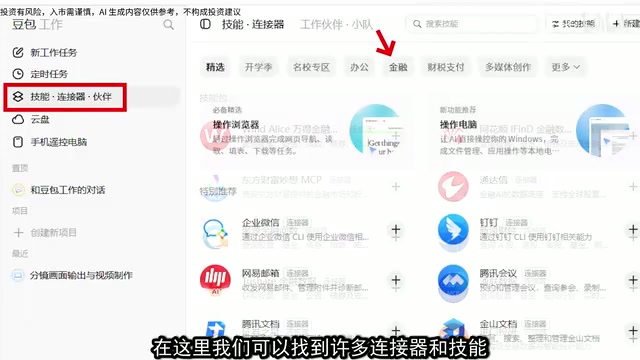
Taking the recently limit-down stock Moore Threads as an example, the creator didn't ask a vague question like "why did it drop." Instead, a more refined approach was used: open the "Skills & Connectors" menu, find the finance category, and call professional connectors like Tonghuashun iFinD and AlphaPy. The purpose is to ensure the data obtained is financial-terminal-grade, real-time, and traceable — not secondhand information scraped from the web. Setup only requires entering an API key or authorization account in the personal center; tutorials are provided in the popup.
Minutes later, a professional report was generated: Moore Threads' recent decline was primarily caused by the lifting of lock-up restrictions on restricted shares, with the report also flagging a larger upcoming unlock in December, while integrating bullish and bearish factors and assessing whether the market had already priced in the news. If satisfied with the result, you can save it as your own skill — no coding required — and reuse it for future stock reviews with a single click.
AI Agent vs. ordinary AI chat assistants: the core difference is "autonomous action capability." Regular conversational models (like the web version of ChatGPT or a mobile app) typically only respond to a single user input and cannot actively break down tasks, call external tools, or execute multi-step operations continuously. An AI Agent, upon receiving a high-level goal, can independently formulate an action plan, decide which tools to invoke (search, database queries, code execution, etc.), and adjust subsequent steps based on intermediate results — the whole process is like an assistant that "thinks it through before acting." The "Doubao Work" product mentioned in this article belongs to this category. Its "Skills Connector" mechanism allows the Agent to call professional financial data interfaces like Tonghuashun iFinD when needed, accessing institutional-grade real-time market data, announcements, and research reports — rather than relying on knowledge baked in during training or secondhand information scraped from public web pages. This is the technical foundation for generating "financial-terminal-grade" reports.
Why a Framework Is More Trustworthy Than a Conclusion
The creator noted a key observation: when Doubao Work performs financial analysis, it doesn't just throw out a conclusion — it presents the framework first, then the supporting evidence. It tells you which dimensions to analyze, what data to look at for each, and then works down to the conclusion step by step. The entire process is not a black box.
This matters especially for novice retail investors. Faced with various conclusive-sounding claims, ordinary people have a hard time judging their validity. A tool that can show its reasoning chain is far more trustworthy than a paid group that only hands out "buy" ratings.
Debunking the "Insider Information": 80% Recycled, 20% Fabricated
After reviewing the so-called "insider information" on everyone's behalf, the creator categorized it into three types: unverifiable positive news (a company is about to restructure or be acquired); publicly available information repackaged (news from a few days ago reworded as "exclusive insider tips"); and a trap within a trap — bullish information is provided, but the exact entry point is withheld. To get a precise buy signal, you need to spend another ¥36,888 to unlock it.

Here's a key fact worth knowing: real insider information cannot be made public — doing so is illegal — and it certainly cannot be sold as a service. If a licensed institution actually tried to sell it, a single report to regulators would shut it down immediately. So any "insider tips" available for sale are almost certainly just public information. The creator fed the report to Doubao Work for online verification, and the result: this ¥16,800 insider report was 80% recycled public information and 20% content with no factual basis whatsoever.
Chinese securities law has a clear legal definition of "insider information": it refers to information related to a company's operations, finances, or any information with a material impact on securities prices that has not yet been made public. Insiders who use such information to trade securities commit insider trading, which can carry sentences of five years or more plus fines for serious cases. This is precisely why any "real insider information," once publicly disseminated, either constitutes a crime or is simply fabricated. Licensed investment advisory institutions (which must be approved by the China Securities Regulatory Commission or local CSRC bureaus) face even stricter regulatory constraints — selling unverified insider information not only violates securities law but directly risks license revocation. Therefore, "insider tips" that can be openly sold are structurally self-refuting from a legal standpoint: genuine ones can't be sold, and ones that can be sold are necessarily not genuine. Understanding this context helps explain why the creator's conclusion is so definitive — it's not just empirical judgment based on after-the-fact verification, but also an a priori inference grounded in regulatory logic.
Capital Flow Data: A False Premise Under Market Reflexivity
Capital flow data is the most complex and least reliable of the three sections. The creator's analysis is insightful: what you see as institutional inflow or outflow is the result of completed transactions, not the cause of future movements. Large orders can be split into small ones, and small orders can be combined to simulate accumulation and create false impressions. Different platforms use different statistical methodologies and estimation models, making institutional positioning a prediction rather than an objective depiction.

At a deeper level, there's market reflexivity: the act of prediction changes the outcome itself. If a piece of information is genuinely effective and everyone can act on it, that consensus expectation becomes the most dangerous thing of all — either it self-fulfills into a bubble that bursts, or it suddenly fails precisely when everyone believes in it.
The creator cuts to the heart of it: if a model could truly predict capital flows, the optimal strategy would be to trade with leverage until you're fabulously wealthy — not sell ¥16,800 memberships. The people selling predictions profit from your desire to predict — not from the predictions themselves. In investing, what ultimately matters isn't who predicts most accurately, but who survives the longest and who can admit "I can't predict this."
Reflexivity is a concept systematically developed by investor George Soros in his book The Alchemy of Finance. The core idea is that market participants' perceptions and actions mutually influence each other, which in turn alters the market's own fundamentals, creating a two-way feedback loop between cognition and reality. This stands in stark contrast to the traditional economics assumption that "market prices reflect objective value" — a one-directional premise. In stock markets, reflexivity means that "prediction" is itself part of the variable: when enough people believe a stock will rise and buy in, the buying itself drives up the price, making the prediction "come true" in the short term. But since this price increase isn't supported by fundamentals, it typically ends in a bubble burst. Capital flow indicators are especially prone to this paradox — once a signal is widely disseminated and followed, institutional money can fully exploit the resulting consensus to engineer bull traps or bear traps, rendering a statistically meaningful signal completely useless.
Legitimate Uses of AI Agents: Save Money, Avoid Traps, Save Time
If AI can expose scams, it can naturally help in legitimate investment scenarios too. The creator shared several use cases from personal experience:
Decoding Financial Product Prospectuses
Many people only look at yield rates and terms when buying wealth management products, with no idea about underlying assets or regulatory registration — only discovering problems after the fact that they bought into non-standard debt or even illegal fundraising schemes. Feed the dense, lengthy prospectus to Doubao Work, and it will read the entire document, extract key information, verify registration and issuer credentials online, trace through layers of underlying assets, and output a plain-language report.
Comparing Insurance Contracts
Insurance policy documents easily run dozens of pages, and comparing multiple products multiplies the reading load exponentially. Throw the sales materials and policy terms in together, and with a single prompt you can get a clear picture of product differences and respective advantages — a time-saver for practitioners as well.
Fund Penetration Analysis

Many people buy funds based solely on the name and assume they know what they're getting, unaware of potential style drift, position concentration, fee ratios, maximum drawdown, or how many funds the manager oversees. The creator jokes: you think you're buying a diversified portfolio, but the manager quietly went all-in on AI. Just screenshot the fund info and hand it to the AI — it covers all these dimensions at once.
All these use cases are fundamentally the same thing: hand off "too specialized to understand, too tedious to read, too much to get through, or just don't want to bother with" professional content to the AI for reading, researching, and analysis — then you just review the most intuitive presentation and make your own judgment.
Why Doubao Work
The creator admits Doubao is the conversational model they've used the longest, with a sense of familiarity built up over time. Beyond personal preference, one point was highlighted that many people overlook: dual local computer and cloud computer modes. Tasks involving local files (desktop documents, certain web data) can be handled locally, with data never leaving your machine. For heavy tasks like scraping hundreds of research reports or reading through ten years of trading data, they can be pushed to the cloud to run even after you close your computer.
Pure cloud capability is available in other Agents too, but some products have complex setups or force you to choose one or the other. Doubao Work's seamless multi-mode switching is the smoothest the creator has experienced among comparable products. As a video content creator, they also value the multimodal integration with Jimo (image/video generation) — the AI can dig through folders to find character design images and generate animations entirely on its own, with no manual file-moving required, closing the loop across the entire chain from investing to content creation.
Currently, new users get a 30-day Pro membership upon download, and combined with the free quota, the cost of doing stock reviews is essentially zero.
Conclusion: Pay for Results, Not for Anxiety
Liu Hangzhang's closing thought is worth remembering: in the age of AI, never again spend serious money on information asymmetry that's already within easy reach. Pay for results — not for anxiety. Stock-picking groups are fundamentally in the business of selling anxiety and information gaps. Now that AI can complete stock reviews, verify claims, and trace through assets in minutes, the moat around that business model is nearly gone.
Related articles

AI Writes Code, Will Programmers Lose Their Jobs? The Truth About Devin's Autonomous Programming
Devin and other autonomous AI coding agents are changing software development: from Copilot-assisted coding to fully automated engineering agents, the programmer's role shifts from writing code to system design and oversight. This article analyzes the impact of AI programming on employment, code security, and junior developer training, as well as the real direction of programmer demand under the efficiency paradox.

Citigroup's 14,000 Engineers Use Devin, Slashing Tech Outsourcing Bill by 30%
Citigroup's 14,000 engineers used AI coding agent Devin to cut its tech vendor bill by 30% and speed releases 30-40%, while JPMorgan says AI gains aren't in earnings yet.

AGENTS.md in Practice: Making Coding Agents Actually Work
AGENTS.md and CLAUDE.md can boost coding agent performance, but research shows misuse raises costs 20%. Here's what to write, what to delete, the 200-line and 32KB limits, monorepo nesting rules, and a security warning.