Is AI Code Generation Like Prefab Cabinets? Developers Debate the Boundaries of Tools

Reddit discussion uses a woodworking analogy to distinguish AI programming from traditional tools and their capability boundaries.
The Reddit community discussed the nature of AI programming. Developers used a woodworking analogy, comparing compilers to power drills and AI-generated code to prefab cabinets or automated factories, emphasizing that traditional tools execute deterministic output while AI autonomously decides how to use tools. The discussion acknowledged hand-coding's quality advantage but limited output, and noted that design and architecture remain AI's weak spot. The community's attitude is complex: acknowledging efficiency gains while worrying about programming's changing nature, moving from self-deprecation to a rational exploration of tool boundaries and quality trade-offs.
Title
Is AI Code Generation Like Prefab Cabinets? Developers Debate the Boundaries of Tools
Meta Description
Reddit developers hotly debate the nature of AI programming: compilers are like power drills, AI like prefab cabinets. The discussion covers the persistence of hand-coding, design and architecture shortcomings, and the 3D-printed house metaphor, exploring tool boundaries and the future of programming.
Article Content
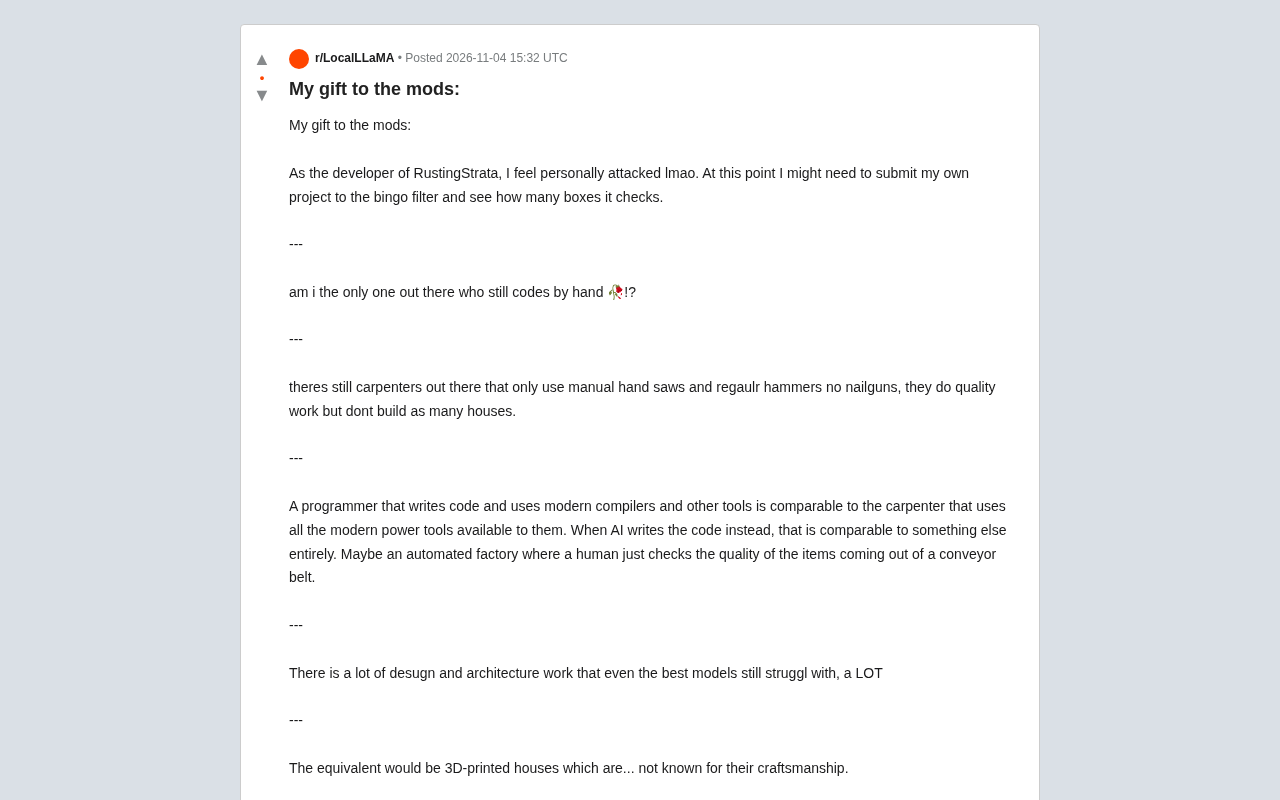
The Reddit community recently sparked a discussion about the nature of AI programming. One developer used a woodworking analogy, comparing compilers to power drills and AI-generated code to prefab cabinets—a metaphor that ignited a heated debate about the boundaries of tools. As the developer of RustingStrata, he joked: "I feel targeted, and now I might have to submit my project to the bingo filter to see how many boxes I can tick."
The Essential Difference of Tools: Deterministic Output vs. Autonomous Decision-Making
The core of the discussion lies in distinguishing traditional tools from AI. One user pointed out that compilers are like power drills—tools that help programmers and carpenters work faster; whereas AI is more like prefab cabinets or a delivery service—you install a tool to execute deterministic output, while AI decides how to use tools to give you the result you need.
"Sometimes you find the cabinets are made a bit differently—some use screws, some use nails. One cabinet won't open; that one has its door glued shut," the user wrote. "I can't answer whether this is the future of programming, but it's different from the tools or conveniences we've had before." This distinction does not deny the value of AI but emphasizes the qualitative change brought by its decision-making autonomy.
The Persistence of Hand-Coding and Analogies
Someone lamented: "Am I the only one still writing code by hand?" To this, another reply offered a clever analogy: "There are still carpenters who use only hand saws and ordinary hammers, no nail guns; they do high-quality work, but they don't build as many houses."
This analogy acknowledges the quality advantage of hand-coding while implying a trade-off in efficiency. Someone in the discussion extended it further: "Programmers using modern compilers and tools are equivalent to carpenters using all modern power tools. When AI comes to write code, that's a whole different matter—perhaps an automated factory where humans only check the quality of products coming off the conveyor belt."
Deterministic output means that given the same input and state, a tool always produces exactly the same result; compilers, power drills, and other traditional tools all have this property. AI models (especially large language models), however, generate output based on probabilities, so even with the same input, multiple runs may yield different results, and the model "autonomously" decides which tools to call and in what order to combine them to complete a task. This autonomous decision-making turns AI from a passive executor into an active planner, and also brings new issues such as predictability, auditability, and accountability.
Design and Architecture: A Fortress AI Has Not Yet Conquered
Although AI has made significant progress in code generation, several participants pointed out that design and architecture work remains AI's weak spot. "There is a lot of design and architecture work that even the best models still struggle with—a lot," one user emphasized.
This points to the current capability boundaries of AI programming tools: they excel at implementing specific features and generating boilerplate code, but their performance is still unsatisfactory on tasks requiring a global view and abstract thinking, such as system design and architectural decisions. This also explains why the hand-coding analogy resonates—high-quality system building still depends on human judgment and experience.
The Metaphor of 3D-Printed Houses
Another vivid metaphor emerged in the discussion: "The equivalent might be 3D-printed houses, but those... are not known for fine craftsmanship." This analogy suggests that AI-generated code may be produced quickly, but at the "craftsmanship" level it may be hard to match the finesse of hand-written code.
This view does not entirely reject AI but reminds us that different scenarios have different requirements for code quality. Rapid prototyping and critical system building may require different tool choices.
Software design and architecture involves global decisions such as decomposing systems, defining module boundaries, selecting technology stacks, and weighing non-functional requirements (performance, maintainability, security). These tasks require a deep understanding of the business domain and the ability to plan long-term at an abstract level. Current AI models are good at local pattern matching and code completion, but lack the ability to continuously track the overall constraints of a system, and find it difficult to make reasonable trade-offs among conflicting quality attributes. Therefore, architectural decisions still rely heavily on human experience and judgment, with AI playing more of an auxiliary role in generating alternative options.
3D-printed houses refer to using large-scale additive manufacturing equipment to extrude materials such as concrete layer by layer to build structures. Their advantages include speed, high design freedom, and reduced labor, but they are often criticized for surface finish, material uniformity, and structural certification, contrasting with the meticulous refinement of traditional craftsmanship. Mapped to AI programming, this metaphor suggests that AI can quickly "print" a runnable code skeleton, but may be rough at the "craftsmanship" level—code style, edge-case handling, performance optimization—requiring manual polishing.
Community Resonance: From Self-Deprecation to Rational Discussion
RustingStrata developer's self-deprecation struck a chord widely, but the discussion quickly shifted to a more rational level. One user joked that such discussions are at least more valuable than questions like "which model is best for a 2060ti" or "can I replace fable 5.5 with qwen 3 0.8b."
This discussion reflects the developer community's complex attitude toward AI programming: acknowledging its efficiency gains while worrying about its transformation of the nature of programming. Tools are evolving, but the discussion about "what constitutes good programming" seems never to stop.
One-line Summary
A Reddit discussion uses a woodworking analogy to distinguish the essential differences and capability boundaries between AI programming and traditional tools.
Paragraph Summary
The Reddit community discussed the nature of AI programming. Developers used a woodworking analogy, comparing compilers to power drills and AI-generated code to prefab cabinets or automated factories, emphasizing that traditional tools execute deterministic output while AI autonomously decides how to use tools. The discussion acknowledges that hand-coding, like manual carpenters, yields high quality but limited output; AI improves efficiency but may sacrifice craftsmanship. Several participants noted that design and architecture work is a fortress AI has not yet conquered, and the 3D-printed house metaphor further suggests that AI code may lack finesse. The community's attitude is complex: acknowledging efficiency gains while worrying about the transformation of programming's nature, the discussion moved from self-deprecation to a rational exploration of tool boundaries and quality trade-offs.
Related articles

AI Coding Enters the Team Collaboration Era: Interpreting Three Major Moves from Meta, GitHub, and Mistral
Meta acquires Conductor, GitHub Copilot Fusion becomes available, Mistral opens Large 4 weights—three moves show AI coding shifting from code generation to organizing development workflows. This article explains task orchestration, model collaboration, and cost control for developers.

Building a RAG Assistant with Dify: A Practical Guide to Knowledge Bases, Workflows, and Agent Nodes
How should knowledge bases, workflows, and Agent nodes connect in a Dify RAG assistant? We break down the division of labor and wiring logic for a shippable app.
 Tech Frontiers
The AI Industry Doesn't Lack Marketing—It Lacks Good Products
AI faces market selloffs and public skepticism—is marketing really the problem? This analysis of market signals and product experience argues the core困境 is incomplete products and a gap between promises and experience; the only way to change perceptions is to ship better products.