Is AI Killing Independent Websites? The Plight of All About Berlin
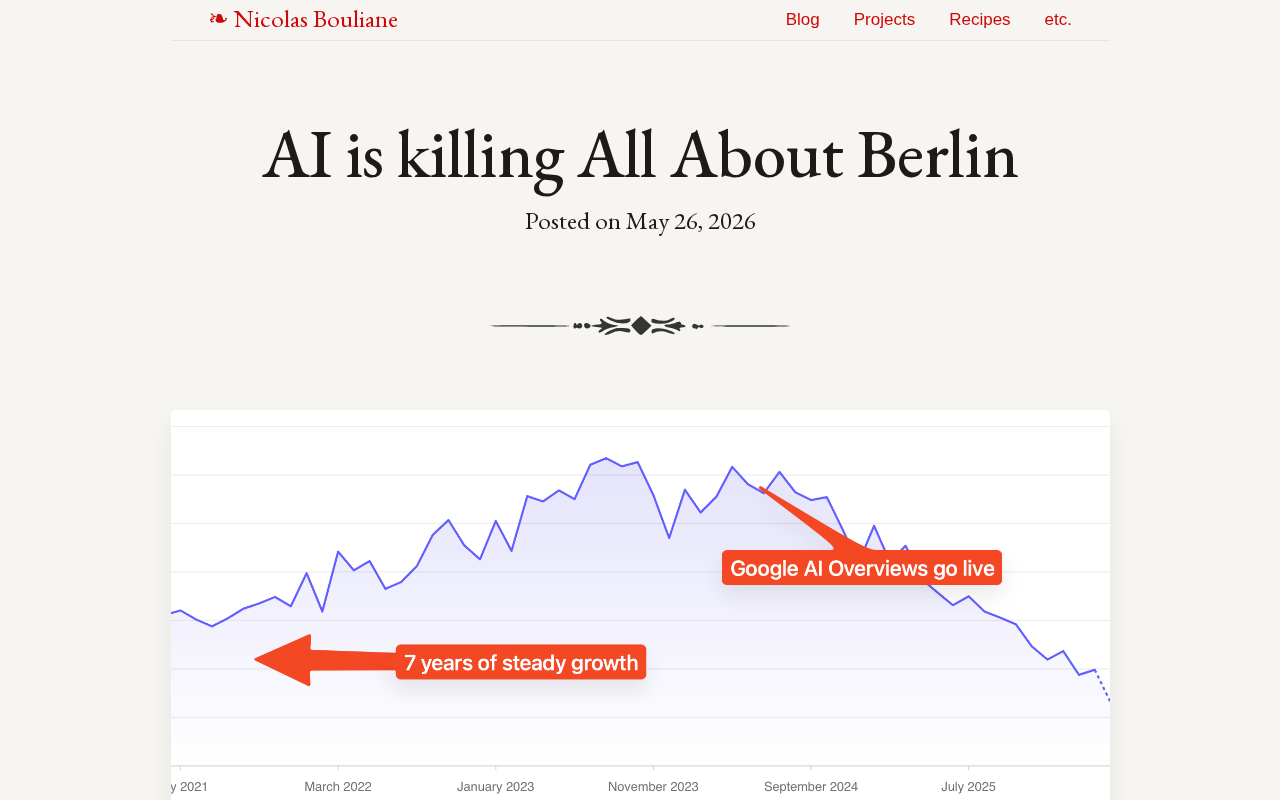
AI summaries and conversational search divert traffic, leaving the Berlin life guide site All About Berlin facing a survival crisis.
Using the independent content site All About Berlin as an example, this article explores the impact of AI search on localized guide websites. In the traditional search model, users click links to visit websites and creators profit through ads or paid content; AI summaries and conversational search generate answers directly on the results page, so users no longer need to visit the original site, causing cliff-like traffic drops for such websites. The article analyzes the "double squeeze" mechanism: content is used by AI as training data or retrieval sources, while AI-generated answers replace the need for users to visit. In response, small websites can strengthen irreplaceability, shift to subscriptions, and integrate AI tools. The case reflects structural issues in how the value of original content is measured and rewarded in the AI era, sparking heated discussion in the Hacker News community.
When AI Summaries Replace Clicks: The Survival Crisis of a Berlin Life Guide Website
A post that sparked heated discussion on Hacker News had a title that was blunt to the point of being jarring—"AI is killing All About Berlin." Behind that sentence lies the real predicament of an independent content creator facing the AI wave. All About Berlin, a website focused on Berlin life guides, is experiencing a cliff-like drop in traffic brought on by AI search and summarization tools.
The title of the post itself is a signal worth pondering. As search engines like Google begin generating summaries directly with AI, and as large language models can instantly answer users' questions about "how to register an address in Berlin" or "the German visa extension process," websites like All About Berlin that rely on precise local information to earn search traffic are the first to feel the impact.
How AI Search Impacts Localized Content Websites
From "Click Through" to "Instant Answers"
In the traditional search model, when a user searches for "Berlin address registration," the search engine returns a list of links, the user clicks into a website, sees ads or paid content, and the creator earns revenue. AI summaries and conversational search have changed this chain—users get the answer directly on the search results page or in a chat interface, without needing to visit the original website.
For local guide websites that provide practical, process-oriented information, this impact is especially devastating. That's because this type of content is precisely what AI can most easily distill, summarize, and output directly. The topics All About Berlin covers—registration, visas, insurance, renting—are all highly structured, standardizable information, exactly the type that large models excel at handling.
AI summaries (such as Google's SGE) and conversational search (such as Bing Chat and Perplexity) are new interaction modes currently being deployed by search engines. Traditional search returns a list of links, and users need to click and browse web pages to get information; AI summaries, by contrast, use large language models to extract, integrate, and generate a concise answer directly from multiple sources, displayed at the top of the search results page. Conversational search goes further, allowing users to ask follow-up questions in natural language, with the system dynamically generating responses. Both modes aim to reduce the steps users need to get an answer, but at the same time they cut off the path for users to visit the original websites, dealing a direct blow to content sites that depend on search traffic.
The "Double Squeeze" on Content Creators
You may not have noticed that these websites face more than just traffic loss. On one hand, AI tools absorb their content as training data or retrieval sources; on the other hand, the answers generated by AI directly replace the need for users to visit the original websites. This situation of being "both exploited and replaced" constitutes the "double squeeze" that content creators face.
Large language models (LLMs) typically train on publicly crawlable web content, including articles from independent websites. Once website content is used as training data, the model gains the ability to answer similar questions, but this process usually comes with no direct financial compensation. At the same time, the AI summary features of search engines also scrape web content in real time as retrieval sources, and after generating an answer, users no longer need to click through to the original site. This dual role of "being used for training" and "being replaced in access" leaves content creators in the AI era facing the dilemma of their value being exploited for free and their traffic being diverted, posing an existential threat especially to small websites that rely on advertising or paywalls for revenue.
Coping Strategies for Small Content Websites
In the face of the AI onslaught, independent content websites are not entirely without options. Several directions emerge from the Hacker News community discussion:
First, strengthen irreplaceability. AI is good at summarizing general information, but localized real-time experience, personalized in-depth perspectives, and community interaction content remain areas that AI struggles to fully replicate.
Second, change the business model. Shift from relying on search advertising traffic to subscriptions, memberships, or directly paid content, reducing dependence on search engine traffic.
Third, embrace AI tools themselves. Some creators have begun integrating AI features into their own websites, offering personalized Q&A services and turning a disadvantage into a differentiating advantage.
Broader Industry Implications
The case of All About Berlin is not an isolated one. It reflects the structural changes facing the entire content ecosystem in the AI era. As information access becomes more instant, free, and conversational, websites that survive on information gaps and search traffic will inevitably be affected.
For the tech industry, this case raises a fundamental question: when AI becomes the primary gateway to information, how should the value of original content be measured and rewarded? This is not just a technical issue, but also a question of business models and the content ecosystem. The discussion heat on Hacker News—126 upvotes and 71 comments—shows that this topic strikes a chord with many developers and creators.
Conclusion
AI will not directly "kill" a website, but it will change the way users access information, and thereby reshape the entire traffic distribution landscape. The plight of All About Berlin reminds us that in an era of AI-dominated information distribution, content creators need to rethink where their core value lies, and how to find their irreplaceable place in a world where AI can instantly answer most questions.
Related articles

GPT-6.2 and Astra Launch Together: OpenAI Has Finally Figured Out Its Release Cadence
OpenAI releases GPT-6.2 Sol and Astra together, with Plus users able to try them in ChatGPT Work and Codex. This article breaks down the positioning differences between the two models, Astra's practical use in long-document retrieval and rewriting, and how the simultaneous dual-model launch affects user workflows.

GPT-6.2 Dual-Model Hands-On: How Big Is the Gap Between Astra and Sol in Clock-Making and Game-Building?
GPT-6.2 Astra vs Sol hands-on: Blender clock, neon shooter, and Formula racing compared. Astra spends $419 with strong execution; Sol costs $197 but drops to 2 FPS. Both still trail Fable and Opus in games and aesthetics.

GPT-6.2 Astra and Sol Released: A Big Cost Drop, and How to Choose Between the Two Models
OpenAI releases GPT-6.2 Astra and GPT-6.2 Sol: Astra tackles professional tasks, Sol targets low-cost everyday use, with cost per task cut to under a third.