Is Catch-and-Release Actually Humane? The Fish Pain Debate We Keep Ignoring

Science suggests fish can feel pain, casting doubt on catch-and-release fishing's "humane" reputation.
Catch-and-release fishing, long considered a humane pastime, is facing fresh scrutiny from science and animal welfare advocates. Studies put post-release mortality rates at 11–25%, with surviving fish showing fin damage, hook wounds, and even eye injuries. More fundamentally, research since the early 2000s has built growing evidence that fish likely have the physiological and behavioral capacity to experience pain — undermining the traditional belief that fishing causes no suffering. The article uses a bird analogy to expose our double standards across species, and explores alternatives like kayaking, snorkeling, and hookless fly fishing.
Every year, millions of Americans head to rivers, lakes, and ponds to catch and release billions of fish. Long celebrated as a well-intentioned pastime — hook a fish, then give it a "second chance" by returning it to the water — catch-and-release fishing is now facing growing scrutiny from researchers and animal welfare advocates. The question they're raising: is it really as humane as we like to think?
The Hidden Harm Behind the Release
The core premise of catch-and-release is "no killing" — but the physical damage inflicted on fish is routinely underestimated. When a steel hook pierces a fish's oral tissue, the animal is repeatedly pulled and fought to exhaustion, then yanked out of the water and exposed to air. Even when released, the fish returns to the water fatigued, injured, and highly vulnerable.
Estimated post-release mortality rates vary across studies, ranging from 11% to 25%. That means when billions of fish are released each year, a significant proportion still don't survive. And those that do may not come back unscathed — they re-enter the water carrying a range of injuries.
It's Not Just About Mortality
The harm goes well beyond death. One study found that released fish commonly showed elevated rates of fin damage and hook wounds — and some even suffered serious eye injuries. The reason is straightforward: hooks don't always land cleanly in the mouth. They can catch eyes or other body parts instead.
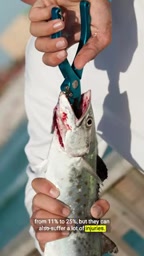
These non-lethal but very real injuries pose a direct challenge to the label of "humane." Release doesn't mean unharmed — it just moves the consequences out of sight.
What If It Were a Different Animal?
The original video raises a striking analogy: imagine threading a worm onto a hook, tossing it into a forest, and waiting for a blue jay or cardinal to bite. Then you yank it out, snap a photo, and release it back into the woods — wounded. Most people would immediately recognize that as needless cruelty.

Yet doing the same to a fish is widely accepted. This double standard in how we perceive different species points to the real issue: our assumptions about fish may simply be out of date.
Do Fish Feel Pain? A Shifting Scientific Consensus
For a long time, the prevailing belief was that fish simply cannot feel pain. That assumption provided the psychological justification for catch-and-release — if they don't hurt, the hook wounds and struggle don't really matter.
But starting in the early 2000s, scientific research began to erode that assumption. A growing body of evidence has built a compelling case that fish very likely can experience pain. This shift in understanding is what has prompted some biologists and animal welfare organizations to reconsider catch-and-release and advocate for alternative ways to enjoy the outdoors.
In 2003, University of Edinburgh researcher Lynne Sneddon published a landmark study recording nociceptors — the physiological basis for pain perception — in the oral tissue of rainbow trout. Over the following decade, multiple behavioral studies found that fish exposed to harmful stimuli exhibit avoidance learning, rub injured areas, lose appetite, and display other responses strikingly similar to pain behaviors in mammals. Crucially, these responses were significantly reduced when analgesics were administered. In 2016, the Cambridge Declaration on Consciousness included fish among animals with "the neurological substrates that generate consciousness."
The core debate centers on the fact that fish lack a neocortex — the brain structure mammals use to process pain — leading some researchers to argue that the subjective experience of pain in fish may differ from our own. But that does not rule out the possibility of functional suffering.
Are There Gentler Alternatives?
For those who want to enjoy the outdoors without causing harm, the video suggests several alternatives: kayaking, hiking, and snorkeling all offer meaningful connection with aquatic environments — without hooking a single fish.
For those still drawn specifically to the experience of fishing, there are middle-ground options. Some anglers committed to a "do no harm" philosophy practice what's known as hookless fly fishing — preserving the casting and simulated-pursuit experience while eliminating the injurious hook entirely. Traditional fish netting is another relatively low-harm option.
Hookless fly fishing builds on fly fishing — a traditional technique in which anglers use artificial lures designed to mimic insects or small prey, delivered through precise casting mechanics. Much of fly fishing's appeal already lies in reading water currents, selecting the right fly, and perfecting the cast — not in the fish's struggle on the line. Hookless fly fishing simply removes the hook from the end of the lure, preserving every technical challenge while eliminating physical harm to the fish. The practice has gained traction in animal welfare-conscious fishing communities and is increasingly seen as a way to engage with fishing culture without negatively impacting ecosystems.
Conclusion: Rethinking a Familiar Pastime
The catch-and-release debate is, at its core, a conversation about updating our assumptions. As research into fish pain advances, the "humane" label we once took for granted is being questioned. That doesn't mean all fishing should be condemned — but it does remind us that when scientific understanding evolves, how we treat other living beings may be worth reconsidering too.
(This article is based on a video published by Vox.)
Related articles

Chain of Thought Isn't Just for AI: How Humans Can Use CoT to Improve Thinking Quality
Chain of Thought isn't just a prompt trick for large models. Starting from a Hacker News discussion, this article analyzes why CoT works for human thinking too, breaks down actionable ways to transfer it, and highlights the key differences between human CoT and machine CoT.
Cloudflare Teams Up with OpenAI: Closi…
Cloudflare Teams Up with OpenAI: Closing the Loop from Vulnerability Discovery to Defense with AI
Cloudflare uses OpenAI Daybreak to investigate security vulnerabilities and generate reviewable remediation plans, while developers use Codex to boost coding efficiency and quality.

Orca Multi-Agent Orchestration in Practice: A Guide to Parallel Collaboration with Claude and Codex
Orca is Stable AI's free open-source agent workbench supporting 34 agents like Claude Code and Codex in parallel. Learn its Git worktree isolation, multi-model orchestration, and mobile management.