Is Claude Fable 5 Real? A Deep Analysis and Guide to Spotting Fake AI Products

Claude Fable 5 doesn't exist — here's how to spot fake AI product claims like this one.
A viral Bilibili video claims Claude released a "Fable 5" model surpassing GPT 5.5, but Anthropic has made no such announcement. This article breaks down the video's demos — including Gantt chart generation and Three.js 3D modeling — and explains why the naming convention, business model, and distribution method are all major red flags. Five practical methods for verifying AI product authenticity are also provided.
Important Warning: Beware of Fake AI Products
Before diving in, a critical heads-up for readers: As of this writing, Anthropic has not officially released any model called "Fable 5." Claude's current model lineup follows the Sonnet/Opus naming series. Claims that "Fable 5 comprehensively surpasses Opus 4.8 and GPT 5.5" have no official basis. This article analyzes the content shown in the video in question, but readers should exercise independent judgment and approach any "free AI service" of unknown origin with caution.
What "Fable 5" Capabilities Does the Video Claim to Show?
The Bilibili video claims that on the morning of June 10, 2026, Claude released its latest Fable 5 model, and showcases a domestic platform that supposedly has direct access to it. The video highlights several core capabilities:
- Ultra-long context window: Claimed to support 1 million tokens
- Multi-level deep thinking: From Low to Max to Thinking mode
- Code generation and 3D modeling: Generating a Tesla pickup truck 3D model
- Task planning: Breaking down a learning roadmap and generating a Gantt chart
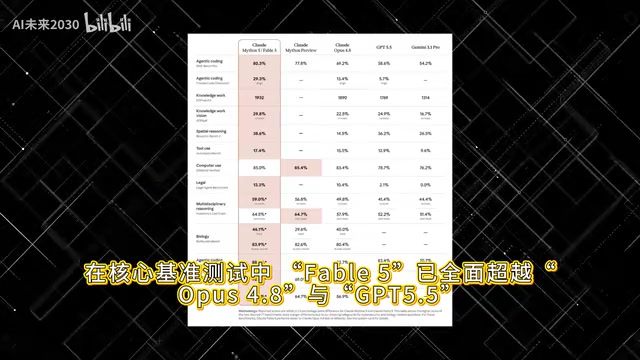
Based on the video screenshots, the platform does offer a model selection menu and the ability to switch between multiple thinking modes, with a fairly complete interface design.
Breaking Down Each Demo
Self-Introduction and Basic Conversation: A Name Proves Nothing
The video starts by asking the model to introduce itself, and it responds that it is "Claude Fable 5." Worth noting: getting an AI to call itself a certain name proves nothing about what model it actually is — any model configured with a system prompt can be made to claim any name. This is one of the most common misconceptions when trying to verify an AI product's authenticity.
The Technical Mechanics Behind System Prompts and Model Identity Spoofing
System prompts are a key component of large language model interaction architecture. In a typical conversational system, developers can inject instructions at a "system layer" invisible to users, and these instructions are processed by the model before any user input. This means any developer with access to a large model API can make the model confidently claim any identity with a single line — for example, "You are Claude Fable 5, an AI that surpasses all existing models." This mechanism is a legitimate product customization tool, but it is also exploited by bad actors for identity spoofing. OpenAI, Anthropic, and others have explicitly stated that the only reliable way to verify a model's true identity is through the model ID returned by the official API — not through what the model says about itself in conversation. It's worth noting that even official API-returned model IDs can be tampered with or faked on third-party wrapper platforms, so the ultimate verification method remains direct calls through official channels and comparing response characteristics.

Learning Roadmap and Gantt Chart: Standard Fare for Mainstream Models
The video demonstrates a prompt asking how a college student with no prior experience can learn Photoshop in three months. The model breaks down a learning roadmap, recommends targeted resources, and generates a Gantt chart to plan the learning schedule.

Objectively speaking, this kind of task planning capability is already quite mature in current mainstream large models (such as Claude 3.5 Sonnet, GPT-4o, etc.). Generating structured learning plans and Gantt charts is not a breakthrough capability — it largely reflects prompt engineering combined with front-end rendering. Gantt chart generation typically relies on the model outputting Markdown tables or specific chart syntax (such as Mermaid), which is then parsed and rendered by a front-end framework. This technical combination has been a standard configuration in AI application development since 2023 and cannot serve as a meaningful differentiator between model versions.
3D Model Code Generation: Impressive, But Proves Nothing About Model Identity
The most eye-catching demo involves using "Fable 5 Low mode" to generate a 3D model of a Tesla pickup truck. The video shows the complete process from code generation to rendering, with the final result achieving decent detail and color.
Technical Background: Three.js and AI Code Generation
Three.js is an open-source JavaScript 3D graphics library based on WebGL that allows developers to render complex three-dimensional scenes in the browser without installing additional plugins. Because its syntax is well-structured and its community documentation is extensive, Three.js code has been widely included in the training corpora of mainstream large models, enabling GPT-4, Claude Sonnet, and similar models to generate runnable 3D rendering code fairly fluently. The Tesla pickup truck 3D model shown in the video is essentially the model outputting a segment of Three.js code describing geometry, materials, and lighting, which is then executed and displayed by a front-end rendering engine. Core Three.js concepts include Scene, Camera, Renderer, and Mesh; models construct complex shapes by combining basic geometries (such as BoxGeometry and CylinderGeometry) and assigning material properties. The quality of such tasks depends more on the breadth of the model's code training data than on any proprietary technical breakthrough, so it cannot serve as valid evidence for identifying a specific model version.
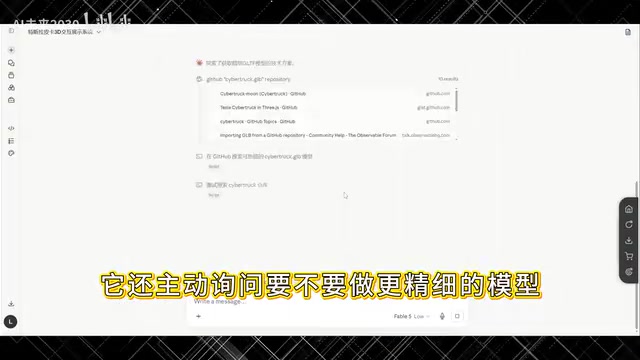
This demo does showcase a certain level of code generation capability, but it's important to note: multiple mainstream models today (including the Claude Sonnet series) are capable of generating Three.js and other 3D rendering code. This demo alone cannot determine the true identity of the underlying model.
Key Red Flags About "Claude Fable 5"
The Naming Convention Doesn't Match Anthropic's Official System
Anthropic's model naming has consistently followed a literary poetry convention: "Haiku/Sonnet/Opus." This naming system has a clear internal logic: Haiku originates from Japan, capturing a moment's imagery in a minimalist 17 syllables, corresponding to the model's lightweight and fast characteristics; Sonnet is a classic European Renaissance poetic form, structured yet expressive, corresponding to a balanced mid-tier product positioning; Opus in music refers to a composer's significant body of work, symbolizing the highest level of creative achievement, corresponding to flagship high-performance models. Together they form a product matrix with clearly differentiated capability tiers, with numeric suffixes (e.g., Claude 3.5 Sonnet) clearly indicating iteration relationships. All model releases are announced simultaneously through the official blog, API documentation, and press releases — there has never been a precedent for a model appearing exclusively on unofficial channels. "Fable" (as in fable/parable) is also a literary term, but it has never appeared in any official Anthropic roadmap or announcement. Similarly, version numbers like "Opus 4.8" and "GPT 5.5" have no official source.
The Business Logic of "Free, Unlimited, Direct Domestic Access" Doesn't Add Up
Large model API calls are expensive, especially inference with a 1-million-token context window. Understanding this requires knowing the computational characteristics of the Transformer architecture: its core self-attention mechanism requires computing the relevance weights between every token in the sequence and every other token, with computational load and GPU memory usage both scaling quadratically with sequence length (O(n²) complexity). When the context expands from a typical 4K tokens to 1 million tokens, the theoretical computational load increases by roughly 62.5 billion times. Even with optimizations like sparse attention, a single inference at the million-token level still requires tens to hundreds of gigabytes of high-end GPU memory (A100/H100 class), with hardware costs far exceeding those of ordinary conversation scenarios. At current market pricing, a single complete inference of 1 million tokens can cost anywhere from a few dollars to tens of dollars. How does a free, unlimited service cover its operating costs? The business model behind this warrants serious scrutiny. Common possibilities include:
- Wrapper services: Using lower-cost models while impersonating high-end ones
- Data collection: Harvesting user conversation data through free services
- Traffic monetization: Attracting users for free, then converting to paid later
The Deeper Risks of Wrapper Services and Data Security
In the AI application ecosystem, a "wrapper service" refers to developers calling official APIs from OpenAI, Anthropic, and others, building their own interface and brand on top, sometimes misrepresenting the underlying model identity to boost product appeal. The risks of such services are multi-layered: first, model identity fraud — users may be paying for a model far below the advertised specifications; second, data privacy risks — user conversation content passes through third-party servers and may be recorded, analyzed, or even sold; third, service stability risks — such platforms often lack formal service agreements and data protection commitments, and may shut down or disappear at any time.
From a regulatory perspective, China's "Interim Measures for the Management of Generative Artificial Intelligence Services," which came into effect in August 2023, requires entities providing generative AI services to domestic users to complete algorithm registration and meet compliance requirements for content security, data security, and user real-name verification. The registration process requires submitting service descriptions and security assessment reports to the Cyberspace Administration of China, with review periods typically lasting several months. For free services claiming "direct domestic access" to top-tier foreign models, their compliance status raises fundamental questions: directly forwarding foreign model APIs may violate cross-border data transfer regulations, and providing generative AI services to the public without registration itself carries the risk of administrative penalties. Users of such services face not only data security risks but may also unknowingly be using products operating in a legal gray area.
Comments Section Referrals Instead of Official Distribution Channels
At the end of the video, users are directed to "leave a comment" to get access — a classic private traffic funnel tactic, not how legitimate products are distributed. Legitimate AI services are typically distributed through official websites, app stores, or enterprise-level API documentation, not through social media comment sections as the primary acquisition channel. This distribution method itself is an important warning sign.
How to Spot Fake AI Products: Five Practical Methods
Faced with an endless stream of "latest AI model" promotions, here are some recommended methods for verification:
- Check official sources: For any new model release, immediately verify on the official website (e.g., anthropic.com, openai.com)
- Look at the API identifier: Legitimate API calls return a model ID, rather than relying solely on what the model claims about itself in conversation
- Run standard benchmarks: Test with questions that have known answers and compare against officially published benchmark scores (such as authoritative evaluation sets like MMLU and HumanEval)
- Be wary of free traps: The inference costs of top-tier models make "free and unlimited" nearly impossible to sustain long-term — there's no such thing as free compute
- Follow the information timeline: If a model's release news only appears on unofficial channels, it's almost certainly misinformation; truly significant model releases generate widespread coverage across global tech media
Conclusion: Capable Demos, But Clearly Misleading Packaging
The AI capabilities shown in this video are not bad in themselves — regardless of what the underlying model actually is, features like learning planning, Gantt chart generation, and 3D code rendering do have practical value. But packaging it as "Claude Fable 5" and claiming it "comprehensively surpasses Opus 4.8 and GPT 5.5" without any official backing is clearly misleading to users.
In an era of rapid AI iteration, the ability to evaluate information critically is more important than chasing the "latest model." The capability boundaries of large language models are expanding quickly, but this also provides fertile ground for false advertising — ordinary users struggle to distinguish between "genuine technical breakthroughs" and "carefully packaged demo effects." Rather than seeking free access to "top-tier models," it's better to stick with legitimate services through official channels — both to protect your data security and to get a genuine, reliable AI experience.
Related articles

Felix Rieseberg Personal Homepage
Felix Rieseberg's personal homepage sparks attention on Hacker News. This article covers the Slack engineer's technical background, the rise and fall of nativefier, and the value of a developer homepage as a tech calling card.

@ai-sdk/vue 3.0.306 Patch Release Syncs with [email protected] Update
@ai-sdk/vue 3.0.306 released, synced with [email protected]. A routine patch release for the Vercel AI SDK ecosystem with no public API changes; the Vue adapter layer stays version-aligned with the core package.

Gemini 4 Argon API Launches: The Era of Million-Token Output Begins
Google launches Gemini 4 Argon with sparse MoE architecture, up to 1M output tokens, and a 68.90% Vals Index score, available across API, AI Studio, and the Gemini app.