Is Claude Opus 5 Worth the Upgrade? A Three-Question Framework to Help You Decide

A reusable Three-Question Framework to decide when Claude Opus 5 is worth deploying over cheaper models.
Claude Opus 5 delivers 2x performance on Frontier-Bench and 3x on ARC-AGI 3 at the same price as its predecessor. Through three real-world cases — 3D model reconstruction, root cause bug fixing, and trading system verification — the article shows Opus 5's strength lies in proactive verification. A reusable Three-Question Framework helps teams decide when to deploy Opus 5 based on task complexity, error cost, and result verifiability, rather than benchmark hype.
Opus 5: Same Price, Noticeably Higher Capability Curve
After the release of Claude Opus 5, the keyword everyone remembers is "more powerful." But the more important question is actually: for the same money, can you reduce rework?
Let's start with pricing. Opus 5's standard API pricing remains $5 per million input tokens and $25 per million output tokens — exactly the same as the previous Opus 4.8. Large language model API pricing is typically measured in "per million tokens," where a token is the smallest unit of text processing (in English, roughly 1 token equals 0.75 words; in Chinese, one character typically takes 1.5–2 tokens). Input and output are priced separately because the computational cost of generating output is far higher than processing input — which explains why the output price is 5x the input price. In other words, the price hasn't gone up, but the capability curve has clearly shifted upward.
Here are the specific benchmark numbers:
- Opus 5's performance on Frontier-Bench is 2x that of Opus 4.8
- Its ARC-AGI 3 score is 3x that of the next-best model
- In business automation benchmarks, pass rates are approximately 1.5x those of the next-best model at the same per-task cost
It's worth explaining these two key benchmarks. Frontier-Bench is a suite specifically designed to evaluate frontier AI models on complex reasoning, long-context processing, and multi-step task execution. It simulates challenges close to real-world work scenarios, rather than simple Q&A or multiple-choice questions. ARC-AGI (Abstraction and Reasoning Corpus for Artificial General Intelligence), proposed by AI researcher François Chollet, aims to test a model's abstract reasoning ability when facing novel, never-before-seen problems — considered a key indicator of general intelligence. ARC-AGI 3 is the third version with increased difficulty, requiring models to discover implicit rules and generalize from very few examples. These benchmarks are valued by the industry because they reflect real-world complex task performance far better than traditional benchmarks like MMLU or HumanEval.
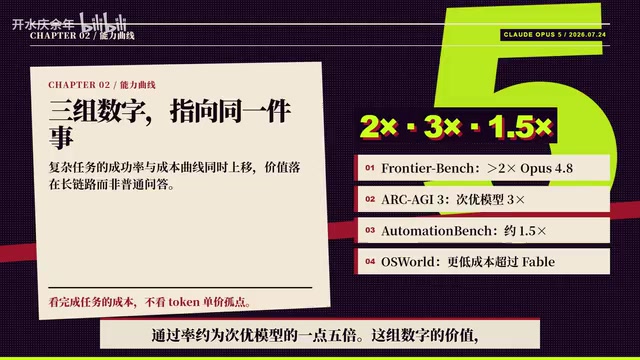
The real value of these numbers isn't to make you mindlessly route all requests to the strongest model. It's more like adding a senior colleague to your team who proactively double-checks before delivery — the longer the task, the more dependencies involved, and the higher the cost of failure, the more valuable this "verification ability" becomes.
In practice, a complex coding task might consume tens of thousands of input tokens (including code context and requirement descriptions) and thousands of output tokens, with a single API call costing anywhere from a few cents to several dollars. The core logic of cost optimization isn't about pushing down the per-call price — it's about reducing repeated calls caused by incorrect output. If a cheaper model needs 5 calls to get the right result while Opus 5 nails it in one, the total cost is actually lower. This is exactly the economic foundation of "choosing models based on task structure."
Three Real-World Cases: Not Just Faster Code, But Built-In Verification
The official release highlighted three very specific examples, all pointing to the same thing: Opus 5 doesn't just write code faster — it proactively fills in the verification steps that are easily overlooked.
Case 1: Rebuilding 3D Models from Pixels
When the model couldn't get a direct front view of a mechanical part drawing, it didn't get stuck. Instead, it wrote its own computer vision pipeline: extracting geometric information from pixels, then reconstructing a FreeCAD model from that data. This demonstrates the ability to proactively find alternative paths when facing information gaps.
FreeCAD is an open-source parametric 3D CAD modeling application widely used in mechanical engineering, product design, and architecture. Unlike commercial software like SolidWorks or Fusion 360, FreeCAD is completely free and supports Python scripting extensions, which allows AI models to directly manipulate its modeling API through Python code. The "extracting geometric information from pixels to rebuild models" mentioned in this case involves a reverse engineering workflow from computer vision: first using image processing algorithms like edge detection and contour extraction to identify geometric features of the part from photos (such as bore diameters, chamfers, arc radii, etc.), then converting these parameters into executable modeling commands for CAD software. This workflow traditionally requires specialized reverse engineering software combined with 3D scanners, yet Opus 5 can build the entire pipeline from just 2D images — demonstrating a breakthrough in cross-domain toolchain composition.
Case 2: Fixing Root Causes, Not Surface Symptoms
Facing a real bug in an open-source package manager, the model didn't just patch the surface symptom. It dug deep to locate the root cause and covered edge cases that community patches had previously missed. This ability to "fill in boundary conditions" addresses exactly where complex engineering projects are most likely to go wrong.
Open-source package managers (such as npm, pip, cargo, etc.) are foundational infrastructure for modern software development, responsible for managing dependency relationships, version control, and package installation/removal. Because these tools are relied upon by millions of developers, a seemingly minor bug can trigger cascading failures under specific dependency combinations, operating system versions, or network conditions. "Edge cases" refer to anomalous scenarios that don't fall on the standard testing path and are only triggered by special inputs or extreme conditions. Community patches often only fix the most common trigger paths, and the missed edge cases are precisely the trickiest sources of production issues. Opus 5's ability to dig into code logic to locate the root cause rather than just patching surface symptoms, while proactively covering boundary conditions missed by community patches, is especially valuable in large engineering projects — because root cause analysis typically requires deep understanding of the codebase and the ability to mentally simulate multiple execution paths.
Case 3: Verifying Correctness Even Without Data
An engineer at a trading firm asked the model to integrate market data from a new exchange. Since there was no live data available for verification at the time, the model went ahead and built its own testing toolkit to verify whether the market data parsing was correct.
Integrating market data from a new exchange into a financial trading system is a high-risk engineering task. Different exchanges use different data protocols (such as FIX, ITCH, Binary, etc.), with varying data formats, field definitions, timestamp precision, and message sequencing rules. Parsing errors can lead to price discrepancies, erroneous trading signals, or even direct financial losses. During the early stages of onboarding a new exchange or in test environments, there's often no live data available for verification. Engineers typically need to manually construct test data or use the exchange's sandbox environment, but these simulated datasets may not cover all real-world scenarios. Opus 5's ability to build its own testing tools for verification without live data means it can understand protocol specification documents, automatically generate test messages conforming to the protocol, and write assertion logic to validate parsing results — a complete engineering loop involving document comprehension, code generation, and test framework construction.

The common thread across all three cases is clear: complex coding, research analysis, and cross-tool automation are precisely the scenarios where AI is most likely to "go off the rails," and Opus 5's value lies in proactively incorporating verification into the delivery workflow.
Capability Boundaries: Opus 5 Isn't Omnipotent, and It's Not Cheap
Interestingly, Opus 5's capability boundaries are described quite candidly.
Regarding security-related capabilities, it performs near top-tier levels in "vulnerability discovery" but falls noticeably behind in "exploit development." Additionally, high-risk requests may be intercepted by classifiers or trigger fallback mechanisms.
In cybersecurity, "vulnerability discovery" and "exploit development" are two fundamentally different capability levels. Vulnerability discovery focuses on identifying security flaws in code — such as buffer overflows, SQL injection, and privilege escalation — which can be accomplished through code auditing, fuzzing, or static analysis. Exploit development, on the other hand, requires constructing actually executable attack code that bypasses modern defenses like ASLR and DEP, precisely controlling program execution flow — demanding deep understanding of operating system kernels, memory layouts, and CPU instruction sets. Anthropic's candid disclosure of Opus 5's limitations in exploit development reflects responsible AI safety assessment practices: letting users understand the model's defensive capabilities while making clear it won't become an offensive weapon. The classifier interception and fallback mechanisms for high-risk requests are part of Anthropic's safety layer design, intended to prevent model misuse for malicious purposes.
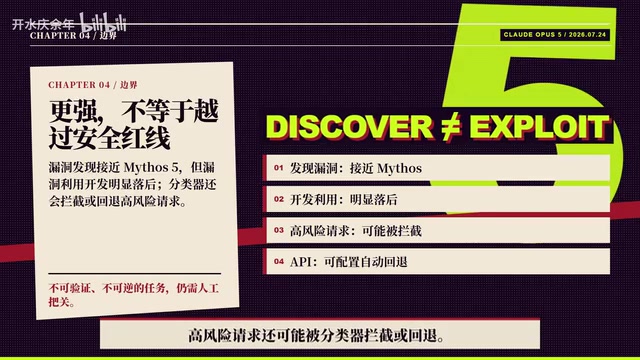
More importantly, there's the cost issue. Opus 5 is not a cheap model. If you throw ordinary summarization, simple rewrites, and low-risk batch processing at it indiscriminately, costs will be inflated unnecessarily.
So the core takeaway is: Don't choose models based on reputation — choose based on task structure.
The Three-Question Framework: A Reusable Model Selection Method
When facing model upgrades, rather than agonizing over leaderboard rankings, use three questions to quickly determine whether you should deploy the most powerful model.
Question 1: Does the task require multi-step execution where plans might change midway?
If the task involves long chains of operations with dynamic adjustments needed, Opus 5's planning and self-correction capabilities deliver the most value.
Question 2: Would a single error cause expensive rework, business risk, or flawed decisions?
The higher the cost of errors, the more it's worth paying for stronger verification capabilities.
Question 3: Can the final result be tested, reconciled, or cross-validated?
If results can't be verified, you need the model to proactively fill in verification steps even more.
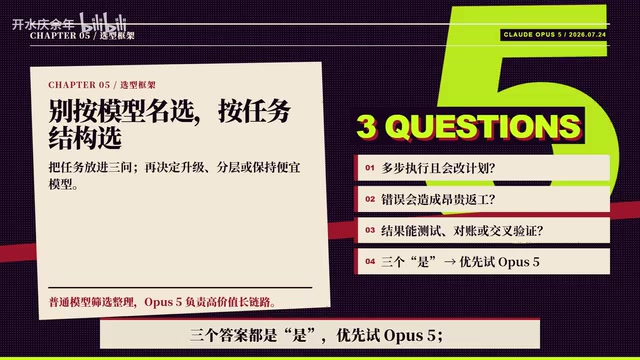
If all three answers are "yes," prioritize Opus 5. If only one is "yes," start with a cheaper model. One critical reminder: if results fundamentally can't be verified, don't blindly trust model output just because it scored higher on benchmarks.
Putting It Into Practice: Tiered Collaboration with Acceptance Criteria Built Into Tasks
Finally, here's a practical method you can implement immediately: let models of different capability levels each play to their strengths.
- Standard models handle screening, organizing, and low-risk drafts to control costs
- Opus 5 handles high-value, long-chain tasks, with testing, reconciliation, and acceptance criteria explicitly written into the task requirements
What you get isn't "a fancier model name" — it's genuinely less rework.
The greatest advantage of this "Three-Question Framework" is its reusability — the next time any model update drops, you can apply this same logic directly rather than being led around by new benchmark numbers. For teams making decisions about AI model costs, this might be more practical than memorizing any benchmark score.
Related articles

Python 3.15 New Feature: Is the sentinel Type Better Than None?
Python 3.15 adds the sentinel type, using named unique sentinel objects to replace None and bare object(), resolving confusion among missing values, explicit emptiness, and invalid input while avoiding type hint failures.

Deep Learning's Three Architectures and the Universal Approximation Theorem: A Complete Guide to MLPs, CNNs, and Transformers
Explaining the inductive bias differences among MLP, CNN, and Transformer, the existence meaning of the Universal Approximation Theorem (UAT), and the role of Taylor expansion in approximation analysis, while clearing up common misconceptions.

GitLab Emergency Patch Release: Analysis of Critical Security Fixes
GitLab releases critical patch 19.5.1, sparking 355 points of discussion on Hacker News. This article analyzes the background, upgrade steps for self-hosted instances, and verification points to help DevOps teams respond quickly to security updates.