Is Claude's Advisor Tool Worth It? A Pairing Cost-Benefit Analysis

Anthropic's test shows a small model with an advisor trades 2.1x cost for a 1.7-point gain, with a clear break-even point.
An Anthropic internal test compared two ways to boost model capability: using Fable 5.1 as an advisor to Opus 5.5, or switching to a larger model. Advisor pairing yielded a 1.7 percentage point gain at 2.1x the cost—about 1.24x more per point. The article argues this suits cases where the main model is near its ceiling, accuracy is critical, and cost is covered by business value; otherwise, raising effort is more direct with a more predictable cost curve. The real key is calculating cost per unit of performance and identifying whether the bottleneck is reasoning depth or cross-validation. Since the result comes from one source, the author recommends an A/B test before production adoption.
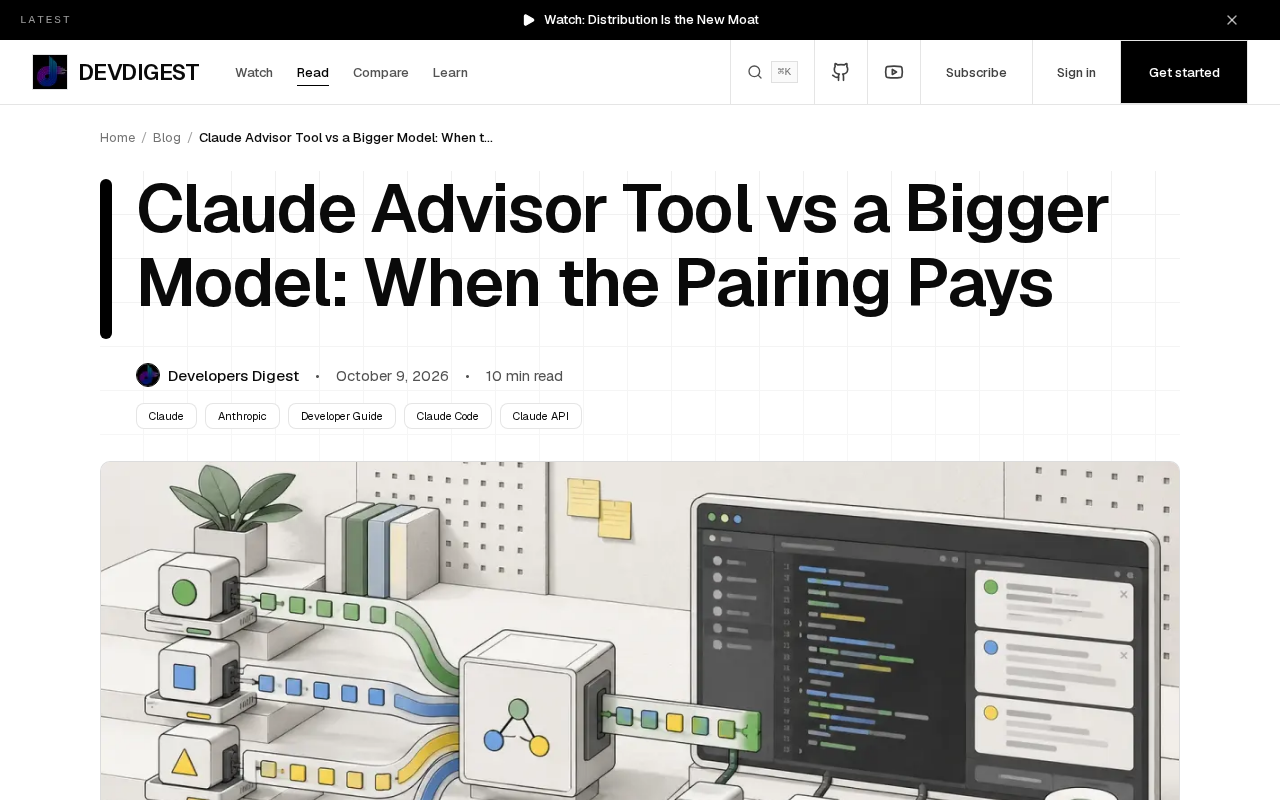
A recent internal test by Anthropic raises a practical engineering question: instead of spending more money to call a larger model, how much cheaper—and how much worse—is it to pair a smaller model with an "advisor" model? The conclusion is surprisingly specific—there's a clear break-even point for cost-effectiveness.
Test Setup: Fable 5.1 as Advisor to Opus 5.5
Anthropic ran a controlled experiment: using Fable 5.1 as an advisor alongside Opus 5.5 performing the main task. The results show this pairing delivers a 1.7 percentage point performance improvement over Opus 5.5 alone, but at 2.1x the cost.
In other words, for every 1 percentage point gained, you pay roughly 1.24x more for the advisor. That number alone isn't shocking—the key is how it compares to simply "switching to a larger model."
An advisor model (advisor / consultant model) is a multi-model collaboration paradigm: a smaller, lower-cost model handles the vast majority of reasoning and generation, while calling a more capable but more expensive model at key decision points to provide a second opinion or corrective suggestions. The key difference from "retry/cascade" is that the advisor model typically doesn't take over the full task—it only outputs judgments, critiques, or candidate solutions at specific nodes, and the main model adjusts its final output accordingly. Therefore, the extra cost mainly depends on how often the advisor is triggered and the context length, not the scale of the main task—which is why the cost curve for advisor pairing tends to be steeper and less predictable than "just switching to a larger model."
When "Advisor Pairing" Pays Off
Working backward from Anthropic's data, the benefits of an advisor tool mainly appear in the following scenarios:
- The base model is already near its capability ceiling, where the marginal improvement from an advisor is small in absolute terms (1.7 points) but considerable in relative terms.
- The task is extremely sensitive to accuracy, where a 1.7-point gain could mean pulling a batch of previously failed cases back above the passing line.
- Cost isn't the primary constraint, and the 2.1x cost increase can be covered by business value.
Conversely, if you just want the model to be "a bit smarter," directly raising effort is usually the more straightforward approach—it doesn't require introducing an additional model call chain, and the cost curve is more predictable.
Raising effort (raise effort / extended thinking) refers to trading more reasoning steps, sampling iterations, chain-of-thought length, or voting aggregation for higher accuracy without switching models. Its cost growth is typically linear or estimable, and it doesn't introduce extra model call chains or context-passing overhead. In contrast, advisor pairing introduces "heterogeneous calls": the two models may differ in input format, context window, and prompt templates, increasing debugging complexity and failure modes. So when purely pursuing accuracy improvements, raising effort is generally the default option with more predictable costs and lower engineering risk; advisor pairing is better suited for scenarios where raising effort has already saturated, or where you need "another perspective" rather than "more compute."
The Engineer's Real Dilemma: Cost Models Matter More Than Performance Numbers
The real value of this experiment isn't the 1.7 points themselves—it's that it forces teams to answer a question: Which layer is your performance bottleneck actually in?
If the bottleneck is the main model's instruction comprehension or reasoning depth, an advisor tool can only help so much; if the bottleneck is certain steps requiring cross-validation, the advisor's "second perspective" might create leverage.
Anthropic didn't offer a one-size-fits-all recommendation, but the combination of 2.1x cost and 1.7-point gain is itself a good decision anchor: first calculate your cost per unit of performance, then decide whether to add an advisor or add compute.
Cost per unit of performance is the core quantitative metric for this type of decision, typically defined as "the cost multiplier required to gain 1 percentage point of accuracy." In this case, 2.1x cost for 1.7 points translates to roughly 1.24x cost per point. Only by comparing this number side-by-side with "directly switching the main model to a stronger one" or "raising effort" can you judge which approach is more cost-effective. Note that this ratio is highly dependent on the task's baseline accuracy: the lower the baseline, the greater the relative benefit of a small improvement; when the baseline is already high, the same marginal cost may only buy fluctuations close to noise.
An Unverified Hypothesis
The current conclusion comes from a single source only. Whether the 1.7-point, 2.1x-cost ratio holds stable across different task distributions still needs more independent reproduction. Before writing this pattern into a production pipeline, it's advisable to run an A/B test on your own batch of real tasks first, rather than directly applying the official numbers.
A/B testing (online controlled experiment) here means converting "official numbers" into "your scenario's numbers." Since model performance is highly dependent on task distribution, prompt phrasing, output format constraints, and evaluation criteria, the same set of models may show gains that differ by multiples—or even reverse direction—across different businesses. The recommended approach: first sample a batch of tasks with clear correct/incorrect judgments from real traffic, fix the prompts and decoding parameters, and run three groups—"single model," "model + advisor," and "single model with high effort"—then compare accuracy, average latency, and per-call cost, followed by a statistical significance test. Only when you reproduce stable positive gains on your own task distribution is it worth writing advisor pairing into your production pipeline.
One-line Summary
Anthropic's test shows a small model paired with an advisor trades 2.1x cost for a 1.7-point gain, with a clear break-even point.
Paragraph Summary
An Anthropic internal test compared two paths to improving model capability: using Fable 5.1 as an advisor to assist Opus 5.5, versus directly switching to a larger model. The results show advisor pairing delivers a 1.7 percentage point performance gain but increases cost to 2.1x—roughly 1.24x more cost per 1-point gain. The article argues this pattern suits scenarios where the main model is already near its capability ceiling, the task is extremely accuracy-sensitive, and the cost can be covered by business value; if you just want it "a bit smarter," raising effort is usually more direct with a more predictable cost curve. The real decision hinges on calculating cost per unit of performance and determining whether the bottleneck is reasoning depth or cross-validation steps requiring a second perspective. Since the conclusion comes from a single source, the author recommends running an A/B test on your own tasks before adopting it in production.
Related articles

Chain of Thought Isn't Just for AI: How Humans Can Use CoT to Improve Thinking Quality
Chain of Thought isn't just a prompt trick for large models. Starting from a Hacker News discussion, this article analyzes why CoT works for human thinking too, breaks down actionable ways to transfer it, and highlights the key differences between human CoT and machine CoT.
Cloudflare Teams Up with OpenAI: Closi…
Cloudflare Teams Up with OpenAI: Closing the Loop from Vulnerability Discovery to Defense with AI
Cloudflare uses OpenAI Daybreak to investigate security vulnerabilities and generate reviewable remediation plans, while developers use Codex to boost coding efficiency and quality.

Orca Multi-Agent Orchestration in Practice: A Guide to Parallel Collaboration with Claude and Codex
Orca is Stable AI's free open-source agent workbench supporting 34 agents like Claude Code and Codex in parallel. Learn its Git worktree isolation, multi-model orchestration, and mobile management.